

Many organizations assume experience design is just another term for user interface work or digital aesthetics. That narrow view misses the strategic power of experience design as holistic orchestration across physical, digital, and mental dimensions. For CX leaders navigating 2026’s AI-driven landscape, understanding how experience design shapes customer journeys, builds loyalty, and drives measurable business outcomes is essential. This guide clarifies what experience design truly encompasses, how it differs from related disciplines, and why 86% of buyers willingly pay more for superior experiences.
Table of Contents
- Understanding Experience Design: Its Scope And Significance
- The Strategic Role Of Experience Design In Modern Customer Journeys
- Experience Design Frameworks: Applying The 5E Experience Model And Peak-End Rule
- Common Pitfalls And Expert Tips For Effective Experience Design
- Explore Expert Experience Design And Customer Experience Leadership With Xverse
- Frequently Asked Questions
Key takeaways
| Point | Details |
|---|---|
| Experience design orchestrates holistically | It integrates physical, digital, and mental elements to create meaningful customer journeys beyond interface work. |
| Distinct yet complementary disciplines | Experience design differs from UX, CX, and service design but works synergistically with each to maximize impact. |
| AI requires lifecycle governance | Agentic AI transforms experiences structurally, demanding upstream strategy and coherent lifecycle architecture for trust. |
| Frameworks enable intentional design | Models like the 5E Experience Model and Peak-End Rule help leaders craft memorable, high-value customer interactions. |
| Superior experiences command premium pricing | 86% of buyers pay more for better experiences, making strategic design a competitive differentiator. |
Understanding experience design: its scope and significance
Experience design orchestrates the entire ecosystem of physical, digital, and mental elements to ensure storytelling, meaning, and value resonate throughout customer interactions. Unlike narrower disciplines, it addresses how environments, interfaces, and emotional contexts combine to shape perception and behavior. For strategic decision-makers, recognizing this holistic scope clarifies how experience design functions as a foundation for competitive advantage.
UX focuses on product interactions and interface usability, optimizing how users engage with specific digital or physical products. CX encompasses every brand interaction, from advertising to support touchpoints, creating a unified perception across channels. Service design maps delivery processes, ensuring workflows and systems enable seamless service fulfillment. Experience design integrates these disciplines, adding layers of meaning and narrative that transform functional interactions into memorable journeys.
These distinctions matter because organizations often conflate disciplines, leading to fragmented strategies. Experience design provides the overarching vision, while UX, CX, and service design contribute specialized execution. Understanding the difference between UX and CX helps leaders allocate resources effectively and align teams around shared outcomes. Similarly, recognizing how employee experience drives customer experience reveals internal touchpoints as critical design opportunities.
Key distinctions and overlaps include:
- Experience design sets strategic direction and integrates all touchpoints into coherent narratives
- UX delivers tactical interface solutions that support broader experience goals
- CX manages brand consistency and relationship quality across the customer lifecycle
- Service design optimizes backend processes and operational efficiency to enable front-stage experiences
- All four disciplines share customer-centricity but operate at different scales and scopes
For CX leaders, this framework clarifies decision-making. When evaluating initiatives, ask whether efforts address isolated touchpoints or contribute to an integrated ecosystem. Experience design thinking prioritizes coherence, ensuring every element reinforces the intended story and value proposition. This holistic approach becomes especially critical as AI and automation reshape how customers interact with organizations.
The strategic role of experience design in modern customer journeys
CX strategy must move upstream into lifecycle architecture, governance, and organizational design to maintain trust as AI integration accelerates. Traditional reactive CX management no longer suffices when technology actively shapes customer decisions and expectations. Strategic experience design anticipates how emerging capabilities transform journeys, embedding governance structures that ensure coherence rather than fragmentation.
Agentic AI shifts from assistive to central, actively resolving logistics, guiding purchases, and influencing core experience outcomes. This structural change demands new thinking about control, transparency, and customer agency. Organizations that treat AI as merely another channel miss the deeper implications for trust and relationship dynamics. Without lifecycle governance, AI optimizes locally, potentially undermining long-term loyalty by prioritizing immediate conversions over sustained value.

The business case for strategic experience design grows stronger as customer expectations rise. 86% of buyers pay more for superior experiences, directly linking design quality to revenue potential. This willingness reflects a broader shift where functional adequacy no longer differentiates brands. Customers reward organizations that understand context, anticipate needs, and deliver frictionless interactions. For leaders, this means experience design investments yield measurable returns through higher lifetime value and reduced churn.
Strategic implications for CX leaders include:
- Elevate experience design from tactical execution to strategic planning and governance
- Integrate AI capabilities within coherent lifecycle frameworks rather than as isolated features
- Build organizational structures that support cross-functional collaboration across UX, CX, and service design
- Measure success through relationship quality and trust metrics, not just transaction efficiency
- Invest in customer experience leadership capabilities that align technology with human-centered outcomes
Pro Tip: Establish lifecycle governance boards that review how AI applications in CX align with long-term relationship goals before deployment. This upstream intervention prevents fragmented optimization and ensures technology reinforces strategic intent.
The shift toward lifecycle thinking also connects experience design to broader business outcomes. Organizations that excel at CX strategy and customer loyalty recognize that every touchpoint either builds or erodes trust. Strategic experience design provides the framework for intentional trust-building, ensuring consistency across channels and over time. As competition intensifies and switching costs decrease, this coherence becomes a primary differentiator.
Experience design frameworks: applying the 5E Experience Model and peak-end rule
The 5E Experience Model divides journeys into five sequential stages: Entice, Enter, Engage, Exit, and Extend. Each stage addresses specific customer needs and decision points, helping designers create intentional transitions rather than accidental experiences. For CX leaders, this framework clarifies where to invest effort and how to measure success at each phase.
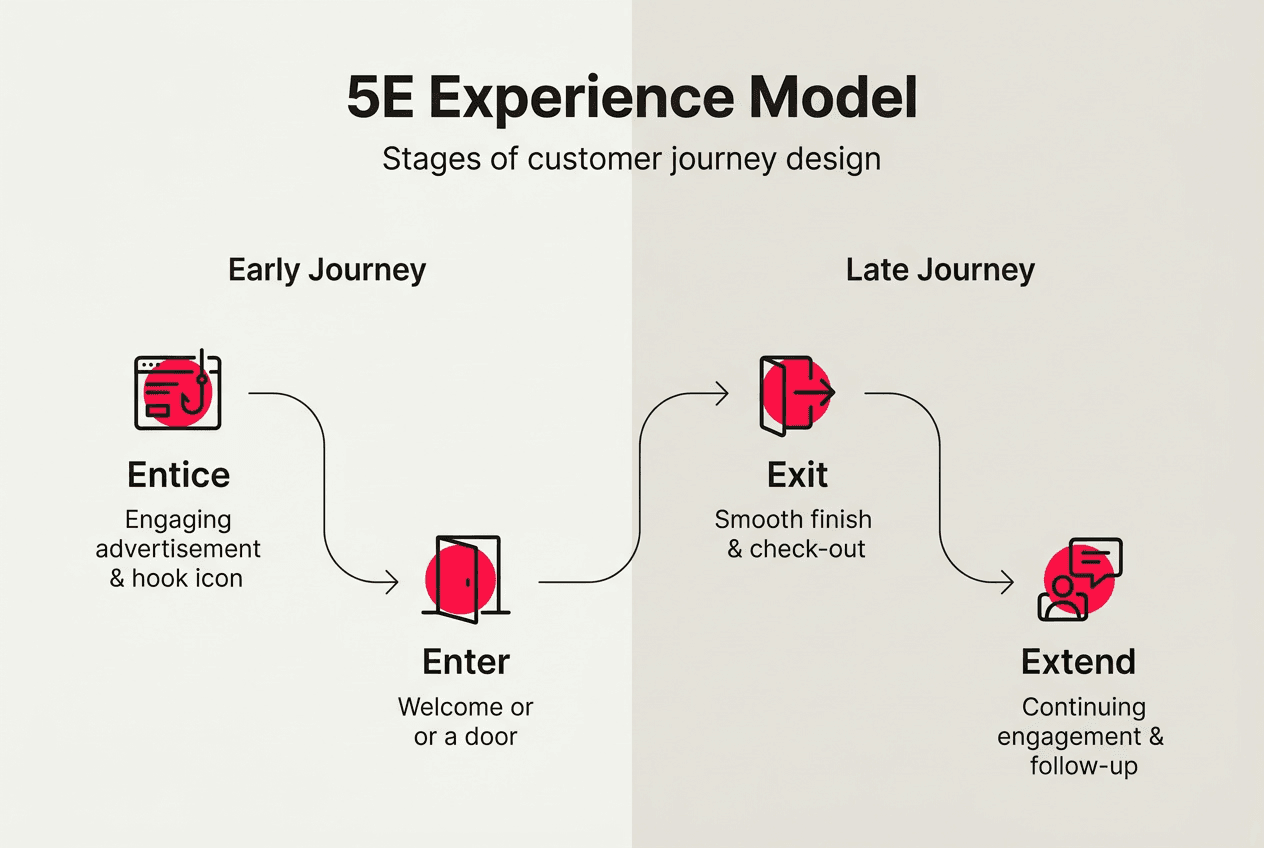
The Entice stage captures attention and builds initial interest through marketing, content, or referrals. Enter focuses on onboarding and first impressions, reducing friction as customers commit to engagement. Engage represents the core value delivery, where customers accomplish goals and form lasting impressions. Exit manages conclusions and farewells, ensuring customers leave satisfied and open to future interactions. Extend maintains relationships post-interaction through follow-up, support, and loyalty programs.
The Peak-End Rule suggests people remember the most intense moment and the final moment of an experience more vividly than the average quality. This cognitive bias means organizations can disproportionately influence perception by designing exceptional peaks during Engage and crafting thoughtful conclusions during Exit. The 5E model encourages teams to prioritize these stages, creating memorable highlights and positive endings that shape overall satisfaction.
Applying the 5E model in practice:
- Map current customer journeys to identify which 5E stage each touchpoint serves
- Analyze where customers experience friction, confusion, or delight at each stage
- Design intentional peak moments during Engage that deliver unexpected value or surprise
- Craft Exit experiences that leave customers feeling accomplished and appreciated
- Build Extend mechanisms that maintain connection without feeling intrusive or transactional
- Measure stage-specific metrics rather than relying solely on overall satisfaction scores
Comparing the 5E model to traditional journey phases reveals strategic differences:
| 5E Stage | Traditional Phase | Key Difference |
|---|---|---|
| Entice | Awareness | Focuses on emotional resonance, not just visibility |
| Enter | Consideration | Emphasizes frictionless commitment over information delivery |
| Engage | Purchase/Use | Designs for memorable peaks, not just functional completion |
| Exit | Post-Purchase | Treats conclusions as strategic opportunities, not afterthoughts |
| Extend | Loyalty | Builds ongoing value exchange rather than promotional outreach |
This framework integrates naturally with customer journey mapping practices, adding psychological depth to tactical touchpoint analysis. By understanding how customers process and remember experiences, leaders can allocate resources toward high-impact moments. The 5E model also supports strategic design in CX by connecting individual interactions to broader narrative arcs.
Pro Tip: Concentrate design innovation on Engage and Exit stages where the Peak-End Rule maximizes impact. Even modest improvements to these moments can dramatically shift overall perception and willingness to return.
For organizations implementing these frameworks, the goal is intentionality. Random excellence at scattered touchpoints creates inconsistent experiences that confuse rather than delight. The 5E model and Peak-End Rule provide structure for deliberate design, ensuring efforts align with how customers actually process and remember interactions. This strategic approach transforms experience design from reactive problem-solving to proactive value creation.
Common pitfalls and expert tips for effective experience design
Even great products fail if users get lost somewhere along the journey. Fragmented experiences discourage customers despite functional adequacy, highlighting how poor navigation and unclear transitions undermine value delivery. For CX leaders, recognizing common pitfalls helps prevent costly mistakes and accelerates successful implementation.
Frequent mistakes include neglecting lifecycle governance when deploying AI, treating each channel as independent rather than interconnected, ignoring physical and mental context in favor of digital-only thinking, and failing to design intentional peaks and endings. Organizations often optimize individual touchpoints without considering cumulative effects, creating disjointed journeys that frustrate rather than satisfy. Another critical error is moving too fast without establishing architectural coherence, resulting in technical debt and customer confusion.
Pro Tip: Balance speed with architectural thinking by establishing core experience principles before scaling initiatives. Rapid iteration within a coherent framework prevents fragmentation while maintaining agility.
Expert tips for enhancing trust and streamlining experiences:
- Design clear wayfinding at every transition point so customers never feel lost or uncertain
- Use consistent language, visual cues, and interaction patterns across all touchpoints
- Build feedback loops that let customers understand system state and next steps
- Integrate expert HCI-based UX/UI design principles to ground decisions in human behavior research
- Test experiences with real users at each 5E stage, not just at final delivery
- Establish governance structures that review cross-functional impacts before launching new features
- Measure relationship quality metrics alongside transaction efficiency to balance short and long-term goals
The importance of guiding users clearly cannot be overstated:
Organizations that invest in seamless navigation and transparent communication reduce customer effort, increase satisfaction, and build loyalty that withstands competitive pressure. Clarity is a strategic asset.
Another common pitfall involves treating experience design as a one-time project rather than ongoing practice. Customer expectations evolve, technology capabilities expand, and competitive landscapes shift. Effective experience design requires continuous iteration, measurement, and refinement. Leaders should build organizational capabilities that sustain design excellence over time, not just deliver isolated improvements.
Finally, many organizations underestimate the importance of internal alignment. When teams operate in silos, experiences fragment regardless of design quality. Cross-functional collaboration, shared metrics, and unified governance ensure everyone contributes to coherent outcomes. Experience design succeeds when it becomes an organizational mindset, not just a specialized function.
Explore expert experience design and customer experience leadership with Xverse
Navigating the complexities of modern experience design requires both strategic vision and execution expertise. Xverse specializes in customer experience leadership, helping organizations build capabilities that transform CX from operational function to strategic asset. Our approach integrates lifecycle thinking, AI governance, and proven design frameworks to deliver measurable business outcomes.
Whether you’re advancing your understanding of what customer experience means in 2026 or implementing expert HCI-based UX/UI design that drives results, Xverse provides tailored solutions aligned with your organization’s maturity and goals. We partner with CX leaders to elevate customer journeys through strategic design, data-driven insights, and organizational transformation.
Our services encompass strategy development, experience blueprint creation, AI integration planning, and leadership advisory. We help you build the governance structures, cross-functional alignment, and measurement frameworks needed to sustain excellence as customer expectations evolve. Explore how Xverse can accelerate your CX transformation and position experience design as a competitive differentiator in your market.
Frequently asked questions
What is experience design in simple terms?
Experience design orchestrates all interactions across physical, digital, and mental dimensions to create meaningful and valuable customer journeys. It goes beyond interface design to address how environments, emotions, and narratives combine to shape perception and behavior. This holistic approach ensures every touchpoint contributes to coherent, memorable experiences that build loyalty and drive business outcomes.
How does experience design differ from user experience and customer experience?
UX focuses specifically on product interface interactions and usability, while CX encompasses all brand interactions across the customer lifecycle. Experience design integrates both with physical environments and emotional contexts to create holistic narratives. It provides strategic direction that aligns UX and CX efforts, ensuring individual touchpoints support broader storytelling and value delivery rather than operating in isolation.
What role does AI play in experience design today?
Agentic AI now actively resolves logistics, guides purchases, and shapes core experiences rather than just assisting with tasks. This structural shift requires lifecycle governance to ensure AI optimizes for long-term relationships, not just immediate transactions. Without coherent integration, AI risks fragmenting experiences and eroding trust despite improving individual touchpoint efficiency.
Why do frameworks like the 5E Experience Model matter for CX leaders?
The 5E model divides journeys into intentional stages, helping leaders design deliberate transitions and memorable moments rather than accidental experiences. It leverages the Peak-End Rule by focusing effort on Engage and Exit stages where perception is most influenced. This structured approach transforms experience design from reactive problem-solving to proactive value creation that measurably impacts satisfaction and loyalty.
How can organizations avoid common experience design pitfalls?
Establish lifecycle governance before scaling AI and new capabilities to prevent fragmentation. Design clear wayfinding at every transition so customers never feel lost. Build cross-functional alignment and shared metrics to ensure teams contribute to coherent outcomes. Treat experience design as ongoing practice, not one-time projects, continuously iterating based on customer feedback and evolving expectations.