

Every CX leader has seen the confusion when teams use UX and CX interchangeably, yet these concepts drive vastly different outcomes. Distinguishing between User Experience and Customer Experience is key for American organizations aiming to boost loyalty and business performance. This article clarifies their core differences, shows why each matters, and provides actionable insights to help you strengthen both strategic pillars for measurable growth.
Table of Contents
- Defining Ux And Cx: Core Concepts Explained
- Where Ux Starts And Ends
- Where Cx Begins
- The Real Distinction
- Comparing Scope, Touchpoints, And Metrics
- Scope: Narrow Versus Holistic
- Touchpoints: Where Measurement Gets Real
- Metrics: How You Actually Measure Success
- How Ux And Cx Influence Business Outcomes
- Ux’s Impact On Product Adoption And Efficiency
- Cx’s Impact On Loyalty And Revenue
- The Combined Effect: Strategic Multiplier
- Aligning Ux And Cx Strategies For Loyalty
- The Alignment Problem
- How Alignment Creates Loyalty
- Building Alignment Across Teams
Key Takeaways
| Point | Details |
|---|---|
| Distinction Between UX and CX | UX focuses on specific product interactions, while CX encompasses the entire customer journey with the brand. Understanding this difference is essential for building loyalty. |
| Operational Differences | UX is measured through usability metrics, whereas CX relies on broader business impact metrics like customer satisfaction and loyalty. Tailor measurement strategies to track both effectively. |
| Alignment for Better Experience | Aligning UX and CX strategies across teams enhances customer perception and trust, leading to consistent experiences. Establish shared definitions and unified communication frameworks. |
| Strategic Investment Impact | Investing in both UX and CX can dramatically improve customer retention and satisfaction. Companies that excel in both outperform competitors by creating coherent and emotionally engaging experiences. |
Defining UX and CX: Core Concepts Explained
User Experience and Customer Experience are often used interchangeably, but they represent distinctly different strategic focuses. Understanding this difference is critical for driving growth and building lasting customer loyalty.
User Experience (UX) focuses narrowly on how users interact with a specific product or service. It’s about the interface, usability, and emotional response during that single interaction.
Customer Experience (CX) encompasses the entire journey a customer takes with your brand—before, during, and after purchase. It spans multiple touchpoints and channels.
The gap between these two concepts matters more than you might think. Many organizations invest heavily in UX without realizing their customers’ overall experience with the brand remains fractured.
Where UX Starts and Ends
UX is rooted in human-computer interaction. It answers questions like:
- How intuitive is the mobile app interface?
- Can users complete a task in three clicks or fewer?
- What emotion do users feel when navigating the website?
UX professionals focus on specific interactions: checkout flows, login screens, search functionality. The scope is bounded by the digital product itself.
Research shows evolving UX definitions continue to challenge unified understanding across the industry, yet all emphasize interaction quality within discrete touchpoints.
Where CX Begins
CX thinks bigger. It includes every moment a customer encounters your brand—social media comments, customer service calls, product packaging, billing statements, in-store experiences.
Think about buying a software subscription. UX covers the signup interface and dashboard design. CX includes:
- How you heard about the product (marketing)
- The sales conversation (sales team tone)
- First login experience (onboarding)
- Support response time when you’re stuck
- Renewal email clarity and pricing
- Cancellation process friction
Over 70 documented definitions of Customer Experience highlight CX as fundamentally holistic and multi-touchpoint. It integrates emotional connection, brand perception, and cumulative brand interaction across an entire journey.
The Real Distinction
Here’s what separates them operationally:
| Aspect | UX | CX |
|---|---|---|
| Scope | Single product interaction | Entire customer journey |
| Touchpoints | Digital interface primarily | All channels and interactions |
| Focus | Usability and interface design | Emotional and brand perception |
| Measurement | Task completion, clicks, time | Loyalty, satisfaction, lifetime value |
UX excellence at one touchpoint cannot compensate for poor experience elsewhere in the customer journey.
A beautifully designed app (great UX) won’t retain customers if your support team is slow to respond (poor CX). Conversely, friendly customer service can’t offset a confusing user interface.
Your customers don’t think in terms of UX or CX—they simply experience your brand as a whole. But you must design differently for each to build strategic advantage.
Pro tip: Audit your organization’s responsibilities by touchpoint: map which teams own UX decisions versus CX strategy, then identify gaps where no one owns the customer’s cross-channel journey.
Comparing Scope, Touchpoints, and Metrics
The operational differences between UX and CX become crystal clear when you examine scope, touchpoints, and how success gets measured. These distinctions determine where you invest resources and what outcomes you actually track.
Scope: Narrow Versus Holistic
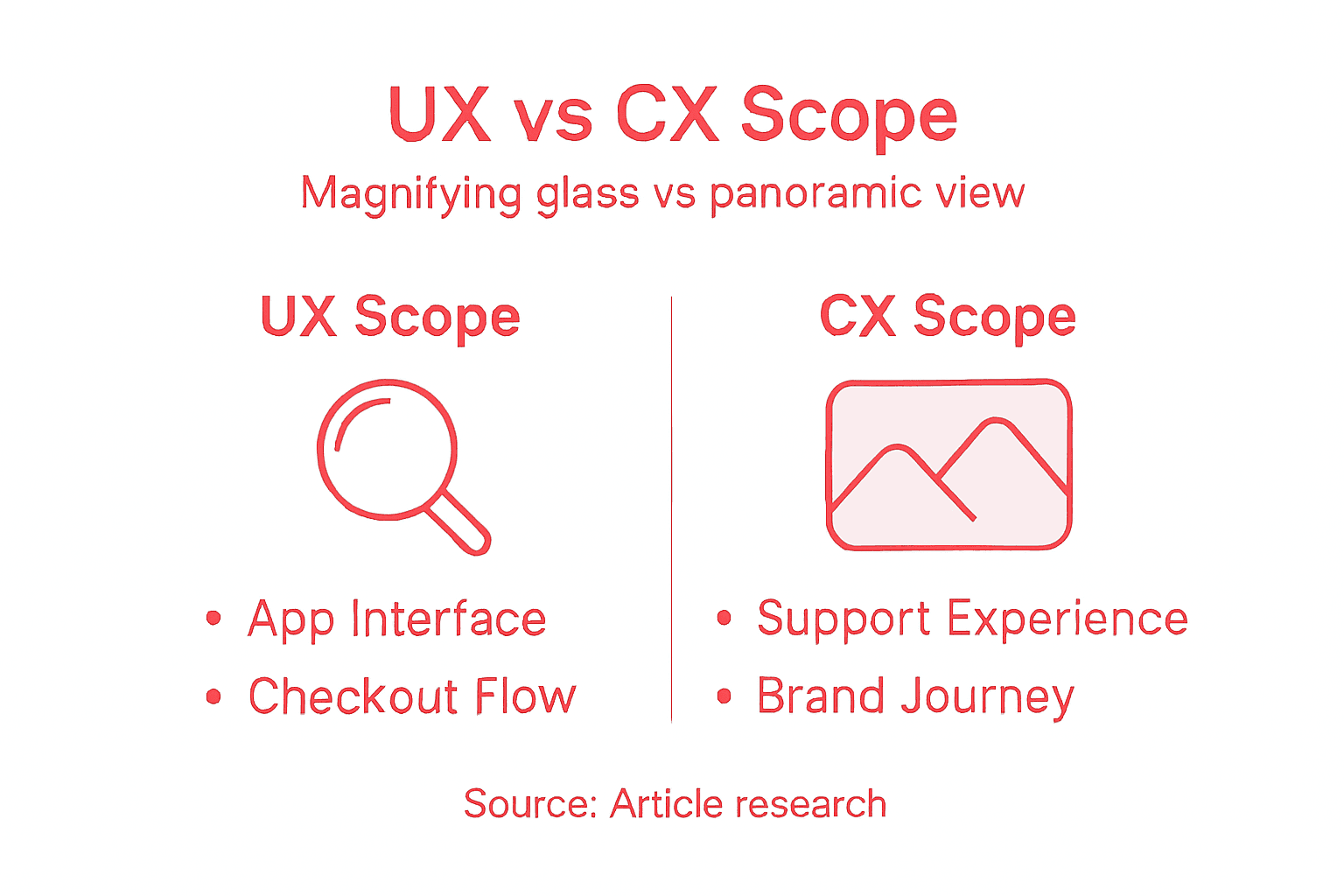
UX scope is intentionally narrow. It focuses on a single product or service interaction—the app, the website, the checkout flow. UX professionals ask: “How well does this specific product work for users?”

CX scope is expansive. It includes every interaction a customer has with your organization before, during, and after purchase. Marketing touchpoints count. Support interactions count. Billing processes count. Packaging counts.
Think of scope this way: UX is a magnifying glass on one moment. CX is a panoramic view of the entire relationship.
Touchpoints: Where Measurement Gets Real
UX touchpoints focus directly on product interaction, while CX touchpoints span every channel. Here’s what that looks like operationally:
UX touchpoints include:
- Mobile app interface and navigation
- Website usability and page speed
- Search functionality and filters
- Form completion and validation
- Error messages and recovery flows
CX touchpoints extend far beyond:
- Social media comments and reviews
- Sales calls and emails
- Onboarding sequences
- In-app support and help resources
- Email communications and statements
- Post-purchase follow-ups
- Cancellation and refund processes
A customer service representative answering a phone call is a CX touchpoint—but has zero impact on traditional UX metrics. Yet it dramatically influences whether that customer stays or leaves.
Metrics: How You Actually Measure Success
UX metrics assess usability and product satisfaction, while CX metrics reveal broader business impact. The distinction matters because it changes what you optimize for.
| Metric Type | UX Examples | CX Examples |
|---|---|---|
| Speed | Page load time, task completion time | Time to resolution, response time |
| Satisfaction | System Usability Scale (SUS), satisfaction with interface | Net Promoter Score (NPS), Customer Satisfaction (CSAT) |
| Behavior | Click patterns, navigation paths | Repeat purchase rate, lifetime value |
| Emotional | Ease of use perception | Brand loyalty, emotional connection |
Here’s the critical insight: a perfectly usable product interface doesn’t guarantee customer loyalty. You need both metrics working together.
UX metrics tell you if your product works. CX metrics tell you if your customers want to stay.
Optimizing UX without measuring CX is like polishing one floor in a building while the walls crumble.
Many organizations measure UX thoroughly—task completion rates, error rates, time on page. But they neglect CX metrics that predict actual business outcomes: churn rate, customer lifetime value, and referral propensity.
Your North American competitors are already tracking both. If you measure only UX, you’re missing the signals that indicate whether your strategy drives growth or just creates friction-free abandonment.
Pro tip: Map your organization’s current metrics by category: identify which are UX-specific versus CX-specific, then pinpoint measurement gaps that obscure the full customer relationship health.
How UX and CX Influence Business Outcomes
UX and CX don’t operate in isolation. They work together to drive retention, growth, and competitive advantage. Understanding how each influences business results helps you allocate resources strategically.
UX’s Impact on Product Adoption and Efficiency
When UX works well, users complete tasks faster and with fewer errors. This directly affects your bottom line through reduced support costs and increased feature adoption.
Strong UX delivers:
- Higher user adoption rates for new features
- Reduced onboarding time and training expenses
- Lower support ticket volume from confused users
- Faster time-to-value for customers
- Better product-market fit signals
A SaaS company with a confusing interface sees customers struggle through onboarding, leading to slow adoption and quick churn. Fix the UX, and adoption accelerates. Customers reach value faster. They stay longer.
But here’s the catch: excellent UX alone doesn’t guarantee growth. A sleek product interface doesn’t overcome poor customer service or weak post-sale support.
Here’s how UX and CX contribute to different business priorities:
| Business Priority | UX Contribution | CX Contribution |
|---|---|---|
| Onboarding Speed | Simplifies steps for users | Ensures clear, welcoming communication |
| Customer Loyalty | Reduces friction in product use | Builds emotional trust and support |
| Revenue Growth | Enables easier feature adoption | Drives referrals and repeat purchases |
| Brand Reputation | Creates positive first impressions | Sustains lasting, memorable interactions |
CX’s Impact on Loyalty and Revenue
Both UX and CX significantly impact customer loyalty and lifetime value, but CX creates the emotional bonds that keep customers returning and referring others.
When CX works well, something shifts psychologically. Customers feel valued, heard, and supported throughout their entire journey with your brand.
Strong CX drives:
- Increased customer lifetime value through repeat purchases
- Higher Net Promoter Scores and brand advocacy
- Reduced churn and customer acquisition costs
- Premium pricing tolerance from loyal customers
- Organic referrals and word-of-mouth growth
A customer who had one frustrating support interaction might tolerate it if everything else was excellent. But stack multiple mediocre CX moments—slow response times, unclear billing, poor onboarding—and they leave, regardless of how polished your interface looks.
The Combined Effect: Strategic Multiplier
Integrated UX and CX approaches create improvements in retention, brand differentiation, and revenue growth by addressing both functional and emotional aspects of customer engagement.
Think of it this way:
- UX alone = functional efficiency without emotional connection
- CX alone = emotional care without product usability
- UX + CX together = customers who stay because the product works AND they feel valued
This combined approach creates a strategic multiplier effect. A company that invests in UX improvements sees 15-20% efficiency gains. Add intentional CX investment, and you see 40-50% retention improvements. The effects compound.
Companies excelling at both UX and CX don’t just outperform competitors—they create defensible market positions through customer loyalty that transcends price competition.
Your North American competitors understand this. Organizations like Zappos built empires on CX. Apple dominates through UX. The true winners excel at both simultaneously, creating customer experiences that feel seamless and emotionally satisfying.
When you optimize only UX, you’re competing on feature parity and usability. When you combine UX and CX, you’re competing on customer devotion.
Pro tip: Audit business outcomes alongside experience metrics: correlate improvements in UX usability scores with CX loyalty indicators to demonstrate the compounding effect of integrated strategy to skeptical stakeholders.
Aligning UX and CX Strategies for Loyalty
Most organizations treat UX and CX as separate initiatives managed by different teams. This siloed approach creates inconsistencies that confuse customers and leave growth on the table. True alignment means coordinating these strategies so every touchpoint reinforces the same brand promise.
The Alignment Problem
Here’s what typically happens: the product team obsesses over interface design while the customer service team operates independently. A user finds the app intuitive but calls support and encounters slow response times. The experience feels fragmented.
Synchronizing design and customer service strategies builds trust and long-term loyalty by creating cohesive brand experiences across every interaction point.
When UX and CX remain misaligned, customers experience contradictions:
- Smooth signup process but unclear billing communications
- Intuitive dashboard but unhelpful support documentation
- Easy onboarding but slow response to account issues
- Beautiful interface but frustrating cancellation process
These gaps erode trust. Customers don’t blame “the UX team” or “the support team”—they blame the brand.
How Alignment Creates Loyalty
Aligned UX and CX strategies share three core elements:
- Consistent messaging across product interface, emails, support interactions, and marketing
- Unified understanding of customer needs at every lifecycle stage
- Integrated metrics that track satisfaction across both product and service touchpoints
When these align, something shifts. Customers feel like they’re dealing with one coherent organization, not fragments.
Consider a SaaS onboarding experience. Misaligned: the product tutorial is clear, but the welcome email is generic. Aligned: the email references specific onboarding sections, support documentation mirrors interface terminology, and in-app prompts connect to knowledge base articles.
The customer doesn’t notice the coordination—they just feel understood and supported throughout their journey.
Building Alignment Across Teams
Alignment requires breaking down organizational silos. Start here:
Define shared customer journey stages together. Product teams and customer service teams must agree on what “onboarding complete” or “power user” actually means.
Create unified messaging frameworks. When product calls a feature “automation,” support should use the same term. Inconsistent terminology creates confusion.
Establish cross-functional success metrics. Track how product usability correlates with support volume and customer satisfaction. This reveals where alignment gaps exist.
Schedule regular sync meetings. Product teams should hear directly from support about user confusion points. Support teams should understand upcoming product changes before customers do.
This table summarizes teamwork alignment strategies for UX and CX:
| Alignment Area | Why It Matters | Success Indicator |
|---|---|---|
| Shared Journey Stages | Unifies definitions across teams | Seamless experience across lifecycle |
| Messaging Consistency | Prevents confusion at touchpoints | Brand language matches everywhere |
| Cross-Team Metrics | Reveals friction and gaps | Improved overall satisfaction rates |
| Sync Meetings | Anticipates and addresses issues | Fewer surprise support complaints |
Loyalty doesn’t come from excellent UX or excellent CX—it comes from customers experiencing both consistently.
Your competitors aren’t just chasing individual experience improvements anymore. They’re weaving UX and CX into unified customer strategies that feel inevitable and trustworthy.
Pro tip: Conduct a “consistency audit” by mapping a customer’s complete journey across touchpoints, documenting where messaging, terminology, or experience quality shifts unexpectedly, then assign ownership for closing each gap.
Elevate Your Growth by Aligning UX and CX Strategies
Understanding the distinct roles of User Experience and Customer Experience is critical if your organization faces fractured brand interactions or inconsistent customer journeys as described in the article. If your product teams focus solely on UX metrics while CX touchpoints like support and onboarding remain misaligned you risk losing loyal customers and leaving revenue on the table. At Xverse we specialize in bridging this exact gap through strategy-led digital transformation and CX leadership advisory.
Transform your customer journeys with:
- Holistic experience blueprint development aligned to business goals
- Data-driven insights that combine UX usability and CX satisfaction metrics
- Cross-functional alignment to ensure consistent messaging and emotional connection

Discover how integrating UX and CX can create a strategic multiplier effect driving both operational efficiency and emotional loyalty. Visit Xverse today to explore our consulting services designed to empower your teams and foster growth. Take action now to turn fragmented experiences into seamless journeys that build lasting customer devotion.
Frequently Asked Questions
What is the difference between UX and CX?
UX (User Experience) focuses on single-product interactions, such as usability and interface design, while CX (Customer Experience) encompasses the entire customer journey with a brand, including all touchpoints and emotional connections.
Why is it important to differentiate between UX and CX?
Differentiating between UX and CX is crucial for building customer loyalty and driving growth. Focusing on both aspects ensures that customers have a seamless experience across all interactions, leading to higher retention rates and overall satisfaction.
How can I improve both UX and CX in my organization?
To improve both UX and CX, align strategies across teams by ensuring consistent messaging, defining shared customer journey stages, and establishing integrated metrics. Regular sync meetings can help each team understand the customer experience from the other’s perspective.
What metrics should I use to measure UX and CX effectively?
For UX, use metrics like task completion rates and system usability scores. For CX, focus on Net Promoter Score (NPS), customer satisfaction (CSAT), and customer lifetime value. Combining these metrics provides a comprehensive view of customer experience success.
Recommended
- Xverse – Transforming experiences with the power of CX, Design & Digital transformation
- 6 Customer Experience Trends 2026 for Tech Leaders – Xverse
- Customer Expectation: Shaping CX Innovation in 2026 – Xverse
- How to Optimize Customer Interactions for Stronger Loyalty – Xverse
- Lean Six Sigma Consulting & Training | Leanscape
- Ziele der Amazon Beratung: Profitables Wachstum realisieren