

Customer experience innovation projects fail at an alarming rate, with digital transformation initiatives facing a 70% failure rate due to misalignment and unclear goals. For CX leaders and digital transformation managers, the stakes are high. Effective CX innovation directly impacts customer loyalty and drives measurable business growth. This guide walks you through the essential steps to prepare, execute, and verify a successful CX innovation process that delivers lasting results and avoids costly mistakes.
Table of Contents
- Preparing For Your Customer Experience Innovation Process
- Executing The Customer Experience Innovation Process Effectively
- Verifying Success And Scaling Your CX Innovations Sustainably
- Discover Expert Support For Your CX Innovation Journey
- Frequently Asked Questions About Customer Experience Innovation
Key takeaways
| Point | Details |
|---|---|
| High failure rates demand strategic planning | Without clear success metrics and stakeholder alignment, CX innovation projects waste resources and miss growth opportunities. |
| Customer-centric beats technology-first | Understanding underlying customer needs through qualitative and quantitative research outperforms solutions focused solely on technology. |
| Iterative innovation sustains results | Continuous improvement cycles deliver better outcomes than one-off digital transformation projects with defined end dates. |
| Data-driven personalization accelerates impact | Combining advanced analytics with human-centered design enables real-time CX optimization and competitive advantage. |
Preparing for your customer experience innovation process
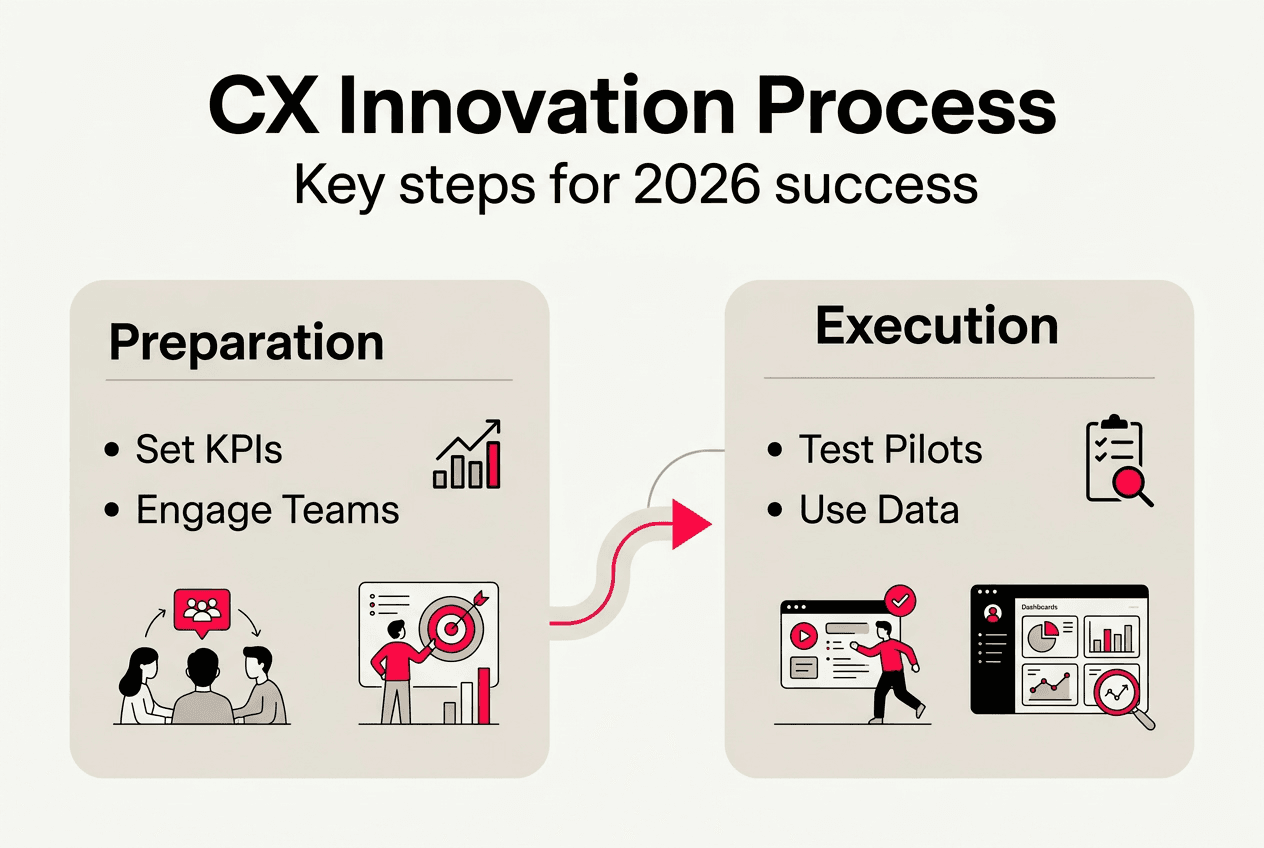
Successful CX innovation starts long before you launch any initiative. Preparation determines whether your efforts will transform customer relationships or join the statistics of failed projects. You need a solid foundation built on clear objectives, cross-functional alignment, and deep customer understanding.
Define measurable success criteria first. Many digital transformation failures stem from lack of measurable definitions of success, leading to misalignment and wasted resources. Establish specific KPIs that connect CX improvements to business outcomes. Revenue growth, customer lifetime value, Net Promoter Score, and operational efficiency metrics should tie directly to your innovation goals. Without these guardrails, teams drift toward subjective opinions rather than data-driven decisions.
Engage stakeholders across departments early. CX innovation requires buy-in from marketing, IT, operations, and executive leadership. Schedule alignment workshops to surface competing priorities and resolve them before execution begins. When everyone understands how CX goals support broader business objectives, you eliminate the silos that derail initiatives. Create a shared vision document that articulates what success looks like for each stakeholder group.
Conduct deep customer research combining qualitative and quantitative methods. A customer-centric approach that considers underlying customer needs is crucial for CX innovation. Ethnographic studies reveal context and emotion that surveys miss. In-depth interviews uncover pain points customers struggle to articulate. Journey mapping identifies friction across touchpoints. Pair these insights with behavioral analytics to validate patterns at scale. This dual approach prevents the common mistake of building solutions based on assumptions rather than evidence.
Establish a customer-centric mindset before selecting technology. Too many organizations rush to implement platforms without understanding the problems they need to solve. Technology should enable your strategy, not define it. Start by documenting current state customer journeys and identifying specific moments where experience breaks down. Only then can you evaluate which tools will address those gaps effectively. This sequence prevents expensive technology investments that fail to move the needle on measuring customer experience outcomes.
Pro Tip: Create a decision matrix that scores potential CX innovation initiatives against both customer impact and business value. This framework helps prioritize projects that deliver maximum ROI while avoiding vanity initiatives that look impressive but lack substance.
Key preparation activities include:
- Mapping current customer journeys with pain points and emotion curves
- Identifying quick wins that build momentum for larger initiatives
- Securing executive sponsorship with clear business case documentation
- Establishing baseline metrics before making any changes
- Building cross-functional innovation teams with defined roles
Executing the customer experience innovation process effectively
Execution transforms preparation into tangible results. Your approach should blend human-centered design with data analytics and iterative testing to minimize risk while maximizing learning. The most successful CX innovations emerge from disciplined experimentation rather than big bang launches.
Adopt iterative development cycles with pilot testing. Start small with a defined customer segment or single touchpoint. This contained approach lets you validate assumptions, gather feedback, and refine solutions before scaling. Design sprints compress ideation and prototyping into focused timeframes. Test concepts with real customers early and often. Each iteration should answer specific questions about feasibility, desirability, and viability. This methodology prevents the costly mistake of building complete solutions only to discover they miss the mark.
Leverage advanced analytics and AI for personalization. Pega Customer Decision Hub offers real-time data and analytics to unlock personalized customer opportunities. Modern platforms analyze behavioral signals, predict intent, and deliver contextual experiences at scale. Machine learning models identify patterns humans miss. Predictive analytics forecast which customers face churn risk or present upsell opportunities. Natural language processing extracts insights from unstructured feedback. These capabilities enable you to move from reactive service to proactive engagement that anticipates needs.

Integrate DevOps practices and microservices architecture. Digital transformation projects now leverage DevOps and microservices for agility and scalability. Traditional monolithic systems create bottlenecks that slow innovation. Microservices let teams develop and deploy features independently. Continuous integration and deployment pipelines accelerate release cycles. This technical foundation supports rapid experimentation essential for fostering customer innovation. You can test new experiences, measure results, and iterate within days rather than months.
Foster collaboration between CX and IT teams. Silos between customer-facing functions and technology groups sabotage even well-planned initiatives. Establish shared objectives and joint accountability for outcomes. Use collaborative tools that provide visibility into development progress and customer feedback simultaneously. Regular standups keep both teams aligned on priorities and blockers. This partnership ensures technical solutions actually solve customer problems rather than creating new friction.
Pro Tip: Implement a CX innovation lab where cross-functional teams can prototype and test ideas rapidly without bureaucratic approval processes. This dedicated space accelerates learning and builds organizational muscle for continuous innovation.
Follow this execution framework:
- Define the specific customer problem or opportunity with supporting data
- Generate multiple solution concepts through collaborative ideation sessions
- Build low-fidelity prototypes to test core assumptions quickly
- Conduct user testing with target customers to gather qualitative feedback
- Refine concepts based on insights and develop high-fidelity versions
- Launch pilot programs with measurement frameworks in place
- Analyze results against success criteria and iterate or scale accordingly
Key execution metrics to track:
| Metric | Purpose | Target |
|---|---|---|
| Time to market | Measures innovation velocity | 30-60 days for pilots |
| Customer satisfaction delta | Quantifies experience improvement | +15% minimum lift |
| Adoption rate | Validates solution relevance | 40%+ in pilot segment |
| Cost per interaction | Tracks efficiency gains | 20%+ reduction |
| Revenue impact | Connects to business outcomes | Positive ROI within 6 months |
Successful execution of digital transformation in CX requires balancing speed with rigor. Move fast enough to maintain momentum and organizational attention. Move deliberately enough to gather meaningful insights that inform decisions. This rhythm becomes your competitive advantage as you build capabilities that competitors struggle to replicate.
Verifying success and scaling your CX innovations sustainably
Verification determines whether your CX innovation delivers promised value or simply creates activity without impact. You need systematic approaches to measure outcomes, identify what works, and scale successes while avoiding expensive missteps. Continuous improvement beats one-time projects every time.
Focus on ongoing verification rather than project completion. Treating digital transformation as a project with a defined end date leads to setbacks and more expensive follow-up initiatives. Customer expectations evolve constantly. Technology capabilities advance rapidly. Competitive dynamics shift. Your verification framework must account for this reality by establishing continuous feedback loops rather than final checkpoints.
Compare short-term project thinking versus transformation mindset:
| Project Approach | Transformation Approach |
|---|---|
| Fixed timeline with end date | Continuous evolution cycles |
| Success defined by launch | Success measured by sustained impact |
| Budget allocated once | Ongoing investment in improvement |
| Team disbands after completion | Permanent capability building |
| Technology focus | Customer outcome focus |
Use predefined KPIs and customer feedback to validate impact. Your preparation phase established baseline metrics. Now compare results against those benchmarks. Look beyond vanity metrics to indicators that matter for business performance. Customer effort scores reveal friction points. Sentiment analysis tracks emotional response. Behavioral data shows actual usage patterns versus stated preferences. Financial metrics connect experience improvements to revenue and profitability. This multi-dimensional view prevents the trap of optimizing one metric while degrading overall experience.
Establish closed-loop feedback systems. Collect input from customers through surveys, interviews, and behavioral tracking. Share insights across the organization weekly. Create clear processes for acting on feedback quickly. Customers notice when their input drives visible changes. This responsiveness builds trust and encourages ongoing participation. Your feedback loops become early warning systems for emerging issues and sources of innovation ideas.
Plan for scaling successes to avoid costly rework. Pilot programs prove concepts work in controlled environments. Scaling introduces complexity around technology infrastructure, organizational change management, and operational processes. Document what you learned during pilots. Identify dependencies and potential bottlenecks before expanding. Develop playbooks that other teams can follow. This preparation prevents the common mistake of successful pilots that fail during broader rollout.
Pro Tip: Create a CX innovation scorecard that executives review monthly. Include leading indicators like experiment velocity alongside lagging indicators like customer satisfaction and revenue impact. This visibility maintains organizational commitment through inevitable challenges.
Critical verification activities:
- Conducting post-implementation reviews within 30, 60, and 90 days
- Comparing actual results against projected outcomes with root cause analysis for gaps
- Gathering customer feedback through multiple channels to validate perceived improvements
- Monitoring operational metrics to ensure efficiency gains materialize
- Calculating return on investment with full cost accounting
- Documenting lessons learned to inform future initiatives
Sustainable CX innovation requires building organizational capabilities, not just delivering projects. Invest in training teams on customer-centric methodologies. Establish centers of excellence that spread best practices. Create career paths that reward innovation contributions. Celebrate both successes and intelligent failures that generate learning. These cultural elements determine whether your CX innovation becomes a competitive advantage or a temporary initiative that fades. Building a CX transformation roadmap ensures your efforts compound over time rather than starting fresh with each new challenge.
Discover expert support for your CX innovation journey
Navigating customer experience innovation requires both strategic vision and execution expertise. You’ve learned the framework, but implementation challenges often reveal gaps between theory and practice. That’s where specialized support accelerates your success.
Xverse partners with organizations to lead CX innovation using proven strategies that align business goals with customer needs. Our team brings deep expertise in customer experience leadership, helping you build capabilities that drive sustainable growth. We’ve guided companies through complex transformations, avoiding the pitfalls that derail initiatives.
Whether you need strategic direction or hands-on implementation support, our customer experience leadership services provide the guidance to accelerate results. We help you develop comprehensive strategies, build cross-functional alignment, and establish measurement frameworks that prove impact. Explore how our approach to CX transformation roadmap development can position your organization for lasting competitive advantage in 2026 and beyond.
Frequently asked questions about customer experience innovation
What are typical causes of CX innovation failures?
Most failures stem from lack of measurable success criteria, insufficient stakeholder alignment, and technology-first approaches that ignore customer needs. Organizations also struggle when they treat innovation as one-time projects rather than continuous processes. Poor communication between CX and IT teams creates silos that prevent effective execution.
How do you define measurable success for CX projects?
Establish specific KPIs that connect customer experience improvements to business outcomes before starting any initiative. Include metrics like customer satisfaction scores, Net Promoter Score, customer lifetime value, revenue growth, and operational efficiency. Set baseline measurements and target improvements with timeframes. This clarity prevents misalignment and enables data-driven decisions throughout execution.
Why is a customer-centric approach important in innovation?
Customer-centric innovation starts with deep understanding of actual needs rather than assumed problems. This approach uncovers root causes that technology alone can’t solve. Organizations that prioritize customer research and involve users throughout development create solutions people actually want to use. The alternative is building features that look impressive but fail to improve real experiences.
How does continuous improvement affect CX innovation outcomes?
Continuous improvement creates compounding returns that one-time projects can’t match. Regular iteration based on customer feedback and performance data keeps solutions relevant as expectations evolve. This approach builds organizational capabilities and prevents the expensive cycle of major overhauls. Companies that embrace ongoing optimization achieve digital transformation benefits that sustain competitive advantage.
What role does technology play in successful CX innovation?
Technology enables scale and personalization but should support strategy rather than define it. Advanced analytics, AI, and modern architecture provide capabilities for real-time optimization and predictive engagement. However, technology investments only deliver value when aligned with clear customer needs and business objectives. Start with the problem you’re solving, then select tools that address those specific challenges.