

Organizations that systematically measure customer experience see revenue growth rates 5-8% higher than competitors who do not. This isn’t just about collecting feedback. It’s about understanding what drives buying decisions, loyalty, and long-term profitability. Measuring customer experience transforms raw data into strategic insights that fuel innovation and competitive advantage.
Table of Contents
- Introduction: Defining Customer Experience Measurement
- The Business Impact Of Measuring Customer Experience
- Common Misconceptions About Customer Experience Measurement
- Frameworks And Methods For Measuring Customer Experience
- Bridging Measurement To Innovation And Strategic Decision-Making
- Practical Applications And Case Studies
- How Xverse Empowers Your Customer Experience Measurement
- FAQ
Key takeaways
| Point | Details |
|---|---|
| Revenue impact | Organizations measuring CX effectively achieve 5-8% higher revenue growth than those who don’t. |
| Metric diversity matters | Relying solely on NPS provides incomplete insights; combining quantitative and qualitative data improves accuracy by 30%. |
| Innovation acceleration | CX measurement speeds product development cycles by 30% through targeted, data-driven improvements. |
| Churn reduction | Effective CX measurement programs reduce customer churn by 15%, directly protecting revenue streams. |
| Strategic alignment | Only 29% of CX programs successfully link measurement data to business strategy, revealing significant opportunity. |
Introduction: defining customer experience measurement
Customer experience measurement is the systematic process of gathering and analyzing feedback across every touchpoint where customers interact with your organization. It captures how customers perceive their journey from initial awareness through purchase, use, and ongoing relationship.
Why does this matter? Because 70% of buying decisions are influenced by perception of customer experience, not just product features or price. When you measure CX effectively, you replace guesswork with evidence. You identify friction points before they become churn triggers. You discover opportunities that competitors miss.
Measurable CX provides the foundation for:
- Understanding customer needs and pain points at each journey stage
- Prioritizing improvements based on actual impact rather than assumptions
- Aligning teams around shared customer-centric goals
- Demonstrating ROI from experience investments to stakeholders
- Building predictive models that anticipate customer behavior
Without measurement, you’re flying blind. With it, you gain the clarity to make decisions that strengthen relationships and drive sustainable growth.
The business impact of measuring customer experience
The financial case for CX measurement is compelling. Companies that track and act on customer experience data achieve revenue growth 5-8% higher than their industry peers. This isn’t marginal improvement. Over five years, this compounds into significant competitive separation.
Customer loyalty drives this growth, and loyalty stems from experience quality, not lowest price. When customers feel understood and valued through seamless interactions, they stay longer, buy more, and recommend you to others. The retention economics are powerful: acquiring new customers costs five to seven times more than retaining existing ones.
Churn reduction represents another critical benefit. Organizations implementing structured CX measurement see churn reduced by 15%, directly protecting revenue streams and lifetime value. Each percentage point of churn reduction translates to millions in preserved revenue for mid-sized and enterprise organizations.

| Metric | Organizations Measuring CX | Organizations Not Measuring CX |
|---|---|---|
| Revenue Growth Rate | 5-8% above market average | At or below market average |
| Customer Churn | 15% lower than baseline | Baseline or higher |
| Customer Lifetime Value | 25-30% higher | Standard market rates |
| Innovation Cycle Speed | 30% faster | Standard timeline |
These outcomes justify CX initiatives to even the most financially focused stakeholders. When you connect experience metrics to revenue performance, customer experience revenue growth becomes a strategic priority, not a nice-to-have program.
Common misconceptions about customer experience measurement
Many organizations stumble by treating Net Promoter Score (NPS) as the only metric that matters. While NPS measures willingness to recommend, it captures just one dimension of experience. Customers might recommend you while still experiencing frustration at specific touchpoints. Relying solely on NPS misses operational issues, journey friction, and improvement opportunities that other metrics reveal.
Another critical gap: only 29% of CX programs successfully link measurement data to business strategy. Most collect feedback but fail to translate insights into action. Data without application becomes shelf-ware, wasting resources and missing opportunities to drive improvement.
Common pitfalls that limit CX measurement effectiveness:
- Measuring too infrequently to catch emerging issues before they escalate
- Focusing exclusively on transactional surveys instead of relationship health
- Ignoring qualitative feedback that explains the “why” behind scores
- Siloing CX data instead of integrating it with operational and financial metrics
- Lacking clear ownership and accountability for acting on insights
Pro Tip: Combine multiple metrics like NPS, Customer Satisfaction Score (CSAT), and Customer Effort Score (CES) with qualitative insights from interviews and open-ended feedback. This multi-dimensional approach reveals not just what’s happening, but why it’s happening and how to fix it.
Without proper measurement frameworks, organizations risk investing in improvements that don’t address root causes. You need comprehensive visibility to make smart decisions that enhance both experience quality and business performance. Visit cx leadership best practices to understand how leading organizations avoid these traps.
Frameworks and methods for measuring customer experience
Customer Journey Mapping provides the foundation for effective measurement by visualizing every interaction customers have with your organization. This framework identifies moments that matter most and reveals where experience breaks down. Organizations using journey mapping see strategy alignment increase by 25%, ensuring measurement focuses on high-impact touchpoints rather than vanity metrics.
Quantitative metrics give you the “what” while qualitative insights explain the “why.” Combining both approaches improves accuracy by 30%, providing context that numbers alone cannot deliver. A declining CSAT score tells you there’s a problem. Customer interviews reveal it’s caused by confusing navigation on your mobile app.
| Metric | What It Measures | Strengths | Limitations |
|---|---|---|---|
| NPS | Likelihood to recommend | Simple, comparable across industries | Doesn’t explain drivers of score |
| CSAT | Satisfaction with specific interaction | Actionable for tactical improvements | Transactional, not relationship focused |
| CES | Ease of completing tasks | Predicts repeat behavior strongly | Narrow scope on effort only |
AI-driven analytics transform CX measurement from periodic reports to real-time intelligence. Advanced platforms analyze sentiment, identify patterns, and flag emerging issues automatically. This capability reduces decision reaction time by 40%, allowing you to address problems before they escalate into widespread dissatisfaction.
Customer journey mapping tools integrated with AI in customer experience platforms create powerful measurement ecosystems. You can track journey progression, measure friction at each stage, and prioritize improvements based on business impact. For technical implementation guidance, explore experience management tools that integrate with your existing systems.
Pro Tip: Don’t wait for annual surveys to understand customer sentiment. Implement always-on measurement that captures feedback continuously across channels. Pair this with AI analytics to surface insights automatically, freeing your team to focus on action rather than analysis.
Bridging measurement to innovation and strategic decision-making
CX measurement insights fuel faster, more targeted product development. When you understand specific pain points customers experience, you can prioritize features and improvements that deliver maximum value. Organizations using CX data to guide innovation see product development accelerate by 30%, shortening time to market while increasing solution fit.
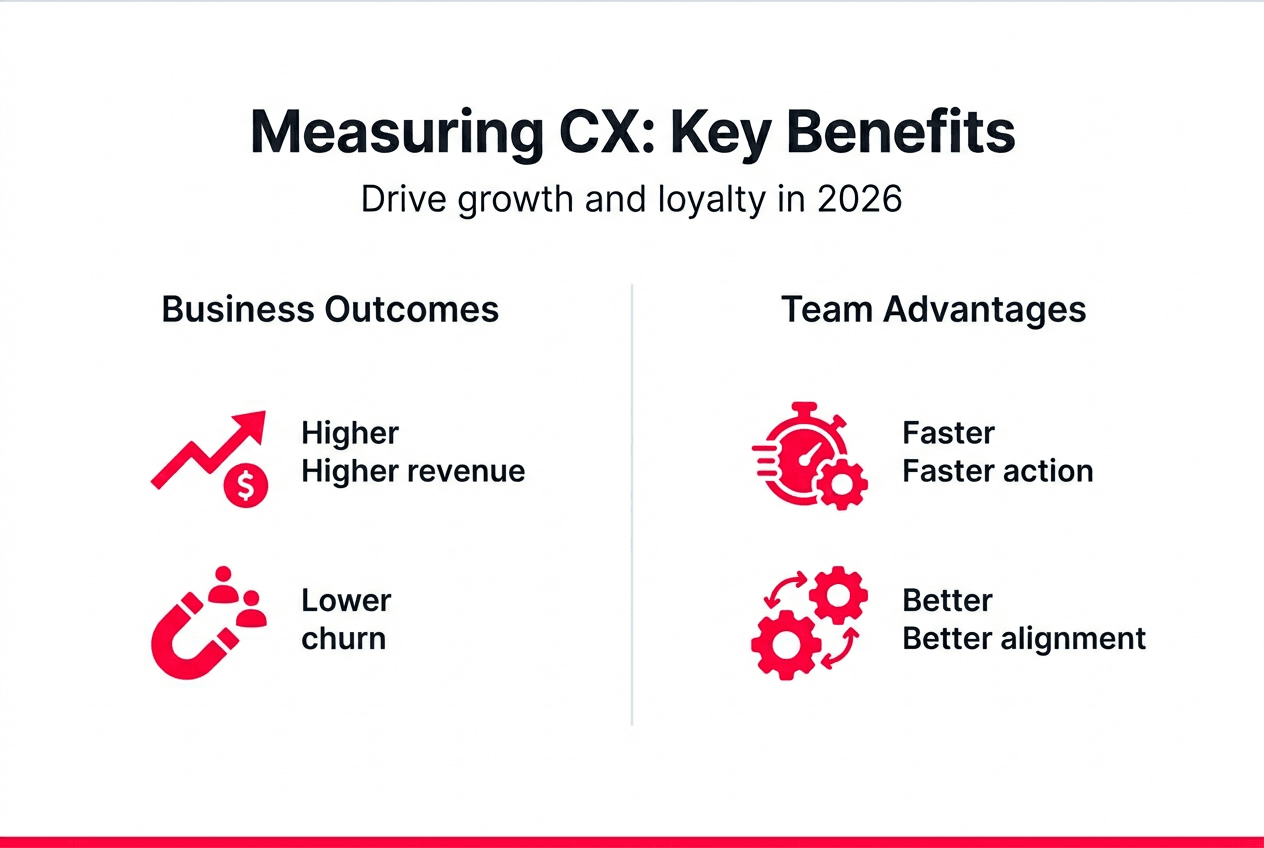
Strategic alignment determines whether CX measurement drives business impact or becomes isolated reporting. Link experience metrics directly to business objectives like revenue growth, market share expansion, or operational efficiency. When executives see CX scores tied to financial outcomes, measurement transforms from cost center to strategic asset.
The cost of ignoring CX metrics is steep. Organizations that don’t measure CX see 20% lower ROI on customer-facing investments because they lack the insights to optimize effectively. They invest in improvements customers don’t value while missing critical friction points that drive churn.
Practical ways to integrate CX insights into decision-making:
- Create cross-functional dashboards that connect CX metrics to operational and financial KPIs
- Establish governance processes that require CX impact analysis before major initiatives launch
| Build feedback loops where product, marketing, and service teams review CX data monthly - Tie executive compensation partially to customer experience performance metrics
- Use journey analytics to identify innovation opportunities customers explicitly request
When CX strategy customer loyalty becomes a board-level priority, organizations unlock sustainable competitive advantages. Measurement provides the evidence to justify investments, track progress, and demonstrate value. Learn how to innovate customer journeys systematically using data-driven frameworks. Explore cx strategy best practices loyalty growth to see how leading organizations connect measurement to business outcomes.
Practical applications and case studies
A global retail brand implemented comprehensive CX measurement across digital and physical channels. By tracking journey friction and acting on insights, they reduced churn by 15% and increased revenue by 20% within 18 months. The key was connecting measurement to action, closing the feedback loop by addressing top pain points customers identified.
Real-time CX measurement delivers immediate impact. One financial services company deployed always-on sentiment analysis across customer service interactions. This approach surfaced emerging issues within hours rather than weeks, enabling rapid response. The result: 25% higher customer satisfaction scores and significantly improved first-call resolution rates.
These successes illustrate both financial and experiential payoffs:
- Measurement identified specific checkout friction causing cart abandonment, leading to conversion rate improvements worth millions annually
- Journey mapping revealed customers struggled with post-purchase onboarding, prompting redesign that reduced support contacts by 40%
- Predictive analytics flagged at-risk customers early, enabling proactive retention efforts that saved high-value relationships
- Voice of customer insights guided feature prioritization, ensuring development resources focused on capabilities customers actually wanted
The pattern is clear: organizations that measure systematically, analyze rigorously, and act decisively transform customer experience from cost center to growth engine. Explore how to optimize customer interactions using proven measurement frameworks. See more examples of customer journey innovation driving tangible business results.
How Xverse empowers your customer experience measurement
Transforming CX measurement from data collection to strategic advantage requires expertise, proven frameworks, and commitment to action. Xverse partners with organizations to implement measurement programs that drive measurable business outcomes.
Our customer experience leadership services help you build capabilities that align CX metrics with strategic goals. We work alongside your teams to establish governance, develop dashboards, and create accountability for acting on insights.
Through specialized customer journey mapping, we identify high-impact touchpoints where measurement delivers maximum value. Our approach combines quantitative rigor with qualitative depth, ensuring you understand not just scores, but the experiences driving them. Discover proven CX strategy customer loyalty frameworks that connect measurement to retention and growth.
FAQ
What are the best metrics to measure customer experience?
Combine transactional metrics like CSAT and CES with relationship metrics like NPS to capture both immediate satisfaction and long-term loyalty. Add qualitative feedback through interviews and open-ended survey responses to understand the drivers behind scores. No single metric tells the complete story.
How does customer experience measurement improve loyalty?
Measurement reveals friction points that frustrate customers and opportunities to exceed expectations. When you systematically address pain points and enhance positive moments, customers feel valued and understood. This emotional connection drives loyalty more effectively than price discounts or promotions ever could.
What challenges should organizations expect with CX measurement?
Common obstacles include survey fatigue from over-measuring, siloed data that doesn’t integrate with other systems, and lack of clear ownership for acting on insights. Organizations also struggle with linking CX metrics to financial outcomes, making it harder to justify investments and sustain executive support.
How frequently should CX be measured for best results?
Implement continuous measurement through always-on feedback mechanisms rather than relying solely on periodic surveys. Capture transactional feedback immediately after key interactions while conducting relationship surveys quarterly. Real-time measurement enables faster response to emerging issues before they escalate.
Can CX measurement really drive innovation?
Absolutely. Customer feedback reveals unmet needs, frustrating friction points, and opportunities for differentiation that internal teams often miss. Organizations that systematically analyze CX data to guide product development create solutions customers actually want, accelerating time to market and improving solution fit by understanding real-world usage patterns.