

Here’s a statistic that should capture every executive’s attention: 70% of customers are willing to pay more for brands that consistently deliver excellent experiences. Customer experience (CX) has evolved from a nice-to-have into a strategic growth engine in 2026. Rising expectations fueled by AI and digital transformation demand intentional CX design. This guide explains why CX matters, common pitfalls that undermine investments, and strategic frameworks to transform CX into measurable business value.
Table of Contents
- Why Customer Experience Directly Impacts Business Growth
- Common Misconceptions About Customer Experience
- Challenges And Gaps In Current Customer Experience Practices
- Frameworks And Strategies For Effective CX Leadership
- Embedding Customer Experience As A Growth Engine For The Future
- Explore Xverse’s Customer Experience Leadership Solutions
Key takeaways
| Point | Details |
|---|---|
| CX as growth lever | Customer experience directly impacts revenue, pricing power, and customer lifetime value. |
| Common misconceptions | Flawed assumptions about personalization, AI, and CX scope prevent effective execution. |
| Strategic gaps | Experience gaps widened since 2024 due to siloed teams and poor insight operationalization. |
| AI-human balance | Hybrid models combining AI efficiency with human empathy optimize 2026 CX delivery. |
| Actionable frameworks | Proven strategies close gaps, align teams, and connect CX investments to business outcomes. |
Why customer experience directly impacts business growth
Customer experience is one of the most powerful growth levers brands have today, decisively impacting loyalty and churn. The business case is clear and quantifiable.
CX drives revenue growth by increasing customer willingness to spend more. When you deliver consistent, quality experiences, customers respond with their wallets. Research confirms that 70% of customers will spend more with brands providing excellent CX. This pricing power translates directly to margin expansion without acquiring new customers.
Loyal customers generate disproportionate profits over time. The data reveals that 70% of future profits come from 20% of existing loyal customers. This concentration effect makes retention strategies powered by superior CX incredibly valuable. Investing in customer experience leadership pays dividends through sustained revenue streams.
Poor CX creates immediate financial consequences through customer abandonment. After just a few negative experiences, customers switch to competitors without hesitation. The cost of acquisition makes this churn devastating to growth trajectories. Building a robust CX strategy focused on loyalty prevents this value leakage.
“Great customer experience is the ultimate competitive advantage in saturated markets where product differentiation narrows.”
Consistent quality experiences differentiate brands in competitive markets. When products and pricing converge, CX becomes the deciding factor. Organizations prioritizing experience design capture market share from competitors stuck in transactional relationships. Even factors like workplace environment impact CX delivery, as research shows the role of cleaning in staff retention affects satisfaction levels that cascade to customer interactions.
| Business Metric | CX Impact |
|---|---|
| Revenue Growth | 70% willing to pay premium for excellent CX |
| Profit Concentration | 70% of profits from 20% loyal customers |
| Churn Risk | High after 2-3 negative experiences |
| Market Differentiation | Primary competitive advantage in 2026 |
Common misconceptions about customer experience
Executive misunderstandings about CX lead to misdirected investments and disappointing returns. Clearing up these myths prevents costly strategic errors.
Personalization backfires when brands cross privacy boundaries or appear intrusive. Despite its popularity, nearly half of personalized communications fail and many consumers find them invasive. Responsible data use and transparency matter more than personalization sophistication. Trust trumps targeting.
CX extends far beyond customer service departments. Many executives mistakenly view CX as a support function rather than an organization-wide strategic priority. Every touchpoint from marketing to product development to billing shapes the experience. Siloed approaches fragment the customer journey and dilute impact.
- Feature overload overwhelms customers and increases abandonment rates
- Excessive notifications train customers to ignore communications
- Complexity creates friction that erodes trust and satisfaction
- Simplicity often delivers better business outcomes than feature richness
More features and notifications rarely improve CX despite intuitive appeal. Organizations pile on capabilities assuming more equals better. The opposite often proves true. Customers value simplicity and clarity over bells and whistles. Each additional feature adds cognitive load.
AI cannot replace human empathy in meaningful customer interactions. While automation handles routine tasks efficiently, complex situations demand human judgment and emotional intelligence. The most effective approach combines AI scale with human touch. Organizations exploring AI in customer experience must maintain this balance carefully.
Pro Tip: Before adding any new CX feature or communication channel, remove two existing ones. This subtraction discipline forces prioritization and prevents overwhelming customers with complexity.
Challenges and gaps in current customer experience practices
Organizations struggle to translate CX investments into tangible business results. Understanding these barriers helps you address them strategically.

A massive perception gap exists between brand confidence and customer reality. Only 17% of consumers agree CX has improved despite 66% of brands believing they’ve made progress. This disconnect signals serious execution problems. Leadership teams see initiatives launched but miss whether those initiatives actually improve experiences.
Departments fail to operationalize CX insights effectively. Research shows 30-40% of departments don’t act on CX insights they collect. Data gathering becomes an end rather than a means. Without cross-functional alignment, insights sit unused while experience gaps persist.
- Experience gaps widened significantly between 2024 and 2026
- Siloed departments create fragmented customer journeys
- Lack of executive alignment prevents coordinated action
- Measurement systems focus on outputs rather than outcomes
Experience gaps have expanded sharply since 2024 as customer expectations accelerated faster than organizational capabilities. Digital transformation raised the bar while many companies maintained status quo practices. This growing divide threatens competitive positioning. Following CX leadership best practices helps close these gaps systematically.
AI adoption requires careful human oversight to prevent over-automation. Rushing to implement AI without governance creates new problems. Customers detect and resent robotic interactions that lack empathy. The solution involves thoughtful integration where technology augments rather than replaces human capabilities.
Frameworks and strategies for effective CX leadership
Senior leaders need practical approaches to overcome common barriers and deliver measurable CX improvements. These frameworks provide actionable roadmaps.
Hybrid human-AI teams optimize both personalization and operational efficiency. Research demonstrates that hybrid CX teams improve personalization and efficiency while maintaining empathy. AI handles repetitive tasks at scale while humans manage complex situations requiring judgment. This division of labor maximizes strengths of both.
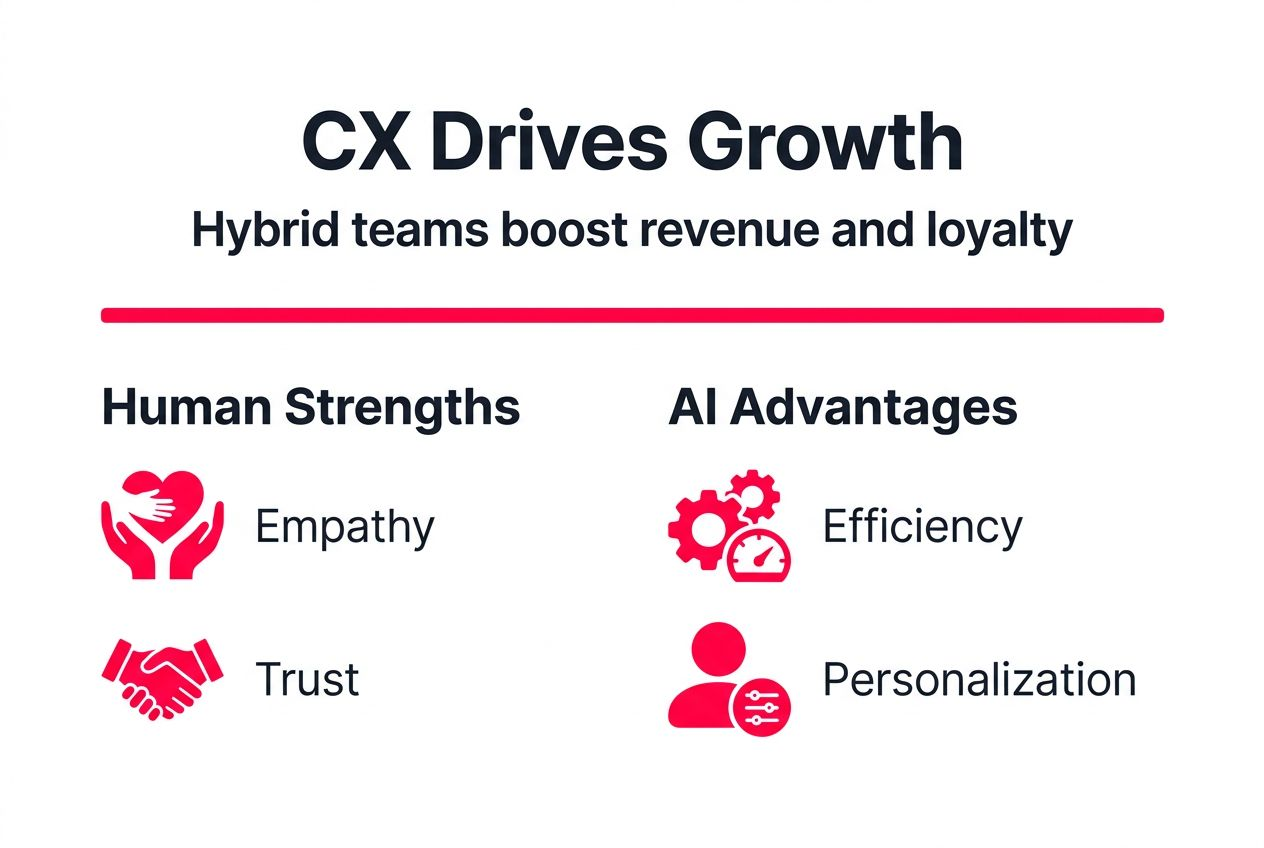
Hybrid teams integrating AI for routine tasks with human agents for complex interactions balance efficiency with empathy. The key lies in clear escalation protocols and continuous learning loops. Technology should feel invisible to customers who simply experience seamless support.
Proactive customer engagement consistently drives superior outcomes. Companies that proactively engage customers achieve 63% better results compared to reactive approaches. Anticipating needs and reaching out before problems escalate builds trust and loyalty. This requires predictive analytics and empowered frontline teams.
| Approach | Key Benefit | Implementation Priority |
|---|---|---|
| Hybrid AI-Human Teams | Efficiency with empathy | High |
| Proactive Engagement | 63% better outcomes | High |
| Experience Simplification | Reduced churn | Medium |
| Cross-Functional Alignment | Coordinated action | High |
Simplifying CX reduces churn and builds customer trust. Strip away unnecessary complexity in processes, communications, and interfaces. Every simplification removes friction points where customers might abandon. Start by mapping your current journey and eliminating steps that don’t add clear value.
Aligning CX strategy with data-driven actionable insights proves critical. Many organizations collect extensive data but lack mechanisms to translate insights into decisions. Implement CX strategy best practices that connect measurement to action. Establish clear ownership and accountability for acting on insights.
- Audit current CX touchpoints to identify friction and gaps
- Define measurable business outcomes tied to CX improvements
- Implement hybrid AI-human models for optimal efficiency and empathy
- Establish cross-functional governance for coordinated execution
- Create feedback loops connecting insights to rapid action
- Measure impact on revenue, loyalty, and customer lifetime value
Understanding the role of data in customer experience enables evidence-based decisions. Without robust analytics, you’re flying blind. Invest in systems that capture meaningful signals and make insights accessible to decision makers. Transforming experiences through CX design requires this foundation.
Pro Tip: Start small with pilot programs that demonstrate measurable ROI before scaling CX initiatives organization-wide. Early wins build momentum and secure ongoing executive support.
Embedding customer experience as a growth engine for the future
CX must transition from initiative to strategic asset woven into organizational DNA. This final step determines whether CX investments deliver sustained competitive advantage.
Treat CX as a strategic asset directly influencing pricing power and customer loyalty. The evidence shows customers willingly pay premiums for superior experiences. This pricing flexibility flows directly to profitability. Stop viewing CX as a cost center and recognize it as a revenue driver.
Executives need to focus relentlessly on closing experience gaps through execution and alignment. The widening divide between customer expectations and delivered experiences threatens market position. Address this through coordinated action across departments. Break down silos that fragment journeys.
- Balance AI efficiency with human empathy for future-proof CX
- Turn insights into action through clear accountability mechanisms
- Measure business outcomes, not just activity metrics
- Continuously iterate based on customer feedback and market shifts
Balanced AI and human empathy combinations remain essential for sustainable CX. Technology alone cannot replicate human connection and judgment. Design systems where each complements the other’s strengths. This hybrid approach scales efficiently while preserving relationship quality.
Transform CX insights into measurable business value through continuous improvement. Establish rhythms for reviewing data, identifying opportunities, implementing changes, and measuring impact. Make CX improvement a discipline rather than a project. Sustained attention compounds results over time.
Explore Xverse’s customer experience leadership solutions
Transforming CX insights into business growth requires specialized expertise and proven frameworks. Xverse guides executives through strategic customer experience leadership and digital transformation initiatives that deliver measurable results.
Our team specializes in aligning CX strategy with business goals through tailored frameworks. We help you implement CX strategy best practices that close experience gaps and drive loyalty. Services include customer journey mapping and AI-human hybrid CX design optimized for 2026’s competitive landscape. Partner with us to turn CX from cost center to growth engine.
FAQ
What are the biggest misconceptions about customer experience?
Personalization often backfires when brands appear intrusive or use data irresponsibly without transparency. Many executives mistakenly limit CX to customer service rather than viewing it as an organization-wide strategic priority. AI should augment human empathy in interactions, not replace it entirely, as complex situations demand human judgment.
How does customer experience impact revenue and loyalty?
Seventy percent of customers willingly pay premium prices for brands delivering consistently excellent experiences. Loyal customers contribute 70% of future profits despite representing only 20% of the customer base. Poor CX triggers rapid customer abandonment, often after just two or three negative experiences, making retention strategies critical.
What challenges do organizations face in improving customer experience?
Between 30% and 40% of departments fail to act on CX insights they collect, creating execution gaps. Experience gaps between customer expectations and actual delivery widened significantly from 2024 to 2026. Over-automation through AI risks eliminating human empathy that customers value in complex interactions.
What practical strategies can executives use to enhance CX in 2026?
Integrate AI for handling routine tasks while reserving human agents for complex interactions requiring empathy and judgment. Proactively engage customers throughout their journeys rather than waiting for problems to surface. Simplify experiences by removing unnecessary complexity that creates friction. Align CX strategy with actionable data insights through clear accountability and governance.
Recommended
- 6 Customer Experience Trends 2026 for Tech Leaders – Xverse
- Customer Experience Leadership | Xverse
- CX Strategy Best Practices 2026: 42% Boost in Loyalty
- Xverse | Expert HCI Based UX & UI Design | Proven Business Results up to 67% conversion improvements
- Klantgerichte Service: De Sleutel tot Succes in de Bagagebranche – BagageBoosters