

Buyers willingly pay a premium when brands deliver superior experiences backed by data insights. In fact, 86% of buyers pay more for data-driven CX, proving that smart data use translates directly into revenue growth. Data transforms customer experience from reactive firefighting into proactive relationship building, enabling personalization at scale and seamless omnichannel journeys. For Chief Customer Officers navigating the intersection of AI, privacy, and human empathy, mastering unified data is the strategic key to unlocking loyalty and competitive advantage.
Table of Contents
- Understanding Unified Customer Data For Personalization And Omnichannel Journeys
- The Role Of Artificial Intelligence And Predictive Analytics In CX
- Common Misconceptions And Privacy Challenges In Data-Driven CX
- Balancing Automation And Human Interaction: A Human-Centric Approach
- Implementing Data-Driven CX Strategies: Frameworks And Case Studies
- Conclusion: Transforming Customer Experience Through Data Mastery
- Unlock CX Growth With Xverse’s Data-Driven Solutions
- Frequently Asked Questions
Key Takeaways
| Point | Details |
|---|---|
| Data-Driven Personalization Drives Retention | Omnichannel strategies boost retention up to 89% when powered by unified customer data. |
| AI Transforms Customer Interactions at Scale | AI will manage 85% of interactions by 2025, improving satisfaction by 25%. |
| Human Empathy Remains Essential | 62% of brands prefer human-led support and 65% of customers find AI impersonal without it. |
| Privacy Transparency Builds Trust | Clear data practices differentiate brands and drive customer loyalty in a privacy-conscious market. |
| Unified Data is Foundational | Single customer views enable seamless personalization across every touchpoint and channel. |
Understanding Unified Customer Data for Personalization and Omnichannel Journeys
Fragmented data silos cripple your ability to deliver consistent, personalized experiences. When customer information lives across disconnected platforms, your teams lack the visibility to anticipate needs or maintain context across channels. This disconnect frustrates customers and erodes trust.
Unified customer data combines zero-party data (preferences shared voluntarily), first-party data (behavioral signals from owned channels), and enriched third-party insights into a single, actionable view. This integration powers the omnichannel experiences that modern buyers expect. Companies with strong omnichannel strategies achieve 89% retention, far outpacing competitors stuck in siloed operations.
Real-time data integration delivers superior insights compared to traditional survey methods, which lag weeks behind actual behavior and capture only 15% satisfaction visibility. When you optimize customer interactions with live data feeds, you respond to customer needs as they emerge rather than reacting to stale feedback.
Key benefits of unified customer data:
- Consistent personalization across web, mobile, email, and in-store touchpoints
- Predictive insights that anticipate customer needs before they articulate them
- Reduced churn through proactive issue resolution
- Higher customer lifetime value via targeted upsell and cross-sell opportunities
| Data Type | Use Case | Business Impact |
|---|---|---|
| Zero-Party | Preference centers, surveys | Hyper-personalized recommendations |
| First-Party | Website behavior, purchase history | Predictive analytics, segmentation |
| Third-Party | Demographic enrichment, market trends | Audience expansion, competitive positioning |
Pro Tip: Prioritize data quality in your customer data platforms before chasing advanced analytics. Clean, unified data powers accurate insights; messy data amplifies errors at scale.
Integrating these data streams into a single platform creates the foundation for AI-driven personalization and predictive customer experience strategies that drive measurable growth.
The Role of Artificial Intelligence and Predictive Analytics in CX
AI transforms unified customer data into actionable insights at speeds impossible for human teams alone. Predictive analytics identify patterns in customer behavior, enabling you to anticipate churn risks, recommend relevant products, and personalize communications before customers signal explicit needs.

By 2025, AI will manage 85% of customer interactions, handling routine inquiries through chatbots and intelligent routing systems. This automation frees human agents to focus on complex, high-value conversations that require empathy and creative problem solving. Organizations implementing AI-driven CX report approximately 25% increases in customer satisfaction metrics.
AI excels at hyper-personalization by processing millions of data points to tailor every interaction. Recommendation engines analyze browsing patterns, purchase history, and contextual signals to surface the right product at the right moment. Dynamic content systems adjust website experiences in real time based on visitor behavior and predicted intent.
Yet responsible AI implementation demands attention to privacy and ethical considerations. Customers expect transparency about how you collect and use their data. Algorithms can perpetuate bias if training data lacks diversity or oversight. Building trust requires clear consent mechanisms, explainable AI decisions, and regular audits for fairness.
Steps to implement AI-driven CX with compliance:
- Map customer data flows and identify privacy risks before deploying AI tools
- Implement consent management platforms that respect regional regulations like GDPR and CCPA
- Train AI models on diverse, representative datasets to minimize algorithmic bias
- Establish human oversight protocols for high-stakes decisions like credit or service access
- Communicate AI use transparently in privacy policies and preference centers
- Monitor model performance continuously and retrain as customer behavior evolves
Pro Tip: Start with AI in customer experience use cases that deliver quick wins, like chatbot deflection of common questions, then expand to predictive modeling as data maturity grows.
When you balance AI’s scalability with human judgment and ethical guardrails, you create customer experiences that feel both personalized and trustworthy.
Common Misconceptions and Privacy Challenges in Data-Driven CX
Two persistent myths hinder effective data use in customer experience strategy. First, many assume AI can completely replace human interaction, eliminating the need for customer service teams. This oversimplification ignores the irreplaceable role of human empathy in complex situations, relationship building, and brand trust. AI handles routine tasks brilliantly but struggles with nuanced emotional intelligence.
Second, organizations often believe that accumulating more data automatically improves CX outcomes. Volume without integration creates noise, not insight. Quality, unified data that flows across systems beats massive siloed datasets every time. Disconnected data remains a key obstacle, preventing the personalization that customers expect.
“71% of C-suite executives identify AI and data personalization as critical competitive advantages, yet disconnected data infrastructure prevents them from executing effectively.”
Transparency in data practices transforms privacy from a compliance burden into a competitive differentiator. When you clearly communicate what data you collect, why you need it, and how it improves customer experiences, you build trust that drives loyalty. Customers willingly share information when they see tangible value in return.
Privacy challenges extend beyond regulatory compliance to customer perception. Opaque data practices erode trust even when technically legal. Customers increasingly choose brands that respect their privacy preferences and offer granular control over personal information.
Common data privacy obstacles CX leaders face:
- Balancing personalization demands with privacy regulations across multiple jurisdictions
- Managing consent preferences consistently across channels and touchpoints
- Explaining AI decision-making in accessible, non-technical language
- Preventing data breaches that destroy customer trust instantly
Addressing these misconceptions and privacy concerns head-on positions your organization to leverage data responsibly while maintaining the human connection that defines exceptional customer experience shaping. Understanding data privacy challenges helps you build compliant, customer-centric data strategies.
Balancing Automation and Human Interaction: A Human-Centric Approach
Despite AI’s capabilities, 62% of brands still prefer human-led customer support for good reason. Human agents provide empathy, creative problem solving, and relationship building that algorithms cannot replicate. Meanwhile, 65% of customers perceive AI service as impersonal without human touchpoints, highlighting the risk of over-automation.
The most effective CX strategies deploy hybrid models that combine AI efficiency with human empathy. AI handles routine inquiries, data processing, and predictive recommendations at scale. Humans step in for complex issues, emotional situations, and high-value relationship moments. This division of labor optimizes both experience quality and operational efficiency.
Training customer-facing teams to complement AI tools amplifies satisfaction gains. When agents access AI-generated customer insights, purchase histories, and next-best-action recommendations during interactions, they deliver faster, more personalized service. The AI provides the context; the human provides the connection.
Effective human-AI collaboration strategies:
- Route simple, data-driven requests to chatbots and self-service portals
- Escalate emotionally charged or complex issues to trained human agents immediately
- Equip agents with AI-powered dashboards showing customer history and sentiment analysis
- Allow customers to choose their preferred interaction mode (AI or human) upfront
- Monitor AI interactions for quality and intervene when automation fails customer expectations
Pro Tip: Design handoffs from AI to human agents seamlessly by preserving conversation context and eliminating the need for customers to repeat information. Nothing frustrates customers more than starting over after a bot transfer.
When you optimize customer interactions by thoughtfully blending automation with authentic human connection, you deliver experiences that feel both efficient and genuinely caring. This balance drives the satisfaction and loyalty metrics that matter most to business growth.
Implementing Data-Driven CX Strategies: Frameworks and Case Studies
Successful data-driven CX rests on three foundational pillars: unified customer identity, AI-driven insights, and human-centric automation. These elements work together to create personalized, predictive, and emotionally resonant customer experiences at scale.
Unified customer identity consolidates fragmented data into single profiles that persist across channels and touchpoints. This foundation enables the personalization that modern buyers expect. AI-driven insights transform raw data into actionable recommendations, churn predictions, and sentiment analysis. Human-centric automation ensures technology enhances rather than replaces the empathy that builds lasting relationships.
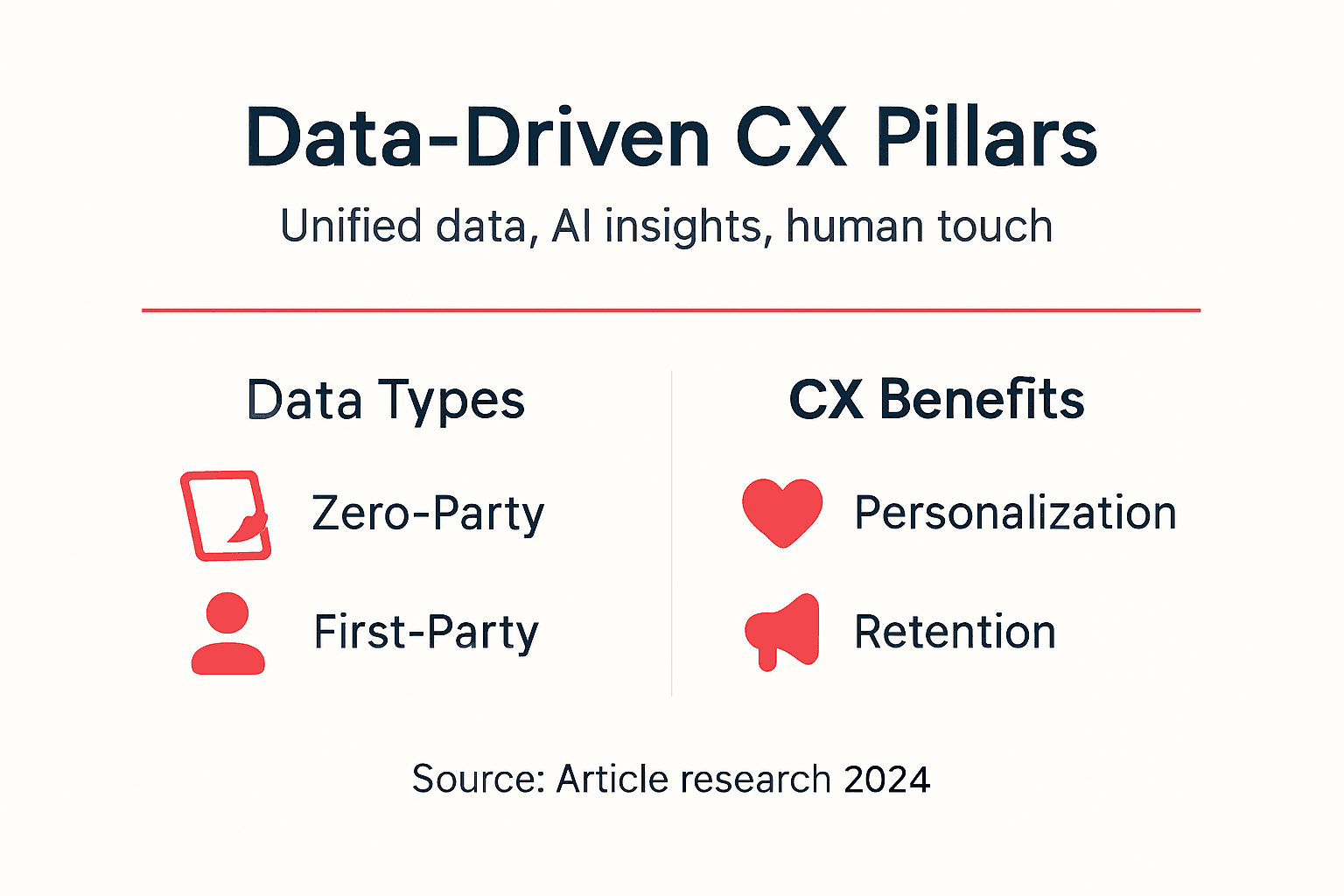
Zero-party data forms the bedrock of hyper-personalization strategies. When customers voluntarily share preferences, interests, and intentions through preference centers or interactive quizzes, you gain explicit permission to tailor experiences precisely. This approach respects privacy while delivering the customization that drives customer loyalty.
A retail organization implemented AI predictive analytics to identify customers at risk of churning based on declining engagement signals. Proactive outreach with personalized offers recovered 40% of at-risk customers and increased average satisfaction scores by 28%. This case demonstrates how predictive models turn data into retention revenue.
Step-by-step implementation sequence:
- Audit existing data sources and identify integration gaps preventing unified customer views
- Select a customer data platform that consolidates identity across channels in real time
- Establish data governance policies ensuring quality, privacy compliance, and ethical use
- Deploy AI models for high-impact use cases like churn prediction or product recommendations
- Train customer-facing teams to leverage AI insights during human interactions
- Measure outcomes against baseline metrics and iterate based on performance data
| Framework Element | Retail Application | Financial Services Application | SaaS Application |
|---|---|---|---|
| Unified Identity | Cross-channel purchase history | Account aggregation across products | Usage tracking across modules |
| AI-Driven Insights | Product recommendations | Fraud detection, spending patterns | Feature adoption predictions |
| Human-Centric Automation | Chatbot FAQs, agent-assisted checkout | Robo-advisors with human escalation | Onboarding bots with CSM handoff |
| Outcome | 35% cart recovery, 22% repeat rate | 18% cross-sell lift, 95% satisfaction | 40% faster time-to-value, 30% retention gain |
These frameworks adapt across industries while maintaining core principles. Following proven CX leadership best practices accelerates implementation and reduces risk.
Conclusion: Transforming Customer Experience Through Data Mastery
Data-driven customer experience is no longer optional. It’s the competitive differentiator separating market leaders from laggards. Organizations that master unified data, AI-powered insights, and human-centric automation unlock measurable gains in retention, satisfaction, and revenue.
The path forward requires balancing technological capability with ethical responsibility. Unified customer data enables the personalization buyers demand, but only when paired with transparent privacy practices and genuine human empathy. AI scales your CX operations, yet humans remain essential for building the trust and connection that drive long-term loyalty.
CX leaders who prioritize data mastery position their organizations for sustainable advantage in increasingly competitive markets. The frameworks, strategies, and insights shared here provide a roadmap from current-state challenges to future-ready customer experience maturity. Your next move determines whether data becomes your strategic asset or missed opportunity.
Unlock CX Growth with Xverse’s Data-Driven Solutions
Ready to transform customer experience from cost center to growth engine? Xverse specializes in unifying customer data, deploying AI-driven insights, and designing human-centric automation strategies that deliver measurable improvements in loyalty and revenue.
Our proven frameworks help organizations overcome disconnected data, privacy challenges, and automation pitfalls. We partner with CX leaders to build capabilities that turn customer insights into competitive advantage. Explore our customer loyalty strategies and AI implementation examples to see how data mastery drives transformational results.
Frequently Asked Questions
How can CX leaders unify fragmented customer data effectively?
Start by auditing all data sources and selecting a customer data platform that consolidates identity across channels in real time. Establish data governance policies ensuring quality, privacy compliance, and clear ownership. Prioritize integrations that connect high-impact touchpoints first, then expand systematically.
What are the key privacy concerns when using AI in CX?
Transparency, consent management, and algorithmic bias top the list. Customers expect clear explanations of data collection and use. AI models trained on biased datasets perpetuate unfair outcomes. Implement consent platforms, diverse training data, and regular fairness audits to build trust.
How does balancing human interaction with automation improve CX outcomes?
Hybrid models optimize both efficiency and empathy. AI handles routine tasks at scale while humans provide creative problem solving and relationship building. This division delivers faster service without sacrificing the personal connection that drives customer satisfaction.
What metrics best measure success in data-driven CX?
Track customer lifetime value, retention rate, Net Promoter Score, and satisfaction scores as primary indicators. Monitor AI deflection rates, average handle time, and first-contact resolution for operational efficiency. Measure consent rates and privacy preference engagement to gauge trust.
Which industries benefit most from AI-powered CX personalization?
Retail, financial services, and SaaS lead adoption due to high transaction volumes and rich behavioral data. However, any industry with recurring customer relationships gains from predictive analytics, automated support, and personalized communications. The key is matching AI capabilities to specific customer journey pain points.