

Companies integrating digital transformation increase satisfaction by up to 30% within a year. Many leaders still view digital transformation as purely technology adoption, missing the strategic interplay of design and data. This guide clarifies how digital transformation genuinely enhances customer experience through integrated frameworks, AI-driven personalization, and cultural alignment, equipping CX leaders with actionable strategies to drive measurable improvements in 2026.
Table of Contents
- Understanding Digital Transformation And Customer Experience
- How Digital Transformation Drives Customer Journey Enhancement
- Common Misconceptions And Pitfalls In Digital Cx Transformation
- Frameworks And Strategic Approaches To Effective Digital Transformation In Cx
- Leveraging Ai And Data-Driven Insights For Enhanced Cx
- Real-World Applications And Case Studies
- Bridging Understanding To Practical Implementation
- Unlock Your Cx Potential With Expert Digital Transformation Leadership
- Frequently Asked Questions
Key takeaways
| Point | Details |
|---|---|
| Digital transformation integrates technology, data, and strategic design | It goes beyond tools to reshape how organizations deliver customer value through coordinated efforts. |
| AI and real-time data enable personalized customer journeys | Predictive analytics and automation create seamless, responsive experiences across all touchpoints. |
| Culture and backend integration are critical to success | Front-end improvements fail without organizational alignment and unified systems supporting them. |
| Structured frameworks prevent common transformation pitfalls | People, process, technology models ensure strategic focus over scattered tech adoption. |
| Measuring CX impact ensures continuous improvement | Tracking satisfaction, retention, and engagement metrics guides iterative enhancements and loyalty growth. |
Understanding digital transformation and customer experience
Digital transformation integrates technology, strategic design, and data analysis to redefine how organizations interact with customers. It’s not about adopting the latest software or launching a mobile app. True transformation involves rethinking processes, culture, and business models to meet evolving customer expectations.
Customer expectations have shifted dramatically. People now demand instant responses, personalized recommendations, and seamless experiences whether they’re browsing online, calling support, or visiting a store. This shift stems from exposure to leaders like Amazon and Netflix, which use sophisticated data and design to anticipate needs.
The interdependence of technology, design, and data creates modern CX excellence. Technology provides the infrastructure and tools. Strategic design shapes customer interactions to feel intuitive and valuable. Data fuels insights that inform both technology deployment and design decisions, creating a feedback loop that continuously improves experiences.
Key elements driving this integration include:
- Real-time analytics platforms that surface customer behavior patterns instantly
- Design thinking methodologies that center solutions around actual user needs
- Cloud infrastructure enabling scalable, flexible customer touchpoints
- Cross-functional collaboration breaking down traditional organizational silos
Recognizing this complexity is essential. Organizations that treat digital transformation as an IT project inevitably struggle. Those that embrace it as a holistic business strategy, with equal attention to people, processes, and technology, gain competitive advantage through superior CX.
How digital transformation drives customer journey enhancement
AI-driven insights enable real-time personalization that increases engagement rates by up to 40%. Artificial intelligence analyzes customer data across touchpoints, identifying patterns that humans would miss. This capability allows organizations to predict what a customer needs before they ask, delivering proactive support and tailored recommendations that feel remarkably intuitive.

Automation plays a vital role in responsiveness and consistency. Chatbots handle routine inquiries instantly, freeing human agents for complex issues. Automated workflows ensure that customer requests trigger appropriate actions across departments without manual handoffs. This reduces response times from hours to minutes while maintaining accuracy.
Unified platforms integrating backend and front-end systems are non-negotiable for seamless multichannel CX. When your e-commerce site, mobile app, call center, and physical stores all access the same customer data in real time, customers experience continuity. They don’t repeat information. Their preferences follow them. This integration requires thoughtful customer journey mapping to identify where disconnects currently exist.
Specific mechanisms enhancing the customer journey include:
- Predictive models that surface relevant products based on browsing history and similar customer behaviors
- Dynamic content that adjusts website layouts and messaging to individual visitor profiles
- Omnichannel orchestration ensuring consistent brand voice and information across every touchpoint
- Real-time inventory and fulfillment visibility preventing disappointing experiences with out-of-stock items
These elements directly improve customer engagement and satisfaction by reducing friction and increasing relevance. When customers feel understood and efficiently served, they return more often and recommend your organization to others. Top AI applications in CX demonstrate how strategic technology deployment creates measurable business value.
Pro Tip: Start with one high-impact customer journey segment rather than attempting enterprise-wide transformation. Perfect the experience for your most valuable customer cohort first, then scale proven approaches to other segments.
Common misconceptions and pitfalls in digital CX transformation
Many leaders believe digital transformation simply means buying new technology. This misconception leads to expensive software implementations that fail to improve CX because processes and culture remain unchanged. Technology is an enabler, not a solution. Without strategic design and organizational alignment, even the best tools deliver disappointing results.
Neglecting organizational culture creates resistance that undermines transformation efforts. Employees accustomed to legacy systems and processes often view digital initiatives as threats rather than opportunities. When leadership fails to communicate vision, provide training, and celebrate early wins, transformation stalls. Incorrect focus on technology over strategy leads to failure in 60% of transformation initiatives.
Prioritizing front-end channels without backend integration creates a polished facade over broken systems. Your mobile app may look beautiful, but if it can’t access real-time inventory data or update customer profiles across systems, it frustrates users. Customers don’t care about your internal technology constraints. They expect every interaction to reflect their complete relationship with your organization.
Common failure points and how to avoid them:
- Launching digital initiatives without clear success metrics, making it impossible to measure impact or justify continued investment
- Underestimating change management needs, assuming employees will naturally embrace new tools and processes
- Treating digital transformation as a one-time project rather than an ongoing evolution requiring continuous iteration
- Ignoring the role of data in customer experience by collecting information but failing to analyze or act on insights
- Copying competitors’ approaches without adapting them to your unique customer needs and organizational capabilities
Avoiding these pitfalls requires viewing digital transformation as a strategic business imperative, not a technical upgrade. It demands executive sponsorship, cross-functional collaboration, and patience to build capabilities over time. Quick wins matter for momentum, but sustainable transformation requires fundamental shifts in how your organization operates.
Pro Tip: Establish a dedicated transformation team with representatives from IT, marketing, operations, and customer service. This cross-functional group should have authority to make decisions and remove obstacles, preventing siloed efforts that create disconnected experiences.
Frameworks and strategic approaches to effective digital transformation in CX
A balanced framework of people, process, and technology greatly increases digital transformation success in CX. The people dimension addresses skills, culture, and change management. Process focuses on workflows, decision-making structures, and how work actually gets done. Technology provides tools and infrastructure enabling new capabilities. Organizations that emphasize one dimension while neglecting others create imbalances that limit transformation impact.
Strategic steps for successful implementation begin with honest assessment of current CX maturity. Where do customer journeys break down today? What capabilities do competitors have that you lack? This diagnostic phase identifies gaps and opportunities, informing roadmap priorities.
Next, create a phased roadmap balancing quick wins with foundational investments. Early victories build momentum and stakeholder confidence. Simultaneously, invest in platform capabilities and data infrastructure that enable more sophisticated initiatives later. Digital transformation frameworks for CX growth provide tested models for sequencing initiatives effectively.
Key strategic elements include:
- Aligning strategic design and technology so technical capabilities directly support desired customer experiences
- Establishing governance structures that balance agility with appropriate oversight and risk management
- Building analytics capabilities to surface actionable insights from growing volumes of customer data
- Fostering partnerships between business units and IT to ensure solutions address actual needs
Measuring success requires tracking metrics that matter to customers and the business. The following table outlines essential KPIs for CX digital transformation:
| Metric Category | Key Indicators | Why It Matters |
|---|---|---|
| Customer Satisfaction | Net Promoter Score (NPS), Customer Satisfaction Score (CSAT) | Direct measures of how customers perceive their experiences |
| Engagement | Session duration, feature adoption rates, repeat visit frequency | Indicates whether digital experiences are compelling and valuable |
| Efficiency | Average handle time, first contact resolution rate | Shows whether automation and better tools improve operational performance |
| Business Impact | Customer lifetime value, retention rate, conversion rate | Connects CX improvements to revenue and profitability |
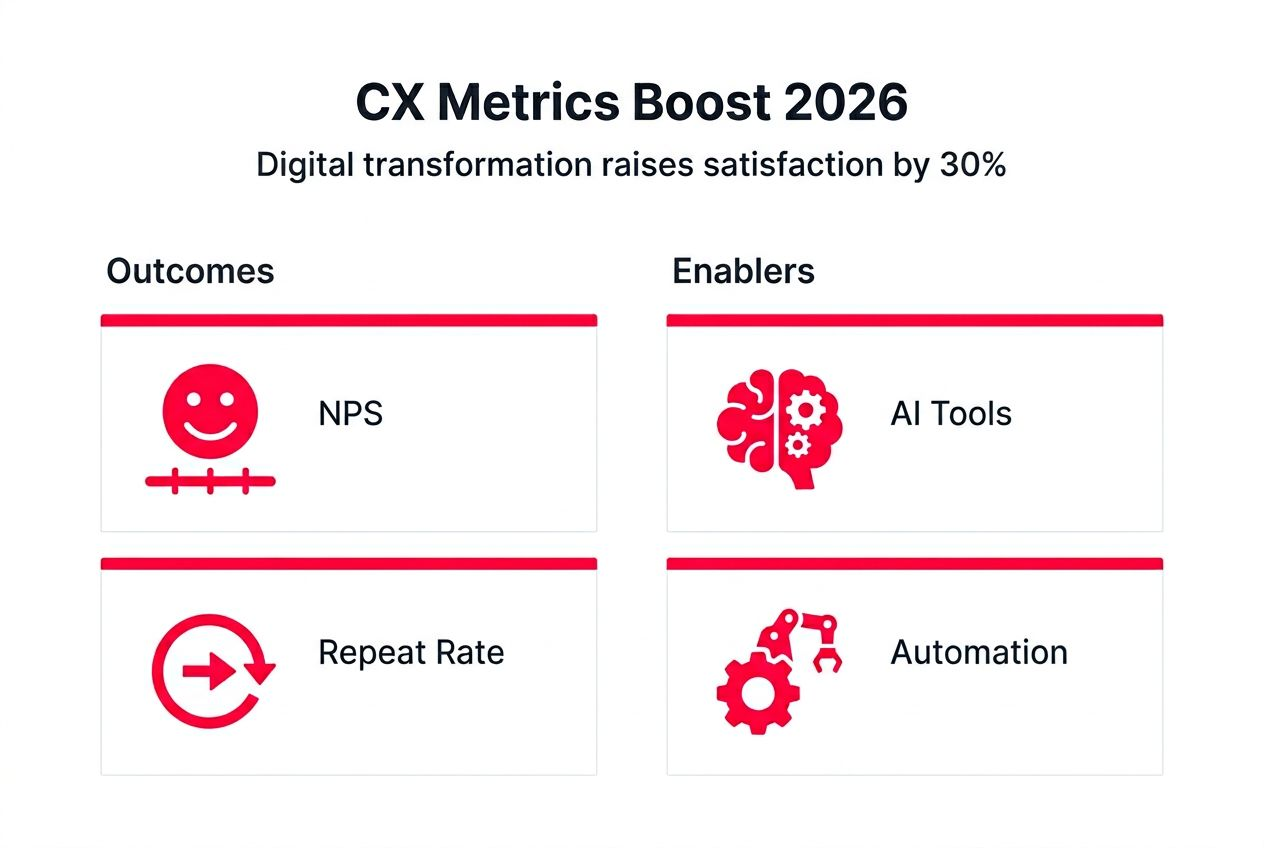
Regularly reviewing these metrics enables data-driven iteration. When NPS drops in a specific customer segment, investigate the root cause. When a new feature drives increased engagement, consider how to expand its application. CX strategy best practices emphasize this continuous improvement cycle as essential for maintaining competitive advantage.
Leveraging AI and data-driven insights for enhanced CX
AI applications for real-time personalization analyze customer behavior as it happens, adjusting experiences instantly. When a visitor browses outdoor gear on your website, AI can surface related products, highlight upcoming sales, and even adjust homepage content on their next visit. This responsiveness makes customers feel understood rather than treated as generic users.
Predictive analytics identify churn risks before customers leave. By analyzing patterns like decreased login frequency, negative support interactions, or abandoned carts, AI flags at-risk accounts for proactive outreach. A personalized offer or check-in call often prevents defection when delivered at the right moment.
AI-powered personalization can reduce customer churn and boost engagement significantly. Retail examples demonstrate this impact clearly. One major retailer implemented AI to analyze purchase history and browsing behavior, creating individualized email campaigns. Open rates increased 35% and conversion jumped 28% compared to generic promotional emails.
Another retailer used AI-driven chatbots to handle size and fit questions, a common pain point in online apparel shopping. The bot asked targeted questions about preferences and past purchases, then recommended sizes with 90% accuracy. Return rates for bot-assisted purchases dropped 22%, directly improving profitability while enhancing customer confidence.
Benefits of continuous AI-driven adjustments to customer journeys include:
- Dynamic pricing that optimizes for both competitiveness and margin based on real-time demand signals
- Personalized content sequencing in email nurture campaigns, adapting to each recipient’s engagement patterns
- Intelligent routing of support inquiries to agents with relevant expertise and availability
- Proactive inventory alerts for customers interested in out-of-stock items when supplies are replenished
These capabilities require robust data foundations. Clean, integrated customer data across systems is essential. AI models are only as good as the information they analyze. Organizations must invest in data infrastructure and governance alongside AI tools.
The most successful implementations start narrow and expand. Choose one high-value use case, perfect the model and integration, then apply learnings to additional scenarios. This approach builds organizational AI literacy while delivering measurable results that justify continued investment. AI in customer experience examples from retail provide inspiration for applications across industries.
Real-world applications and case studies
A national retail chain faced declining NPS and stagnant repeat purchase rates despite investing in e-commerce. Customer research revealed frustration with inconsistent experiences between online and in-store channels. The retailer launched a comprehensive digital transformation initiative integrating inventory systems, implementing unified customer profiles, and training staff on new tools.
Retail case studies demonstrated significant NPS improvement and repeat purchase rate increases after CX digital transformation. Specific results after 18 months included:
| Metric | Before Transformation | After Transformation | Improvement |
|---|---|---|---|
| Net Promoter Score | 32 | 58 | +81% |
| Repeat Purchase Rate | 28% | 41% | +46% |
| Average Order Value | $67 | $89 | +33% |
| Customer Service Cost per Interaction | $8.50 | $5.20 | -39% |
Technology integration delivered these benefits by enabling experiences previously impossible. Customers could check in-store inventory online before visiting. Store associates accessed complete purchase history on tablets, making personalized recommendations. Online orders became returnable at any location with instant refunds.
“The transformation wasn’t about the technology itself. It was about using technology to remove friction and empower our teams to serve customers better. When we aligned our systems, processes, and culture around the customer journey, results followed naturally.”
Key lessons from implementation include starting with customer pain points rather than available technologies. The retailer resisted the temptation to implement every trendy tool, instead focusing on specific journey breakdowns causing dissatisfaction. They also invested heavily in change management, recognizing that store associates needed support to embrace new ways of working.
Another critical insight involved measuring leading indicators, not just lagging outcomes. The team tracked system adoption rates, employee confidence scores, and customer effort metrics weekly. This allowed quick course corrections when adoption lagged in certain regions or customer segments found new features confusing.
These CX leadership best practices demonstrate that digital transformation delivers measurable business value when approached strategically. Success requires patience, investment, and willingness to iterate based on data rather than assumptions.
Bridging understanding to practical implementation
Implementing digital transformation in CX requires deliberate steps moving from strategy to execution. Start by assembling a cross-functional transformation team with representatives from IT, marketing, operations, customer service, and finance. This team needs executive sponsorship and authority to make decisions affecting multiple departments.
Promote culture change through transparent communication about why transformation matters and how it benefits employees, not just customers. Share customer feedback showing current pain points. Celebrate early wins publicly. Provide training that builds confidence with new tools and processes. Organizational culture shifts and cross-functional collaboration are essential for sustaining CX digital transformation success.
Set measurable goals tied to business outcomes, not just activity metrics. Instead of “launch mobile app by Q2,” aim for “increase mobile customer engagement 25% by Q3 through app launch and promotion.” This outcome focus keeps teams oriented toward impact rather than checking boxes.
Sequential steps for practical implementation:
- Conduct baseline customer journey mapping to document current state experiences and identify priority improvement areas
- Define target state experiences describing how transformed journeys will work and feel from the customer perspective
- Identify capability gaps between current and target states across people, process, and technology dimensions
- Prioritize initiatives balancing customer impact, business value, and implementation feasibility
- Build detailed roadmaps with clear owners, timelines, and success metrics for each initiative
- Establish feedback loops collecting customer and employee input throughout implementation to enable rapid iteration
- Create governance structures reviewing progress regularly and making resource allocation decisions based on performance data
Continuous feedback loops are non-negotiable. Use analytics to track how customers respond to changes. Conduct regular testing with real users. Don’t wait for perfect solutions before launching. Ship minimum viable improvements, measure impact, and iterate based on learning.
Leadership plays a critical role in digital CX adoption. Executives must model desired behaviors, using new tools themselves and referencing customer data in decision-making. When leaders demonstrate commitment, middle management and frontline employees follow. Transformation stalls when leadership treats it as an IT project they can delegate and forget.
Pro Tip: Schedule monthly transformation reviews where the team shares wins, challenges, and key metrics with broader stakeholders. This visibility builds organizational momentum and ensures leadership stays engaged. Use these sessions to remove obstacles and celebrate progress, maintaining energy through inevitable rough patches.
Customer experience leadership capabilities are built over time through consistent focus and investment. Organizations that treat digital transformation as a journey rather than a destination develop sustainable competitive advantages that compound as capabilities mature.
Unlock your CX potential with expert digital transformation leadership
Transforming customer experience through digital innovation requires strategy, technology, and organizational alignment working together. Xverse specializes in customer experience leadership that drives measurable results, combining strategic design, AI-driven insights, and proven frameworks to accelerate your transformation journey.
Our customer journey mapping services identify where your experiences break down today and design future-state journeys that delight customers while improving operational efficiency. We partner with CX leaders and digital transformation managers to build capabilities that deliver sustainable competitive advantage. Organizations working with Xverse achieve 37% higher CX success rates through our data-driven, design-led approach to transformation.
Frequently asked questions
What is digital transformation in customer experience?
Digital transformation in CX means integrating technology, data, and strategic design to improve how customers interact with your organization. It focuses on personalizing and streamlining customer journeys across all channels, from initial awareness through post-purchase support. True transformation reshapes processes, culture, and business models rather than simply adding new tools.
How can AI improve customer journey personalization?
AI analyzes customer behavior and preferences in real time, identifying patterns that inform personalized experiences. It enables tailored product recommendations, predicts what customers need before they ask, and automates responses to routine inquiries. This proactive engagement makes customers feel understood while improving efficiency, with some organizations seeing engagement increases up to 40%.
What are common barriers to successful digital CX transformation?
Overemphasis on technology over culture and strategy causes most failures, with 60% of initiatives struggling due to this imbalance. Lack of integration between front-end channels and backend systems creates disconnected experiences that frustrate customers. Insufficient use of real-time data analytics means organizations miss opportunities to iterate and improve based on actual customer behavior.
How do I measure the success of digital transformation in CX?
Use customer satisfaction scores, net promoter score, retention rates, and engagement metrics to assess CX transformation impact. Track operational efficiency improvements like reduced handle times and increased first-contact resolution. Leverage analytics tools to monitor these metrics continuously, enabling data-driven decisions that guide iterative enhancements and ensure investments deliver measurable business value.
Recommended
- Why adopt digital transformation? 37% higher CX success
- Role of Data in CX: 86% Pay More for Superior Service
- 6 Customer Experience Trends 2026 for Tech Leaders – Xverse
- CX Strategy Best Practices 2026: 42% Boost in Loyalty
- Digital Transformation in 2025: A Comprehensive, Step-by-Step Guide – devPulse