

Organizations applying strategic design in CX see up to 30% boost in customer satisfaction. Yet many CX leaders struggle to move beyond surface changes, missing the deeper integration of innovation, data, and business alignment that transforms fragmented touchpoints into cohesive journeys. This guide reveals actionable frameworks combining strategic design principles with data-driven insights to elevate your customer experience maturity and drive measurable business growth in 2026.
Table of Contents
- Understanding Strategic Design In Customer Experience
- Data-Driven Insights In Strategic Design For CX
- Common Misconceptions About Strategic Design In CX
- Frameworks And Models Supporting Strategic Design In CX
- Leadership And Organizational Impact Of Strategic Design
- Technology And AI-Enabled Strategic Design In CX
- Case Studies Illustrating Strategic Design Impact
- Implementing Strategic Design For Business Growth
- Explore Strategic Design Leadership Solutions At Xverse
- Frequently Asked Questions About Strategic Design In CX
Key takeaways
| Point | Details |
|---|---|
| Strategic design definition | Integrates business strategy, customer psychology, and operational capabilities to create coherent, satisfying customer journeys aligned with business goals. |
| Data-driven personalization | Analytics enable predictive adaptations and rapid iteration, improving conversion rates and customer satisfaction through real-time feedback loops. |
| Common misconceptions | Strategic design extends far beyond aesthetics, requiring multidisciplinary collaboration and leadership commitment to operationalize successfully. |
| Leadership’s critical role | Executive sponsorship drives cross-functional collaboration and capability building, boosting CX maturity and measurable outcomes like NPS improvements. |
| Technology acceleration | AI and emerging tools speed decision-making, enhance personalization, and enable dynamic CX adaptation across customer touchpoints. |
Understanding strategic design in customer experience
Strategic design represents far more than visual appeal or interface polish. It’s a comprehensive approach that aligns customer needs with business objectives, creating experiences that feel intentional and satisfying at every touchpoint. Strategic design integrates business strategy, customer psychology, and operational capabilities to enhance CX coherence and satisfaction.
This multidisciplinary practice draws from design thinking, behavioral psychology, operational excellence, and technology innovation. When executed well, it transforms disjointed customer interactions into fluid journeys that build loyalty while driving revenue. The difference between companies that thrive and those that struggle often comes down to whether CX feels like an afterthought or a strategic asset.
Successful implementation requires specific prerequisites. Leadership must commit resources and champion cultural change. Teams need access to robust data platforms that reveal customer behavior patterns. Organizations should establish cross-functional collaboration frameworks that break down silos between marketing, operations, product, and service teams.
Pro Tip: Start with journey mapping workshops that bring together frontline staff, designers, data analysts, and executives to identify friction points and opportunities where strategic design can deliver quick wins while building momentum for larger transformations.
Key elements supporting strategic design maturity include:
- Customer research methodologies that uncover latent needs and emotional drivers
- Design systems ensuring consistency across all touchpoints and channels
- Measurement frameworks connecting CX improvements to business KPIs
- Governance structures clarifying decision rights and accountability
- Continuous learning loops enabling rapid iteration based on performance data
By grounding design decisions in customer experience leadership principles and business strategy, organizations create experiences that customers value and that deliver measurable financial returns.
Data-driven insights in strategic design for CX
Customer data analytics serve as the foundation enabling strategic design to move from guesswork to precision. When you understand behavioral patterns, preference signals, and pain points through data, design decisions become targeted interventions rather than hopeful experiments. Analytics reveal which journey stages create friction, which features drive engagement, and which segments require different approaches.

Personalization stands out as the most visible benefit of integrating data with design. By analyzing interaction history, purchase patterns, and contextual signals, you can tailor experiences to individual needs at scale. This goes beyond inserting someone’s name in an email. It means presenting relevant content, adjusting interface complexity based on expertise level, and predicting next-best actions that genuinely help customers achieve their goals.
Predictive analytics take this further by enabling proactive adaptations. Machine learning models identify customers likely to churn, products that will interest specific segments, and optimal timing for interventions. This foresight allows you to design experiences that anticipate needs before customers articulate them, creating moments of delight that build lasting loyalty.
Conversion rate optimization becomes systematic when data guides iterative testing. A/B tests, multivariate experiments, and behavioral analytics reveal which design variations perform best. Real-time feedback loops allow rapid refinement, compressing what once took months into weeks or days. The role of data in customer experience demonstrates how analytics significantly improve personalization and predictive outcomes.
Pro Tip: Establish data governance early to ensure customer information flows securely across systems while maintaining privacy compliance, enabling your design teams to access insights without compromising trust.
Essential data capabilities supporting strategic design include:
- Customer data platforms unifying information from all touchpoints
- Behavioral analytics tracking micro-interactions and journey progression
- Sentiment analysis extracting emotional signals from feedback and conversations
- Predictive modeling forecasting future behaviors and preferences
- Real-time dashboards surfacing actionable insights to design and product teams
When data and design work together, you create experiences grounded in customer reality rather than internal assumptions, dramatically improving both satisfaction and business outcomes.
Common misconceptions about strategic design in CX
Many organizations stumble because they misunderstand what strategic design actually entails. The most persistent myth equates it with visual aesthetics, assuming prettier interfaces automatically improve experience. While visual design matters, strategic design addresses the entire system of interactions, processes, and emotional connections that shape customer perception.
Another misconception minimizes the organizational complexity required for successful adoption. Leaders sometimes expect design teams to implement strategic CX improvements without cross-functional authority, adequate data access, or executive sponsorship. Only about 35% of CX projects fully integrate strategic design due to complex operationalization challenges.
Some executives underestimate data’s role, viewing analytics as a nice-to-have rather than a core enabler. They approve design initiatives based on intuition or copying competitors, missing opportunities to ground decisions in customer behavior insights. This approach leads to solutions that look innovative but fail to address actual pain points.
Organizational silos create another barrier. Marketing owns brand experience, IT controls digital platforms, operations manages service delivery, and product development builds features. Without integration, strategic design fragments into disconnected initiatives that create inconsistent customer experiences despite individual excellence.
The belief that strategic design delivers instant results also hampers adoption. Transforming CX maturity requires sustained effort, cultural change, and iterative refinement. Quick wins matter for building momentum, but lasting impact comes from systematic capability building across the organization.
Common pitfalls and their solutions:
- Treating design as a siloed function instead of a cross-functional discipline requiring collaboration
- Launching initiatives without executive sponsorship, leading to resource constraints and political obstacles
- Skipping customer research and relying on assumptions about needs and preferences
- Failing to connect CX improvements to business metrics, making ROI invisible to finance leaders
- Neglecting employee experience, forgetting that frontline staff deliver the designed experiences
By recognizing these misconceptions early, you can structure initiatives following CX strategy best practices 2026 that overcome barriers and build sustainable CX excellence.
Frameworks and models supporting strategic design in CX
Structured frameworks organize strategic design thinking and guide implementation across complex organizations. The empathy-driven iterative design model provides a proven approach. It starts with deep customer research to understand needs, emotions, and contexts. Teams then ideate solutions, prototype rapidly, test with real users, and refine based on feedback. This cycle repeats, progressively improving experiences while building organizational learning.
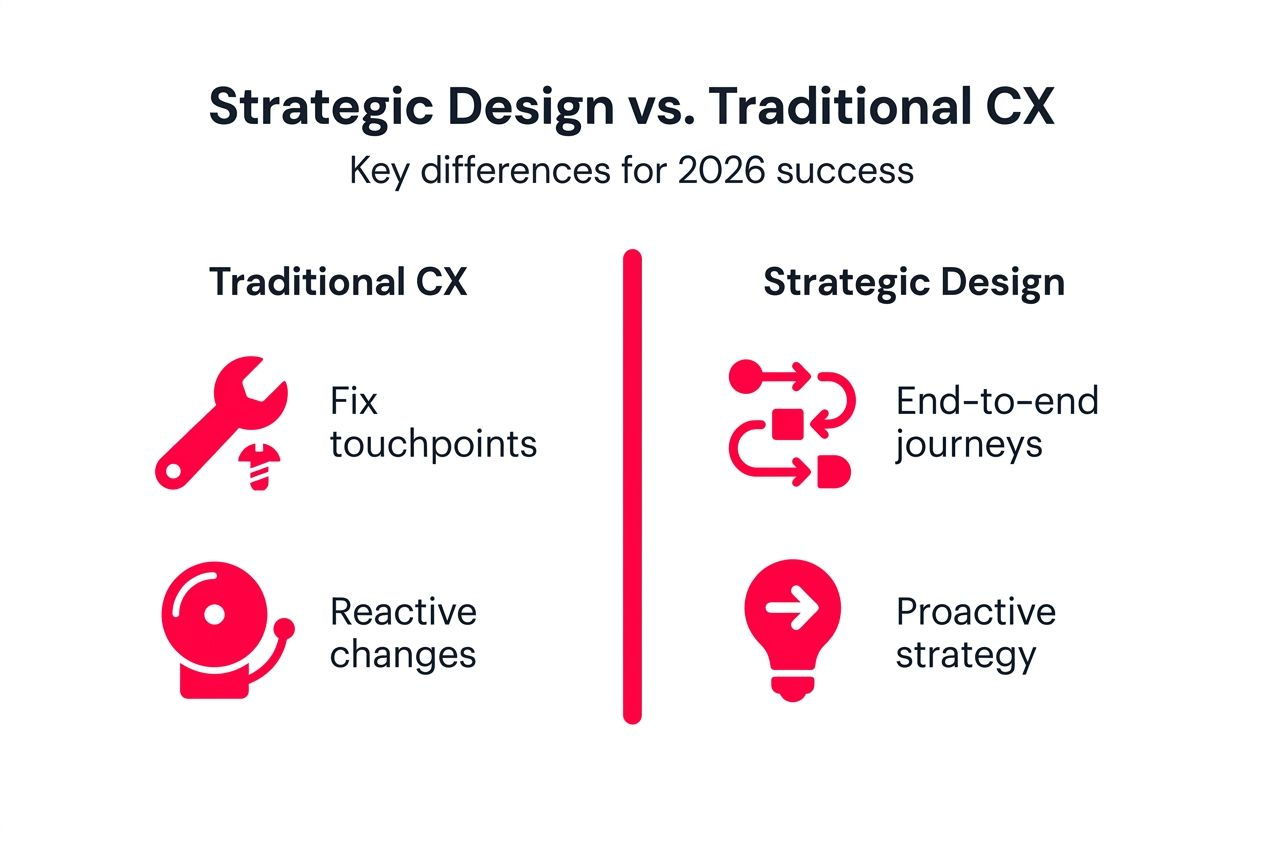
Comparing strategic design with traditional CX approaches clarifies the distinctions:
| Dimension | Traditional CX | Strategic Design in CX |
|---|---|---|
| Focus | Fixing problems reactively | Proactively shaping journeys |
| Data use | Surveys and complaints | Behavioral analytics and predictive models |
| Organizational scope | Department-specific initiatives | Cross-functional integration |
| Time horizon | Quarterly improvements | Long-term capability building |
| Success metrics | CSAT and NPS scores | Business KPIs plus experience metrics |
Strategic design frameworks integrate both emotional and operational dimensions. They consider how customers feel at each touchpoint while ensuring backend processes support seamless delivery. This dual focus prevents the disconnect where beautifully designed front-end experiences collapse due to operational failures.
Scalability and flexibility distinguish effective frameworks. They provide enough structure to ensure consistency while allowing adaptation to different business units, customer segments, and markets. Cookie-cutter approaches fail because customer needs and organizational capabilities vary significantly across contexts.
Pro Tip: Select frameworks aligned with your organizational maturity level rather than copying what works for industry leaders, ensuring your teams can actually execute the methodology with existing capabilities while building toward more sophisticated approaches.
Key framework components include:
- Research methods uncovering customer jobs-to-be-done and emotional needs
- Journey mapping techniques visualizing current state and desired future experiences
- Ideation processes generating innovative solutions grounded in insights
- Prototyping approaches enabling rapid testing before full implementation
- Measurement systems tracking both experience quality and business impact
Frameworks like these, detailed in CX strategy best practices 2026, help teams move systematically from insights to action. They also support customer journey innovation by providing structured methods for identifying and implementing breakthrough improvements.
Leadership and organizational impact of strategic design
Executive sponsorship determines whether strategic design initiatives thrive or languish. When leaders actively champion CX transformation, allocate sufficient resources, and hold teams accountable for outcomes, organizations achieve significantly better results. Leadership involvement boosts cross-functional collaboration in CX by 50%, breaking down silos that fragment customer experiences.
Leadership’s role extends beyond approving budgets. Executives must articulate clear vision connecting CX excellence to business strategy, helping teams understand how their design work drives competitive advantage. They set cultural tone, modeling customer-centric decision-making and celebrating wins that demonstrate strategic design’s value.
Cross-functional collaboration flourishes when leaders establish governance structures clarifying how teams work together. This includes decision rights for experience design, data sharing protocols, and escalation paths for resolving conflicts. Without this clarity, initiatives stall as departments protect turf rather than solving customer problems.
Capability building represents another critical leadership contribution. Investing in training, tools, and external expertise develops internal competencies that sustain CX excellence beyond any single initiative. Organizations that view strategic design as a capability to develop rather than a project to complete achieve lasting transformation.
Measurable business outcomes validate leadership’s investment. Companies with strong executive CX sponsorship report higher NPS scores, improved customer retention, and increased lifetime value. These metrics directly impact revenue and profitability, making the business case for continued strategic design investment clear to boards and shareholders.
Leadership best practices include:
- Establishing CX as a board-level priority with regular reporting and accountability
- Creating cross-functional steering committees that align design initiatives with business goals
- Investing in customer research and data capabilities that inform strategic decisions
- Recognizing and rewarding teams that deliver measurable CX and business improvements
- Building partnerships with firms offering CX strategy for customer loyalty expertise
By following CX leadership best practices, executives transform strategic design from a tactical activity into a strategic capability that differentiates their organizations in competitive markets.
Technology and AI-enabled strategic design in CX
Artificial intelligence and emerging technologies dramatically accelerate strategic design capabilities. AI-powered analytics process vast behavioral datasets, surfacing patterns human analysts would miss. Machine learning models predict customer needs, optimize journey flows, and personalize experiences at scale impossible through manual effort.
AI-driven personalization engines analyze real-time signals like browsing behavior, purchase history, and contextual factors to deliver tailored content, recommendations, and interfaces. In retail, these systems match products to individual preferences while optimizing inventory and pricing. AI-driven decision making speeds up strategic design and enhances CX innovation across industries.
Predictive analytics powered by AI forecast customer behaviors, enabling proactive interventions. Models identify churn risk before customers disengage, surface upsell opportunities at optimal moments, and predict support needs before issues escalate. This foresight transforms reactive service into proactive care that strengthens relationships.
Technology integration accelerates time-to-market for CX innovations. Rapid prototyping tools, automated testing platforms, and continuous deployment pipelines compress design-build-launch cycles. What once required months now happens in weeks, allowing organizations to iterate faster and stay ahead of evolving customer expectations.
Pro Tip: Evaluate AI tools based on integration capabilities with your existing data infrastructure and design workflows rather than chasing the newest technology, ensuring investments deliver practical value instead of creating technical debt.
Emerging technologies supporting strategic design include:
- Natural language processing analyzing customer conversations for sentiment and intent
- Computer vision personalizing visual experiences based on user preferences and contexts
- Recommendation engines suggesting next-best actions across customer journeys
- Chatbots and virtual assistants providing 24/7 support with human-like understanding
- Marketing automation platforms orchestrating personalized omnichannel experiences
Exploring AI in customer experience examples retail reveals practical applications across sectors. Staying current with customer experience trends 2026 ensures your technology strategy aligns with evolving capabilities and customer expectations.
Case studies illustrating strategic design impact
A major financial services firm implemented strategic design principles to overhaul digital banking experiences. By integrating behavioral analytics with empathy-driven design research, they redesigned account opening, loan applications, and service interactions. Strategic design initiatives led to 40% NPS improvement and measurable business growth within 18 months.
The initiative connected experience improvements directly to business metrics. Simplified application processes reduced abandonment rates by 28%. Personalized financial guidance increased product adoption by 35%. Proactive service notifications cut support call volume by 22% while improving satisfaction scores. These outcomes demonstrated clear ROI, securing continued executive sponsorship.
Operational challenges emerged during implementation. Legacy systems limited real-time personalization capabilities. Organizational silos created inconsistent experiences across channels. Compliance requirements constrained certain design innovations. The team overcame these barriers through phased rollouts, incremental integration, and cross-functional working groups that balanced innovation with risk management.
Lessons learned emphasized starting with high-impact, lower-complexity opportunities. Quick wins built credibility and funding for more ambitious transformations. Engaging frontline employees early surfaced practical insights that pure customer research missed. Establishing clear governance prevented scope creep while maintaining strategic focus.
Key success factors included:
- Executive sponsorship providing resources and removing organizational obstacles
- Customer research combining quantitative analytics with qualitative empathy interviews
- Cross-functional teams breaking down silos between digital, operations, and marketing
- Iterative approach delivering incremental value while building toward comprehensive transformation
- Measurement frameworks tracking both experience metrics and business KPIs
Examples like these, detailed in CX leadership success stories, demonstrate that strategic design delivers tangible business results when implemented systematically with strong leadership backing.
Implementing strategic design for business growth
Successful implementation follows a structured sequence. Begin with current-state assessment, analyzing existing customer journeys, identifying pain points, and benchmarking experience quality against competitors. This diagnostic phase reveals opportunities where strategic design investments will deliver maximum impact.
Next, define future-state vision aligned with business goals. What experiences will differentiate your brand? Which customer segments deserve prioritization? How will improved CX drive revenue, reduce costs, or strengthen competitive position? Clear answers guide design decisions and resource allocation.
Develop prototypes and test with real customers before full-scale implementation. Rapid experimentation reduces risk by validating assumptions early. Iterative refinement based on user feedback ensures solutions actually solve customer problems rather than reflecting internal preferences.
Implementation requires cross-functional coordination. Marketing, IT, operations, and customer service must align on experience standards, data sharing, and accountability. Change management processes help employees understand new approaches and develop required skills.
Measure impact through both CX and business KPIs. Track NPS, customer effort scores, and satisfaction alongside conversion rates, revenue per customer, retention, and lifetime value. Aligning strategic design initiatives with business goals ensures significant CX and financial performance improvements.
Pro Tip: Establish continuous improvement processes where data feedback automatically triggers design reviews, creating self-reinforcing cycles that progressively enhance experiences without requiring manual intervention for every optimization.
Implementation steps include:
- Conduct comprehensive journey mapping and pain point analysis
- Prioritize opportunities based on customer impact and business value
- Build cross-functional teams with clear roles and decision authority
- Develop and test prototypes with customer panels before scaling
- Deploy in phases, learning and refining based on performance data
- Measure outcomes against predetermined KPIs and business objectives
- Scale successful initiatives while sunsetting approaches that underperform
Common pitfalls include scope creep, inadequate executive sponsorship, insufficient data infrastructure, and weak change management. Address these proactively by maintaining strategic focus, securing leadership commitment, investing in enabling technologies, and supporting employees through transitions.
Resources like difference between UX and CX clarify how strategic design integrates both disciplines. Understanding digital transformation CX success factors helps avoid common mistakes that derail implementation efforts.
Explore strategic design leadership solutions at Xverse
Transforming customer experience through strategic design requires specialized expertise and proven methodologies. Xverse partners with organizations seeking to elevate CX maturity by combining leadership coaching, data-driven insights, and actionable frameworks tailored to your business context.
Our customer experience leadership services help executives build capabilities that sustain CX excellence. We provide strategic guidance aligning design initiatives with business goals, ensuring investments deliver measurable returns. Through customer journey mapping, we identify opportunities where targeted improvements create competitive advantage.
Xverse brings deep expertise driving the kind of measurable outcomes detailed throughout this guide. Whether you’re beginning your strategic design journey or scaling existing capabilities, we offer customized solutions addressing your specific challenges. Explore how our approach to CX strategy customer loyalty can accelerate your transformation and deliver business growth in 2026.
Frequently asked questions about strategic design in CX
What differentiates strategic design from traditional CX approaches?
Strategic design proactively shapes entire customer journeys by integrating business strategy, behavioral insights, and operational capabilities, while traditional CX often reacts to problems through department-specific fixes. It uses predictive analytics and cross-functional collaboration to create coherent experiences aligned with business goals, whereas traditional approaches typically rely on surveys and siloed improvements.
How can leadership foster strategic design in large organizations?
Executives should establish CX as a board-level priority with clear governance structures, cross-functional steering committees, and accountability for measurable outcomes. Investing in customer research capabilities, data platforms, and employee training builds sustainable competencies. Modeling customer-centric decision-making and celebrating wins that demonstrate business impact creates cultural momentum for strategic design adoption.
What role does AI specifically play in modern CX design?
AI powers personalization engines that tailor experiences to individual preferences at scale, analyzes behavioral data to surface patterns human analysts miss, and predicts customer needs enabling proactive interventions. Machine learning optimizes journey flows, automates testing, and accelerates time-to-market for CX innovations. Natural language processing and computer vision create more intuitive, responsive interfaces across digital touchpoints.
How do you measure ROI on strategic design investments?
Track both experience metrics like NPS, customer effort scores, and satisfaction alongside business KPIs including conversion rates, revenue per customer, retention, and lifetime value. Establish baseline measurements before initiatives, then monitor changes attributable to design improvements. Connect CX gains to financial outcomes through attribution modeling, demonstrating how experience enhancements drive measurable business growth and competitive advantage.
What are early signs of successful strategic design adoption?
Increased cross-functional collaboration on customer initiatives, leadership actively championing CX in strategic decisions, and teams using data insights to guide design choices indicate positive momentum. Quick wins delivering measurable improvements in specific journey stages build credibility. Growing employee engagement with customer-centric processes and expanding investment in research and analytics capabilities signal maturing strategic design practice.