

Most organizations believe they deliver personalized experiences, yet 71% of customers expect personalization and 76% feel frustrated when it’s absent. This disconnect reveals a fundamental gap between intent and execution. Personalized customer experience isn’t about adding names to emails or recommending products based on browsing history alone. It’s a strategic discipline combining data infrastructure, AI decisioning, and human oversight to deliver relevant interactions at scale. This guide defines what personalized customer experience truly means in 2026, explores the technologies powering it, examines the balance between benefits and risks, and provides actionable steps for CX leaders to implement personalization that drives measurable growth.
Table of Contents
- Defining Personalized Customer Experience And Why It Matters In 2026
- Core Mechanics And Technologies Powering Personalized Customer Experiences
- Balancing Benefits And Risks Of Personalization: Trust, Privacy, And Effectiveness
- Strategic Application: Implementing Personalized Experiences To Drive Growth
- Enhance Your Personalized Customer Experience With Xverse
- Frequently Asked Questions
Key takeaways
| Point | Details |
|---|---|
| Definition and evolution | Personalized customer experience uses individual data to tailor interactions across touchpoints, evolving toward AI-driven hyper-personalization in 2026. |
| Core technologies | Zero-party data, first-party data, AI/ML predictive analytics, recommendation engines, and real-time decisioning enable scalable personalization. |
| Benefits and risks | Increases loyalty and customer lifetime value but risks trust erosion if transparency and privacy safeguards are inadequate. |
| Strategic implementation | Requires assessing CX maturity, building data infrastructure, mapping journeys, establishing governance, and measuring impact with CLV metrics. |
| Human oversight essential | AI enables personalization at scale but human judgment prevents bias, maintains ethical standards, and builds customer trust. |
Defining personalized customer experience and why it matters in 2026
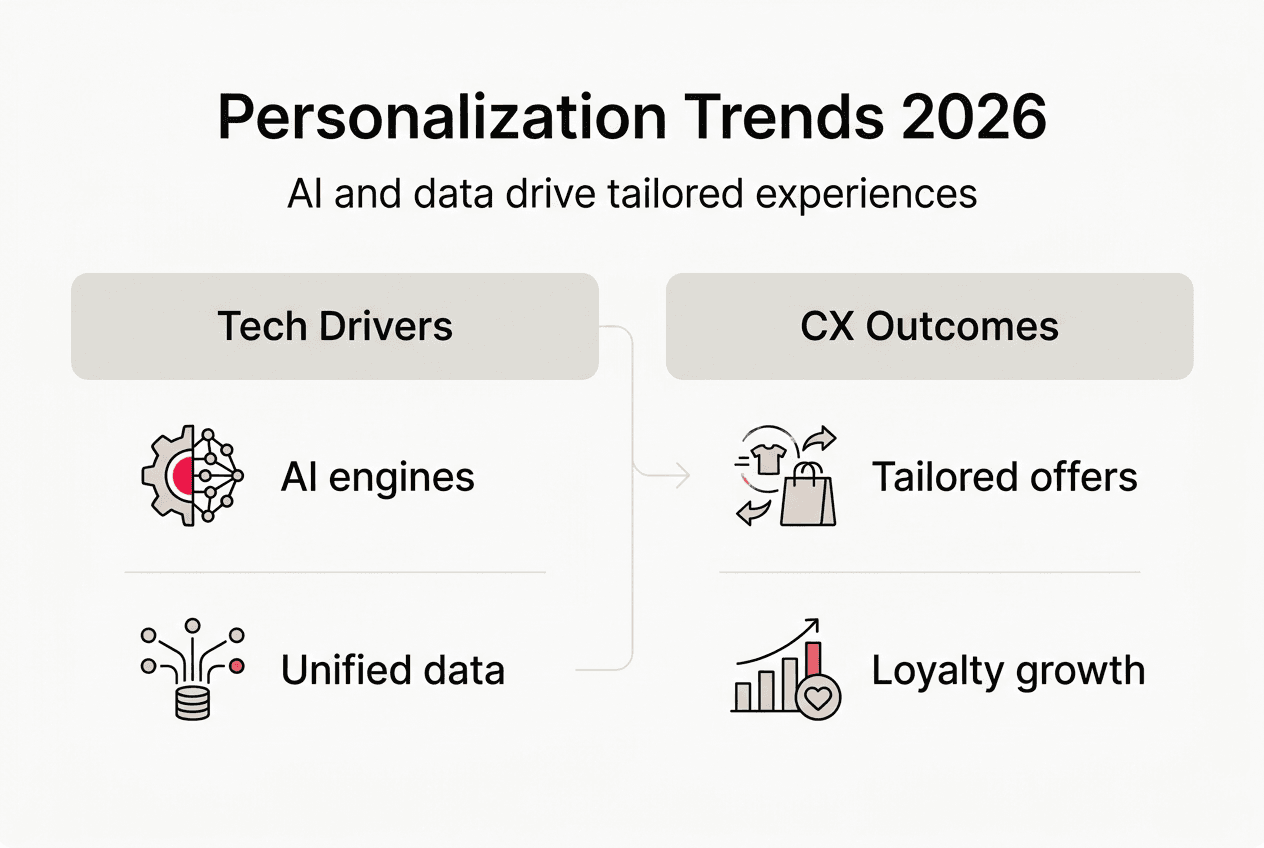
Personalized customer experience uses customer data to deliver tailored interactions that evolve based on individual preferences, behaviors, and context across the entire journey. This isn’t static segmentation. It’s dynamic adaptation powered by real-time signals and predictive models. In 2026, personalization has shifted from a competitive differentiator to table stakes, with customers expecting brands to understand their needs before they articulate them.

The business case is compelling. Organizations implementing hyper-personalization achieve 40% higher customer lifetime value compared to those relying on basic segmentation. This uplift stems from increased purchase frequency, higher average order values, and reduced churn. Yet only a fraction of companies execute personalization effectively, creating significant opportunity for customer experience leadership that bridges strategy with operational excellence.
AI has transformed personalization from batch processing to real-time decisioning. Natural language processing interprets customer intent from conversational inputs. Predictive analytics forecast next-best actions based on behavioral patterns. Recommendation engines surface relevant content, products, or services at precisely the right moment. These technologies enable organizations to move beyond demographic targeting toward individualized experiences that adapt as customer contexts change.
“Personalization is not about first and last names. It’s about relevant content delivered at the right time through the right channel based on individual behavior and preferences.”
The shift toward hyper-personalization reflects broader customer experience trends 2026 where AI, data integration, and omnichannel orchestration converge. Customers interact with brands across web, mobile, social, physical stores, and contact centers. Effective personalization maintains context and continuity across these touchpoints, creating seamless experiences that feel intuitive rather than disjointed.
Pro Tip: Start with high-value customer segments where personalization impact is measurable, then expand systematically rather than attempting enterprise-wide rollouts that strain resources and dilute focus.
The expectation for personalization extends beyond marketing. Customers want personalized service interactions, product recommendations, content curation, and even pricing in some contexts. This breadth requires cross-functional alignment between marketing, sales, service, product, and technology teams. Organizations treating personalization as a marketing initiative miss opportunities to differentiate through service excellence and product innovation informed by individual customer insights.
Core mechanics and technologies powering personalized customer experiences
Effective personalization starts with data. Zero-party data, information customers intentionally share through preference centers or surveys, provides explicit signals about interests and needs. First-party data, behavioral information collected through direct interactions, reveals implicit preferences through actions rather than stated intentions. Together, these data types form the foundation for understanding the role of data in CX and enabling accurate personalization.
AI and machine learning transform raw data into actionable insights. Predictive analytics identify patterns indicating purchase intent, churn risk, or service needs before customers explicitly request assistance. Natural language processing interprets sentiment and intent from text or voice interactions, enabling conversational AI to deliver personalized responses. Computer vision analyzes visual content preferences, particularly relevant for retail and media applications. These AI applications in CX operate continuously, learning from each interaction to refine future predictions.
Recommendation engines apply collaborative filtering, content-based filtering, or hybrid approaches to surface relevant options. Collaborative filtering identifies patterns across similar customer cohorts, suggesting items based on what comparable users preferred. Content-based filtering analyzes attributes of items a customer engaged with previously, recommending similar options. Hybrid models combine both approaches, balancing novelty with relevance to avoid filter bubbles while maintaining personalization accuracy.
| Technology | Primary Function | Personalization Benefit |
|---|---|---|
| Zero-party data | Explicit preference capture | Accurate intent understanding without inference |
| First-party data | Behavioral signal collection | Implicit preference identification through actions |
| Predictive analytics | Future behavior forecasting | Proactive personalization before explicit requests |
| Recommendation engines | Relevant option surfacing | Reduced search friction and discovery enhancement |
| Real-time decisioning | Moment-specific offer delivery | Context-appropriate interactions at scale |
Real-time decisioning platforms evaluate multiple signals simultaneously, selecting optimal actions within milliseconds. When a customer visits a website, the platform considers browsing history, purchase patterns, current context, inventory availability, and business rules to determine which content, offers, or recommendations to display. This orchestration happens invisibly, creating experiences that feel intuitive while optimizing for both customer value and business objectives.
Omnichannel orchestration ensures personalization consistency across touchpoints. A customer researching products on mobile should see relevant recommendations when visiting a physical store or contacting customer service. Achieving this requires unified customer data platforms that aggregate signals across channels and decisioning engines that maintain context as customers move between touchpoints. Organizations with fragmented systems struggle to deliver coherent personalized experiences, creating frustration rather than delight.
Pro Tip: Invest in data quality and integration before scaling personalization technology, as poor data foundations amplify errors and erode customer trust faster than basic experiences.
The technology stack supporting personalization includes customer data platforms for identity resolution and profile unification, marketing automation for campaign execution, analytics platforms for performance measurement, and AI/ML tools for predictive modeling. AI in customer experience examples demonstrate how these components work together, particularly in retail contexts where personalization directly impacts conversion and loyalty.
Balancing benefits and risks of personalization: trust, privacy, and effectiveness
Personalization delivers measurable business value when executed thoughtfully. Organizations report increased customer loyalty as personalized experiences demonstrate understanding and relevance. Higher customer lifetime value results from increased purchase frequency and basket sizes when recommendations align with genuine needs. Competitive advantage emerges as superior personalization becomes difficult to replicate without equivalent data assets and technological capabilities. These benefits explain why CX strategy customer loyalty increasingly emphasizes personalization as a core pillar.
Yet personalization carries risks that CX leaders must manage proactively. Trust erosion occurs when personalization feels invasive, crossing boundaries customers perceive as private or using data in ways that feel manipulative. The line between helpful and creepy varies by individual and context, making universal rules insufficient. Organizations must establish frameworks for evaluating personalization appropriateness that consider customer expectations, cultural norms, and ethical implications beyond legal compliance.
Privacy concerns mediate the relationship between personalization and trust. Customers increasingly understand that personalization requires data, but they expect transparency about what’s collected, how it’s used, and who has access. Opaque data practices, even when legally compliant, damage trust and trigger defensive behaviors like providing false information or abandoning relationships entirely. Transparency builds confidence, while control mechanisms like preference centers and data deletion options demonstrate respect for customer autonomy.
“The most effective personalization strategies balance relevance with respect, using data to serve customer needs rather than manipulate behavior.”
Not every interaction requires personalization. Sometimes customers prefer efficiency over customization, particularly for routine transactions or when exploring options without commitment. Over-personalization can feel constraining, limiting discovery of new interests or creating filter bubbles that reinforce existing preferences without introducing novelty. Strategic personalization identifies moments where customization adds genuine value rather than applying it universally as a default approach.
Human oversight remains essential despite AI capabilities. Algorithms optimize for patterns in historical data, potentially perpetuating biases or missing contextual nuances that humans recognize intuitively. Regular audits of personalization outputs identify unintended consequences like discriminatory recommendations or tone-deaf messaging during sensitive situations. CX strategy best practices emphasize governance structures that combine AI efficiency with human judgment for ethical personalization.
The balance between personalization benefits and risks requires ongoing calibration. Customer expectations evolve as personalization becomes ubiquitous, raising bars for relevance while heightening sensitivity to privacy. Regulatory environments shift, imposing new requirements for consent, transparency, and data handling. Organizations treating personalization as a static implementation rather than dynamic capability find themselves misaligned with customer expectations and exposed to trust erosion that undermines the value personalization was meant to create.
Strategic application: implementing personalized experiences to drive growth
Implementing personalized customer experience requires systematic progression through capability-building stages. This approach manages complexity while demonstrating value incrementally, building organizational confidence and stakeholder support for sustained investment.
-
Assess current CX maturity and personalization capabilities. Evaluate existing data infrastructure, technology platforms, organizational skills, and governance frameworks. Identify gaps between current state and requirements for effective personalization. This assessment informs realistic roadmaps and investment priorities aligned with customer experience leadership strategic objectives.
-
Build or enhance data infrastructure with zero and first-party data collection. Implement customer data platforms that unify identities across touchpoints and create comprehensive profiles. Establish data collection mechanisms that respect privacy while capturing signals necessary for personalization. Focus on data quality, ensuring accuracy, completeness, and timeliness that enable reliable decisioning.
-
Integrate AI and ML tools for predictive analytics and real-time personalization. Deploy recommendation engines, predictive models, and decisioning platforms that operationalize data for customer-facing applications. Start with use cases offering clear value and measurable outcomes, expanding as capabilities mature and organizational confidence grows.
-
Map customer journeys to identify high-impact personalization moments. Use customer journey mapping to pinpoint interactions where personalization significantly improves outcomes. Prioritize moments with high customer frustration, decision complexity, or business value. Not every touchpoint requires equal personalization investment.
-
Establish governance for transparency, privacy, and human oversight. Create policies defining acceptable personalization practices, data usage boundaries, and approval processes for new applications. Implement transparency mechanisms that inform customers about data usage. Build audit processes ensuring personalization aligns with ethical standards and brand values.
-
Measure impact with key metrics like CLV uplift and loyalty gains. Define success metrics before implementation, establishing baselines and targets. Track customer lifetime value, retention rates, satisfaction scores, and engagement metrics. Use controlled testing to isolate personalization impact from other variables, building evidence-based understanding of what works.
| Metric | Non-Personalized Baseline | Personalized Performance | Typical Uplift |
| — | — | — |
| Customer Lifetime Value | $1,200 | $1,680 | 40% |
| Repeat Purchase Rate | 22% | 31% | 41% |
| Average Order Value | $85 | $102 | 20% |
| Customer Satisfaction Score | 7.2/10 | 8.4/10 | 17% |
Pro Tip: Launch personalization pilots in controlled environments with clear success criteria and exit strategies, learning quickly while limiting risk exposure before scaling enterprise-wide.
Successful implementation requires cross-functional collaboration. Marketing provides customer insights and campaign execution. Technology builds infrastructure and integrates systems. Product incorporates personalization into core offerings. Service leverages personalization for proactive support. Legal and compliance ensure regulatory adherence. This coordination demands executive sponsorship and governance structures that align incentives across functions.
AI readiness in CX determines implementation velocity and effectiveness. Organizations with mature data practices, integrated technology stacks, and AI-literate teams progress faster than those building foundational capabilities simultaneously with personalization initiatives. Honest assessment of readiness informs realistic timelines and resource requirements, preventing overcommitment that leads to failed implementations and organizational skepticism about personalization value.
Enhance your personalized customer experience with Xverse
Navigating personalized customer experience complexity requires expertise spanning strategy, technology, and organizational change. Xverse partners with medium to large organizations to accelerate personalization initiatives while managing risks that undermine customer trust.
Our customer experience leadership services help you define personalization strategies aligned with business objectives and customer expectations. We provide customer journey mapping that identifies high-impact personalization opportunities and guides implementation priorities. Our AI readiness assessments evaluate your technology infrastructure, data maturity, and organizational capabilities, creating roadmaps that build personalization capabilities systematically. Partnering with Xverse means accessing proven frameworks, avoiding common pitfalls, and realizing personalization value faster while maintaining the trust that makes customer relationships sustainable.
Frequently asked questions
What is personalized customer experience?
Personalized customer experience tailors interactions to individual preferences, behaviors, and contexts using data and AI to deliver relevant content, recommendations, and services across touchpoints. It goes beyond segmentation to treat each customer as unique, adapting in real time as their needs evolve.
How does AI enable personalized customer experiences?
AI analyzes behavioral patterns to predict customer needs, powers recommendation engines that surface relevant options, and enables real-time decisioning that selects optimal actions within milliseconds. Natural language processing interprets intent from conversations, while predictive analytics forecast future behaviors, allowing proactive rather than reactive personalization.
What are the main risks of personalization?
Personalization risks include trust erosion when customers perceive data usage as invasive, privacy violations from inadequate safeguards or transparency, and algorithmic bias that creates discriminatory experiences. Over-personalization can also limit discovery and create filter bubbles that constrain customer exploration of new interests or options.
How do you measure personalization effectiveness?
Measure personalization through customer lifetime value uplift, repeat purchase rates, average order values, satisfaction scores, and engagement metrics like time spent or content consumption. Use controlled testing to isolate personalization impact, comparing personalized experiences against non-personalized baselines to quantify incremental value accurately.
What data is needed for effective personalization?
Effective personalization requires zero-party data from explicit customer preferences, first-party behavioral data from direct interactions, and contextual signals like location, device, or time. This data must be unified across touchpoints in customer data platforms that resolve identities and create comprehensive profiles enabling accurate, real-time decisioning. For more foundational insights, explore our customer experience guide 2026.