

Most digital transformation initiatives stumble because organizations lack clear direction and measurable goals. Approximately 70% of digital transformation initiatives fail, often due to fragmented approaches that treat transformation as a one-time project rather than an ongoing strategic evolution. A comprehensive CX transformation roadmap provides the structured framework CX leaders need to orchestrate customer ecosystems, define success criteria, and deliver measurable business outcomes. This guide walks you through preparation, execution, and verification phases to build a roadmap that drives sustainable customer experience improvements in 2026.
Table of Contents
- Understanding The Problem: Why Many CX Transformation Efforts Fail
- Preparation Phase: What You Need Before Building Your CX Transformation Roadmap
- Execution Phase: Step-By-Step Building Your CX Transformation Roadmap
- Verification Phase: Measuring Success And Ensuring Lasting Impact
- Explore Xverse’s Expert Services To Lead Your CX Transformation
- Frequently Asked Questions
Key takeaways
| Point | Details |
|---|---|
| Ecosystem orchestration | Effective CX transformation requires holistic coordination across all touchpoints, not isolated channel fixes. |
| Measurable success criteria | Defining clear operational metrics prevents the vague goals that cause most transformation failures. |
| Adaptive journey mapping | Real-time, event-driven customer journeys outperform static, batch-processed approaches. |
| Culture embedding | Sustainable transformation impact demands customer-centric values across every department and decision. |
Understanding the problem: Why many CX transformation efforts fail
The transformation landscape reveals a sobering reality. Many digital transformation initiatives fail due to a lack of a measurable definition of success, leaving teams without clear operational targets or baseline metrics to track progress. Organizations frequently treat transformation as a finite project with a definitive end date, rather than recognizing it as an ongoing evolution that requires continuous adaptation and refinement.
Fragmented channel optimization creates another critical failure point. When teams focus on improving individual touchpoints without considering the complete customer journey, they generate disconnected experiences that frustrate customers and undermine loyalty. This siloed approach ignores how customers actually move between channels and interact with your brand across multiple contexts.
Leadership buy-in and cultural alignment receive insufficient attention in many transformation plans. Without executive sponsorship and organization-wide commitment to customer-centric values, even well-designed roadmaps struggle to gain traction. Teams revert to old patterns, and transformation initiatives become isolated experiments rather than strategic shifts.
Common failure modes include:
- Vague success metrics that prevent meaningful progress measurement
- Incomplete scope that misses critical touchpoints or customer segments
- Technology-first approaches that ignore process and people dimensions
- Inadequate change management that leaves employees unprepared
- Missing feedback loops that prevent course correction
Pro Tip: Before launching any transformation initiative, write down exactly what “done” looks like with specific numbers. If you cannot measure it, you cannot manage it.
The difference between transformation success and failure often comes down to whether organizations define clear operational goals before they start building solutions.
Understanding these pitfalls positions you to avoid them. Organizations that recognize transformation as a strategic journey rather than a tactical project create the foundation for digital transformation that boosts CX satisfaction and delivers measurable business results. The roadmap you build must address each of these failure modes explicitly, with concrete strategies to overcome them.
The evidence is clear: adopting structured digital transformation approaches yields 37% higher CX success rates compared to ad-hoc initiatives. Your roadmap becomes the strategic tool that transforms these insights into action.
Preparation phase: What you need before building your CX transformation roadmap
Successful roadmap construction demands solid groundwork. You need clear success criteria before you map a single journey or select any technology. Define what transformation means for your organization with specific, measurable outcomes tied to business impact. Establish baseline metrics across customer satisfaction, operational efficiency, and revenue contribution so you can quantify progress.

Leadership support extends beyond budget approval. A culture that prioritizes the customer in every decision and action is driven by leadership buy-in and collective effort, requiring executives to model customer-centric behaviors and hold teams accountable for experience outcomes. Without this cultural foundation, your roadmap becomes a document rather than a driver of change.
Technology infrastructure plays a critical enabling role. The customer experience strategy landscape shifted toward ecosystem orchestration and unified intelligence platforms that connect data across channels and enable real-time decision making. Legacy systems that trap customer data in silos undermine transformation efforts, so infrastructure modernization often becomes a prerequisite rather than a parallel workstream.
Adaptive customer journey mapping replaces static process documentation. Modern journeys reflect how customers actually behave, incorporating real-time events and contextual triggers rather than rigid sequential steps. This shift from batch processing to event-driven architecture enables personalization at scale and responsive experience delivery.
Preparation essentials include:
- Documented success criteria with operational definitions and target metrics
- Executive sponsorship with visible commitment and resource allocation
- Unified data platform enabling cross-channel customer intelligence
- Current-state journey maps identifying pain points and opportunities
- Competitive benchmarks establishing context for your transformation goals
Pro Tip: Conduct stakeholder interviews across departments before finalizing your preparation phase. Hidden dependencies and conflicting priorities surface early when you ask the right questions.
| Preparation Element | Why It Matters | Typical Timeline |
|---|---|---|
| Success criteria definition | Prevents scope creep and enables progress tracking | 2-4 weeks |
| Leadership alignment | Secures resources and removes organizational barriers | 4-6 weeks |
| Technology assessment | Identifies infrastructure gaps requiring remediation | 3-5 weeks |
| Journey mapping | Establishes transformation priorities and quick wins | 4-8 weeks |
The CX design process you follow during preparation determines roadmap quality. Invest time in comprehensive discovery and stakeholder alignment rather than rushing to solution design. Organizations that shortcut preparation inevitably encounter delays during execution when foundational elements prove inadequate.
Customer journey mapping tools provide the analytical foundation for identifying transformation priorities. Map current-state journeys with brutal honesty, documenting friction points and moments that matter most to customers. These insights drive roadmap prioritization and ensure you focus transformation efforts where they deliver maximum impact.
Execution phase: Step-by-step building your CX transformation roadmap
Roadmap construction follows a systematic approach that translates preparation insights into actionable phases. Start by defining clear milestones with measurable KPIs that track progress toward your success criteria. Each phase should deliver tangible value rather than simply completing tasks, creating momentum and demonstrating return on investment.
- Establish transformation phases aligned with business cycles and customer priorities. Quick wins in early phases build credibility and secure continued support.
- Define specific outcomes and success metrics for each phase. Vague objectives like “improve customer satisfaction” become concrete targets such as “reduce contact center escalations by 25%.”
- Map dependencies between initiatives to sequence work logically. Some capabilities must exist before others can launch successfully.
- Allocate resources realistically based on organizational capacity. Overcommitting creates stress and undermines quality.
- Build feedback loops into every phase so you can adjust based on what you learn. Rigid roadmaps that resist adaptation become obsolete quickly.
Agentic AI now handles complex workflows end-to-end, automating tasks from lead qualification through issue resolution. Incorporate AI-driven automation strategically, focusing on repetitive processes that consume agent time while delivering limited customer value. This frees human talent for complex situations requiring empathy and creative problem solving.
Real-time orchestration has replaced batch processing in leading CX organizations, powering adaptive journeys that respond to customer behavior as it happens. Your roadmap should transition from legacy batch systems to event-driven architecture that enables contextual personalization and proactive service delivery.
| Approach | Batch Processing | Real-Time Orchestration |
|---|---|---|
| Response time | Hours to days | Milliseconds to seconds |
| Personalization | Segment-based | Individual context-aware |
| Channel coordination | Manual handoffs | Automated continuity |
| Adaptability | Rigid workflows | Dynamic journey paths |
Pro Tip: Phase your roadmap to deliver customer-facing improvements every quarter. Visible progress maintains executive support and energizes teams working on longer-term infrastructure projects.
Integrate personalization principles throughout your roadmap rather than treating them as a separate initiative. Customers expect relevant, frictionless experiences that recognize their history and preferences. Top AI applications boost CX engagement by delivering this personalization at scale, using machine learning to predict needs and recommend next best actions.
Your roadmap must address how to optimize customer interactions across every touchpoint, creating consistency while respecting channel-specific contexts. Mobile experiences require different interaction patterns than desktop or voice channels, but underlying data and business logic should remain unified.
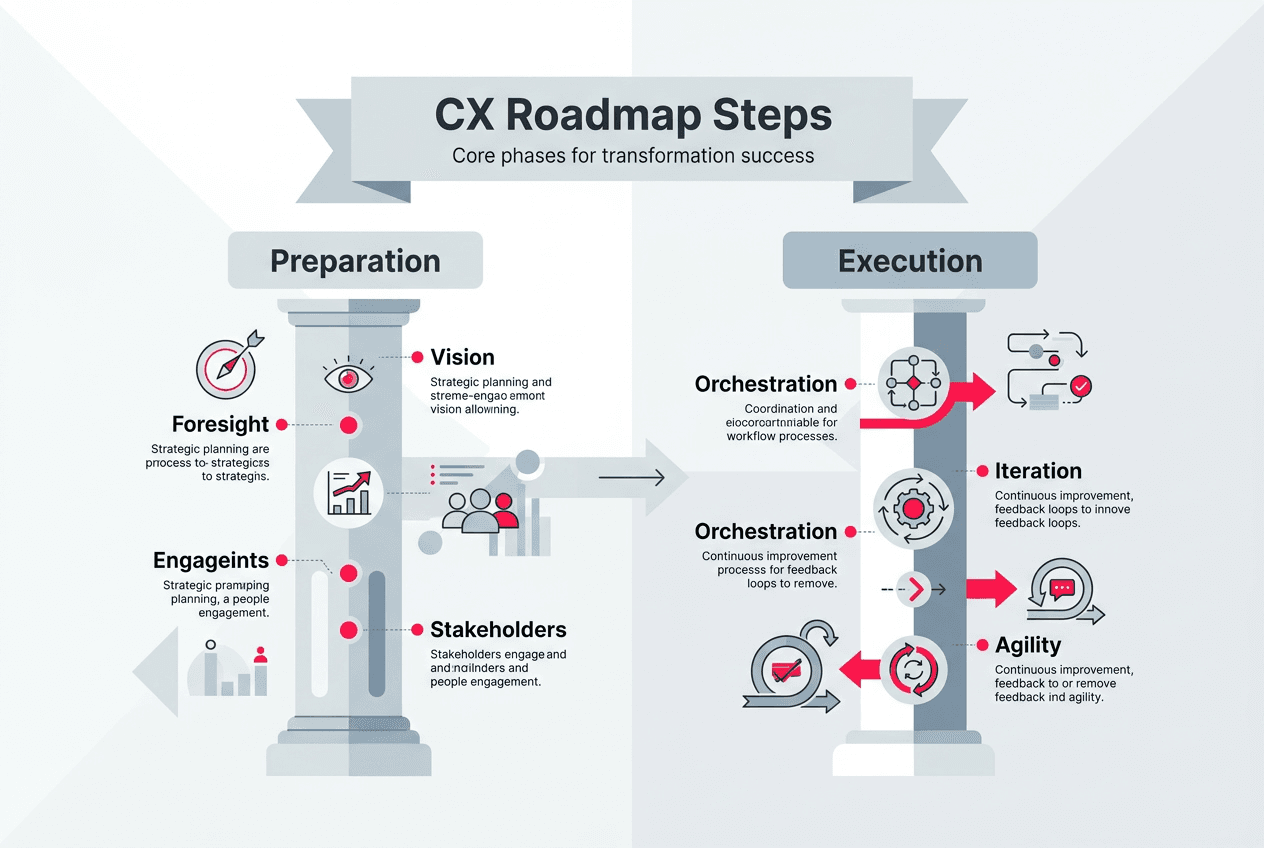
Continuous iteration distinguishes effective roadmaps from static plans. Schedule quarterly reviews to assess progress, incorporate new technologies, and adjust priorities based on changing customer expectations. The roadmap serves as a living strategic document rather than a one-time deliverable.
Verification phase: Measuring success and ensuring lasting impact
Measurement transforms transformation from activity to outcomes. Establish baseline metrics before launching roadmap initiatives so you can quantify impact accurately. Track both leading indicators that predict future performance and lagging indicators that confirm results. This dual focus enables proactive adjustments while validating strategic direction.
Communication quality significantly impacts customer retention, with poor communication increasing churn risk substantially. Monitor message clarity, channel appropriateness, and response timeliness across all customer touchpoints. Multi-channel communication quality becomes a key retention metric that correlates directly with business outcomes.
Customer sentiment toward emerging technologies requires careful tracking. Many consumers are wary of GenAI in customer communications due to data security and ethical concerns. Transparent practices and clear value propositions help overcome this skepticism, but you must measure sentiment continuously and adjust your approach based on what customers tell you.
Critical verification metrics include:
- Customer satisfaction scores (CSAT, NPS) tracked by journey stage and touchpoint
- Operational efficiency gains measured through handle time, resolution rates, and cost per interaction
- Revenue impact quantified via conversion rates, average order value, and customer lifetime value
- Employee engagement reflecting cultural adoption of customer-centric practices
- Technology performance monitoring system reliability and integration effectiveness
Pro Tip: Create executive dashboards that surface transformation impact in business terms rather than technical metrics. Leaders care about revenue, retention, and competitive advantage more than system uptime percentages.
| Metric Category | Example Measures | Review Frequency |
|---|---|---|
| Customer satisfaction | NPS, CSAT, effort scores | Monthly |
| Operational efficiency | Handle time, first contact resolution | Weekly |
| Business impact | Revenue per customer, churn rate | Quarterly |
| Technology performance | System availability, integration success | Daily |
Implement real-time dashboards that provide visibility into customer journey effectiveness. Modern analytics platforms surface patterns and anomalies as they emerge, enabling rapid response to experience degradation. Waiting for monthly reports means customers suffer through problems that could have been addressed immediately.
Feedback loops connect measurement to action. Establish clear processes for translating insights into roadmap adjustments, ensuring your transformation remains responsive to what data reveals. Agile methodologies work well for CX transformation, with short sprint cycles enabling frequent course correction.
Measuring customer experience drives growth and innovation by revealing opportunities that intuition alone would miss. Quantitative data identifies where to focus improvement efforts, while qualitative feedback explains why customers behave as they do. Combine both for comprehensive understanding.
Sustaining transformation impact requires embedding new practices into organizational DNA. Training programs, performance metrics, and recognition systems must all reinforce customer-centric behaviors. When employees see that customer experience excellence drives career advancement and organizational success, cultural transformation becomes self-reinforcing.
Explore Xverse’s expert services to lead your CX transformation
Building a transformation roadmap that delivers measurable results requires both strategic vision and execution expertise. Xverse partners with CX leaders to craft comprehensive roadmaps grounded in proven frameworks and industry best practices. Our customer experience leadership services guide you through every phase, from initial assessment through sustained optimization.
Access the strategic insights and practical tools that drive CX strategy best practices for loyalty growth in your organization. Our approach combines advanced analytics, journey orchestration capabilities, and change management expertise to help you avoid common transformation pitfalls. We bring deep experience across industries, enabling faster time to value and reduced implementation risk.
Leverage our customer journey mapping expertise to optimize multi-channel engagement and create seamless experiences that build lasting customer relationships. Together, we will transform your CX vision into operational reality.
Frequently asked questions
What is a CX transformation roadmap and why is it essential?
A CX transformation roadmap is a strategic plan that guides organizations through systematic customer experience improvements across all touchpoints and channels. It defines clear phases, measurable outcomes, resource requirements, and success criteria that align stakeholders around shared goals. The roadmap reduces transformation failure risk by providing structure and accountability, ensuring initiatives deliver measurable business value rather than becoming endless projects without defined endpoints. Organizations with documented roadmaps achieve significantly higher success rates because they can track progress, adjust priorities based on results, and maintain executive support through visible milestones.
How can agentic AI improve my customer experience transformation?
Agentic AI is moving from pilot to production, handling complex workflows end-to-end without human intervention. It automates repetitive tasks like lead qualification, order status inquiries, and common issue resolution, freeing human agents to focus on situations requiring empathy and creative problem solving. Real-time personalization becomes scalable when AI analyzes customer context and recommends next best actions instantly. This technology also enables proactive service by predicting customer needs before they escalate into problems. Explore top AI applications that boost CX engagement to understand implementation strategies for your organization.
What metrics should I track to measure CX transformation success?
Communication quality significantly impacts customer retention, making it a critical metric alongside traditional satisfaction scores. Track Net Promoter Score (NPS), Customer Satisfaction (CSAT), and Customer Effort Score (CES) to gauge experience quality. Monitor operational metrics like first contact resolution, average handle time, and channel shift rates to measure efficiency gains. Business impact metrics including customer lifetime value, churn rate, and revenue per customer demonstrate financial returns. Multi-channel engagement patterns reveal whether customers find value across touchpoints or concentrate activity in specific channels. Learn more about measuring customer experience to drive growth with comprehensive analytics frameworks.
How long does it take to see results from a CX transformation roadmap?
Quick wins should deliver visible improvements within the first quarter, building momentum and demonstrating value to stakeholders. Comprehensive transformation typically requires 18 to 24 months to fully implement and embed across the organization. Early phases focus on high-impact, lower-complexity initiatives that generate measurable results quickly. Later phases tackle more complex challenges requiring significant technology investment or cultural change. Phasing your roadmap to balance short-term wins with long-term strategic initiatives maintains executive support while driving sustainable improvement. Organizations that expect overnight transformation inevitably face disappointment, while those committed to systematic evolution achieve lasting competitive advantage.