

Customer feedback floods your inbox, social channels, and support tickets daily, yet most organizations struggle to convert this goldmine into meaningful innovation. CX and innovation leaders face a persistent challenge: translating abundant customer input into products, services, and experiences that drive measurable business growth. This guide delivers proven strategies to harness customer innovation effectively in 2026, transforming feedback systems and organizational culture into engines of sustainable competitive advantage. You’ll discover actionable frameworks to collect, process, and activate customer insights that fuel innovation while building loyalty and advocacy.
Table of Contents
- Understand The Value And Prepare To Harness Customer Innovation
- Build Structured Systems To Collect, Process, And Act On Customer Feedback
- Foster Customer-Led Growth Through Communities And Personalized Experiences
- Measure, Learn, And Continuously Improve Your Customer Innovation Efforts
- Drive Innovation With Expert Customer Experience Leadership
Key takeaways
| Point | Details |
|---|---|
| Strategic feedback collection | Implement structured systems that convert customer input into innovation fuel through closed-loop processes and multi-channel data integration. |
| Culture and leadership alignment | Foster organizational environments where collaboration, risk-taking, and customer-led experimentation become standard operating procedures. |
| Community-driven growth | Activate engaged customer communities and personalized experiences to deepen loyalty while co-creating products and services. |
| Measurement and iteration | Track advocacy, engagement, and retention metrics to validate innovation impact and refine strategies continuously. |
| Real-world validation | Apply proven frameworks from industry leaders who achieved measurable business value through customer-focused innovation programs. |
Understand the value and prepare to harness customer innovation
Your customers offer more than complaints and compliments. Customer feedback is a strategic asset for innovation, acting as R&D fuel, market radar, and innovation engine simultaneously. Organizations that treat feedback as a tactical afterthought miss opportunities to identify emerging needs, validate concepts before heavy investment, and build solutions customers actually want. The shift from reactive complaint management to proactive innovation sourcing requires deliberate preparation across systems, culture, and leadership.
Leadership commitment separates successful customer innovation programs from failed experiments. Fostering an innovation culture requires operational shifts to empower employee collaboration, idea-sharing, and risk-taking across all levels. Executives must allocate resources, champion cultural transformation, and model the behaviors they expect. Without visible leadership support, even the best feedback systems gather dust while employees revert to familiar patterns that prioritize short-term metrics over long-term innovation.
Building the right organizational foundation involves several critical elements:
- Establish clear goals linking customer input to innovation outcomes and business KPIs
- Create safe spaces for experimentation where calculated failures become learning opportunities
- Break down silos between customer-facing teams and product development groups
- Invest in tools and training that enable employees to capture, analyze, and act on insights
- Develop accountability structures ensuring feedback translates into tangible initiatives
Pro Tip: Start by mapping your current feedback flow from collection to action, identifying where customer insights get lost or ignored, then address the biggest bottleneck first rather than attempting a complete overhaul simultaneously.
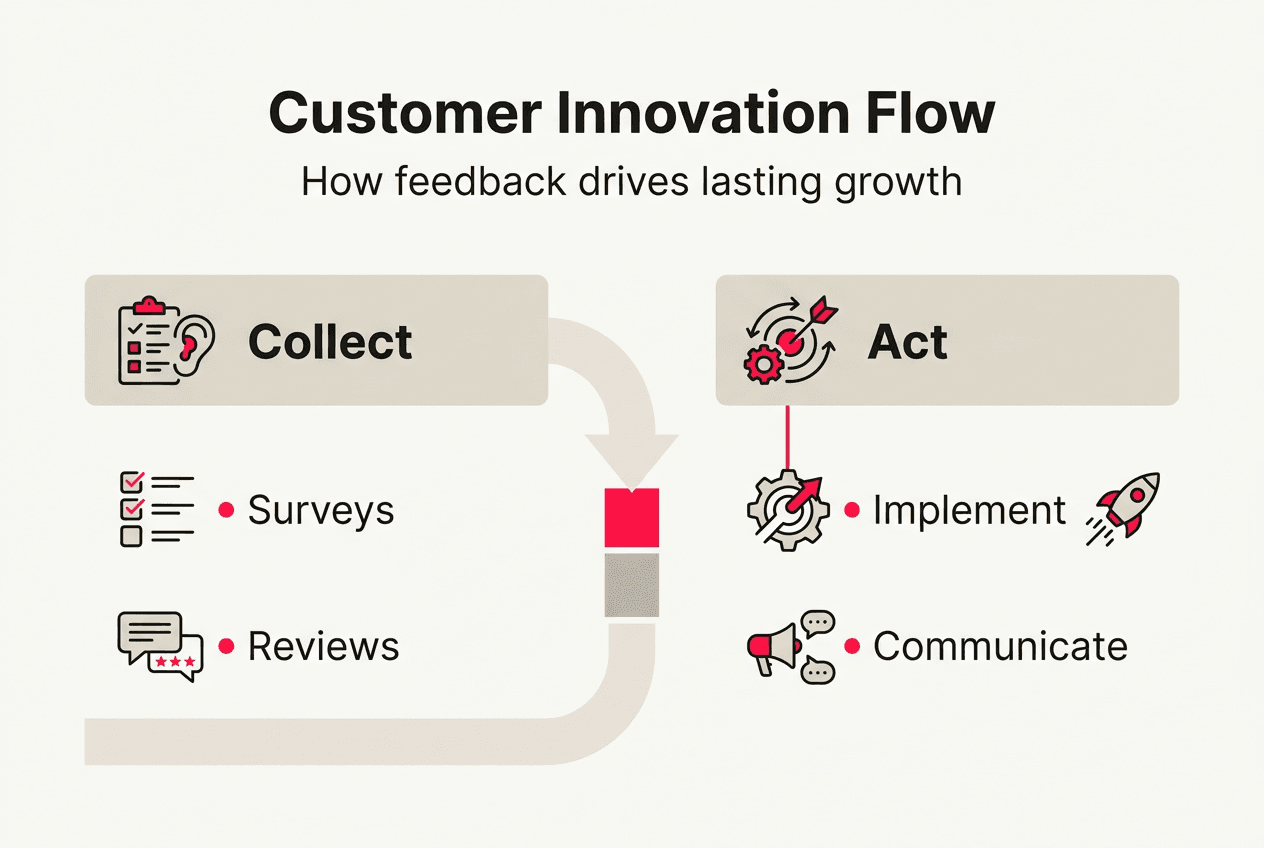
Effective customer experience leadership recognizes that innovation culture cannot be mandated through policy alone. You need systematic approaches that make customer-led innovation the path of least resistance. When employees see leadership acting on customer insights, celebrating customer-inspired wins, and protecting time for innovation exploration, behaviors shift organically. This cultural foundation becomes essential as you implement the structured systems that convert feedback into business value. Understanding why innovate customer journeys helps align teams around shared innovation objectives tied to customer outcomes.
Build structured systems to collect, process, and act on customer feedback
Random feedback collection creates noise, not innovation. A structured feedback system ensures feedback travels the full journey from customer voice to product roadmap, with accountability at every stage. Closed-loop systems track each piece of input from initial capture through analysis, prioritization, action, and customer follow-up. This visibility prevents valuable insights from disappearing into departmental black holes while demonstrating to customers that their input drives real change.
Your feedback architecture should integrate multiple channels to capture diverse perspectives:
- Deploy relationship surveys like NPS to measure overall sentiment and identify promoters versus detractors
- Implement transactional CSAT surveys at key journey moments to pinpoint friction points
- Monitor social media conversations and online reviews for unsolicited, authentic reactions
- Analyze support transcripts and chat logs to identify recurring pain points and feature requests
- Conduct regular customer advisory board sessions for deep strategic input
- Use behavioral analytics to understand what customers do versus what they say
The power emerges when you connect these streams into a unified view. Real-world success validates this approach. Michelin achieved 100% manager action commitment and 93% survey participation by implementing structured feedback systems with clear accountability. Managers committed publicly to specific actions based on employee and customer input, creating transparency that drove both participation and follow-through. This accountability mechanism transformed feedback from a compliance exercise into a strategic planning tool.
| System Component | Purpose | Key Metric |
|---|---|---|
| Multi-channel collection | Capture diverse customer perspectives | Response rate, channel coverage |
| Centralized analysis platform | Identify patterns and priorities | Time to insight, theme accuracy |
| Action tracking workflow | Ensure feedback drives decisions | Closure rate, implementation speed |
| Customer communication loop | Demonstrate responsiveness | Follow-up completion, satisfaction lift |
Pro Tip: Assign executive sponsors to high-impact customer insights, making senior leaders personally accountable for translating specific feedback themes into innovation initiatives with defined timelines and success criteria.
Transparency amplifies impact. When customers see their suggestions implemented, they become innovation partners rather than passive respondents. Share product roadmap updates highlighting customer-inspired features, acknowledge specific feedback that influenced decisions, and close the loop with individuals who contributed valuable insights. This visibility increases future participation while building trust that feedback matters. Understanding why measure customer experience helps you select metrics that connect feedback quality to business outcomes. Effective customer journey mapping reveals where to position feedback collection for maximum strategic value. The Michelin engagement case study demonstrates how structured systems with leadership accountability create sustainable feedback cultures.
Foster customer-led growth through communities and personalized experiences
Engaged customers become innovation collaborators when you create the right platforms and experiences. Customer-led growth significantly boosts loyalty and advocacy, leading to sustainable business expansion beyond traditional acquisition models. Moving customers from passive purchasers to active co-creators requires intentional community building and personalization strategies that make participation valuable and rewarding for both parties.
Building real customer communities fosters collaboration and influence on brand direction, transforming customers into evangelists who recruit others while contributing innovation insights. LEGO Ideas exemplifies this approach, enabling fans to submit product concepts, vote on submissions, and influence which sets reach production. Successful community platforms share common elements:
- Clear value exchange where customers gain exclusive access, recognition, or influence
- Structured processes for submitting, evaluating, and implementing customer ideas
- Transparent communication about how input shapes decisions and roadmaps
- Recognition systems celebrating contributors and showcasing customer-inspired innovations
- Ongoing engagement beyond one-time feedback requests
Personalization deepens these relationships by demonstrating understanding of individual customer contexts and preferences. Casper revolutionized mattress buying by creating a transparent, personalized journey that reduced friction while building trust. Their approach combined educational content addressing specific sleep concerns, risk-free trial periods acknowledging purchase anxiety, and responsive support tailored to individual situations. This personalization transformed a commodity transaction into a relationship-building experience.
“The most powerful innovation insights come from customers who feel genuinely heard and valued, not from those completing obligatory surveys. When you treat customers as collaborators rather than data sources, they share deeper truths about unmet needs and future possibilities.”
You can apply these principles regardless of industry or company size. Start by identifying your most engaged customers, those who already provide unsolicited feedback, participate in surveys, or advocate publicly. Invite this group into deeper collaboration through advisory boards, beta testing programs, or co-creation workshops. Their enthusiasm and insights will fuel initial innovation wins that justify expanding the program. Building CX strategy for customer loyalty helps you design community programs that drive both innovation and retention. Understanding employee experience impact ensures your team can deliver the personalized interactions that deepen customer relationships. Explore customer-led growth insights for detailed frameworks on building sustainable community programs.

Measure, learn, and continuously improve your customer innovation efforts
Innovation without measurement becomes expensive guesswork. Measuring customer relationships, advocacy, and engagement matters more than immediate sales when evaluating long-term innovation success. The right metrics validate whether customer-driven initiatives actually strengthen relationships and business performance or simply create activity without impact. Establishing clear KPIs before launching innovation programs enables objective evaluation and course correction.
Prioritize metrics that reflect relationship depth and future value:
- Net Promoter Score tracking advocacy trends and identifying innovation champions
- Customer retention rates measuring whether innovations reduce churn
- Engagement metrics showing participation in feedback programs and communities
- Feature adoption rates validating that customer-inspired innovations solve real problems
- Customer lifetime value increases demonstrating business impact of stronger relationships
- Innovation pipeline metrics tracking ideas from submission through implementation
Voice of the customer programs integrate solicited surveys with unsolicited data from social media, reviews, and support interactions to create comprehensive insight streams. This combination reveals what customers say when asked versus what they express spontaneously, often surfacing different priorities. Behavioral data adds another dimension, showing what customers actually do versus what they claim they want. Triangulating these sources produces more accurate innovation direction than any single channel.
| Metric Category | Leading Indicator | Lagging Indicator |
|---|---|---|
| Advocacy | NPS trend, referral rate | Customer acquisition cost |
| Engagement | Feedback participation, community activity | Repeat purchase rate |
| Innovation Impact | Idea submission volume, beta adoption | Revenue from new features |
| Relationship Strength | Support satisfaction, resolution speed | Customer lifetime value |
Real-world results validate the business case for customer-focused innovation. Dow’s digital transformation delivered $300M value, doubling conversion rates and skyrocketing repeat visits through customer experience improvements informed by systematic feedback analysis. They didn’t guess at customer needs but built measurement systems revealing friction points and opportunities, then validated improvements through ongoing tracking. This iterative approach allowed continuous refinement based on actual customer response rather than internal assumptions.
Set quarterly review cycles examining both leading indicators like engagement and participation alongside lagging indicators like retention and revenue impact. Use these reviews to identify which innovation initiatives drive meaningful results versus which generate activity without business value. Double down on successful approaches while quickly pivoting away from programs that fail to move key metrics. Learn more about optimizing customer interactions to maximize the value of every customer touchpoint. The Dow digital transformation case provides detailed examples of measurement frameworks that connect CX investments to business outcomes.
Drive innovation with expert customer experience leadership
Transforming customer feedback into sustained innovation requires specialized expertise and strategic frameworks that most organizations struggle to develop internally. Professional customer experience leadership services accelerate this journey by bringing proven methodologies, industry benchmarks, and implementation experience that shortcut common pitfalls. Xverse Digital partners with mid to large organizations to embed customer innovation capabilities through tailored consulting, strategic design, and data-driven transformation programs.
Our approach combines CX strategy development with practical implementation support, ensuring your team builds sustainable capabilities rather than temporary projects. We help you design feedback systems that capture actionable insights, foster organizational cultures that prioritize customer-led innovation, and measure results that matter to executive stakeholders. Digital transformation unlocks greater innovation potential by connecting customer insights to AI-driven analytics, automated workflows, and personalized engagement at scale. Explore our CX strategy for customer loyalty insights or discover how Xverse digital transformation expertise can accelerate your customer innovation journey.
Frequently asked questions
How do I start fostering customer innovation in my organization?
Begin by establishing structured feedback channels across multiple touchpoints and securing visible leadership commitment to act on insights. Start small with a pilot project turning high-priority customer ideas into prototypes, demonstrating value before scaling. Choose a specific customer pain point with clear business impact, involve cross-functional teams in the solution design, and share results widely to build momentum.
What are the most effective feedback channels to drive innovation?
Use a mix of solicited surveys like NPS and CSAT alongside unsolicited data from social media, online reviews, and support transcripts. Combine qualitative insights from customer interviews and advisory boards with quantitative behavioral analytics showing actual usage patterns. The most powerful innovations emerge when you triangulate what customers say, what they do, and what they share spontaneously.
How can I measure if customer innovation efforts are successful?
Track customer advocacy through NPS trends, engagement via feedback participation rates, loyalty through retention metrics, and business impact through revenue from customer-inspired features. Monitor adoption rates of new innovations to validate that solutions address real needs rather than assumed problems. Set baseline metrics before launching initiatives, then measure quarterly to identify which approaches drive meaningful improvement versus which create activity without results.
What are common pitfalls to avoid when fostering customer innovation?
Collecting feedback without acting on it destroys trust and reduces future participation, creating a vicious cycle of declining input quality. Lack of leadership support and resource allocation dooms initiatives to failure regardless of team enthusiasm. Failure to create open cultures where employees can experiment safely and closed feedback loops demonstrating customer impact prevents sustainable innovation programs from taking root.