

Many organizations chase customer experience improvements while overlooking the foundation that makes those improvements possible: employee experience. The quality of interactions your customers have depends directly on how engaged, empowered, and satisfied your employees are. If you’re investing in CX initiatives without addressing employee experience, you’re building on unstable ground.
Table of Contents
- Why Employee Experience And Customer Experience Are Inseparable
- How Strategic Employee Experience Management Enhances CX And Business Outcomes
- Key Metrics And Frameworks Connecting Employee And Customer Experience
- Common Pitfalls And Expert Nuances In Aligning Employee Experience With Customer Experience
- Enhance CX By Integrating Employee Experience With Xverse
- Frequently Asked Questions
Key takeaways
| Point | Details |
|---|---|
| EX and CX interdependence | Employee experience and customer experience must be managed together for organizational success. |
| Engaged employees drive loyalty | Empowered and engaged employees significantly boost customer trust and create lasting customer relationships. |
| Training impacts bottom line | Companies investing in employee training see 24% higher revenue per employee and 21% profit margin increases. |
| Measurement enables improvement | Aligning employee engagement scores with customer KPIs drives continuous organizational enhancement. |
| Strategic EX reduces turnover | Deliberate employee experience initiatives lower turnover and improve business performance metrics. |
Why employee experience and customer experience are inseparable
Employee experience (EX) encompasses every interaction, tool, process, and cultural element that shapes how employees feel about their work. Customer experience (CX) represents the sum of all interactions customers have with your organization. These two forces don’t just influence each other; they’re fundamentally inseparable.
As one expert noted, CX and EX management are bedfellows and completely aligned, comparing the relationship to a bicycle where one without the other creates one round wheel and one square wheel. You can’t ride smoothly when one experience domain is optimized and the other neglected.
Poor employee experience creates immediate, visible damage to customer relationships:
- Disengaged employees provide inconsistent, low-quality service
- Frustrated staff lack motivation to solve customer problems creatively
- High turnover disrupts customer relationships and institutional knowledge
- Untrained employees create friction at every customer touchpoint
The reverse is equally true. When customers are difficult, processes are broken, or expectations are unrealistic, employee morale suffers. This creates a downward spiral where poor CX degrades EX, which further damages CX.
Many organizations make the critical mistake of believing they can improve customer outcomes through better scripts, new technology, or revised processes alone. These customer-facing changes fail when employees lack the engagement, autonomy, and support to execute them effectively. Customer experience leadership requires simultaneous attention to both the employee and customer sides of every interaction.
How strategic employee experience management enhances CX and business outcomes
Deliberate EX strategies create measurable business value. Strategic EX management delivers results through empowerment initiatives, positive workplace cultures, heightened employee engagement, and reduced turnover rates.
Employee empowerment stands at the center of this transformation. When you give employees authority to make decisions, access to the right tools, and clear understanding of organizational goals, they become proactive problem solvers rather than script followers. This autonomy translates directly into faster issue resolution and more personalized customer interactions.

Training and development form another critical pillar. Organizations that invest in building employee capabilities see remarkable returns. Research shows companies investing in training achieve 24% revenue increases per employee and profit margins that are 21% higher than competitors who underinvest in development.
The employee engagement factor cannot be overstated. Engaged employees bring energy, creativity, and genuine care to customer interactions. They stay with organizations longer, building expertise and customer relationships over time. Lower turnover means customers interact with knowledgeable staff who understand context and history.
Culture shapes everything. A positive workplace culture where employees feel valued, heard, and supported creates a foundation for exceptional customer service. Employees in toxic cultures cannot authentically deliver positive experiences to customers, no matter how well designed your CX strategy appears on paper.
As one analysis concluded, customer and employee satisfaction represent two sides of the same coin. You cannot sustainably achieve one without the other. Understanding this relationship helps explain why customer experience drives revenue growth when organizations approach it holistically.
Key metrics and frameworks connecting employee and customer experience
The Service-Profit Chain provides a powerful framework for understanding EX-CX connections. This model illustrates how employee experience directly influences customer experience and subsequently drives financial outcomes. Internal service quality affects employee satisfaction, which shapes employee retention and productivity, which determines service value, which creates customer satisfaction and loyalty, which generates revenue growth and profitability.
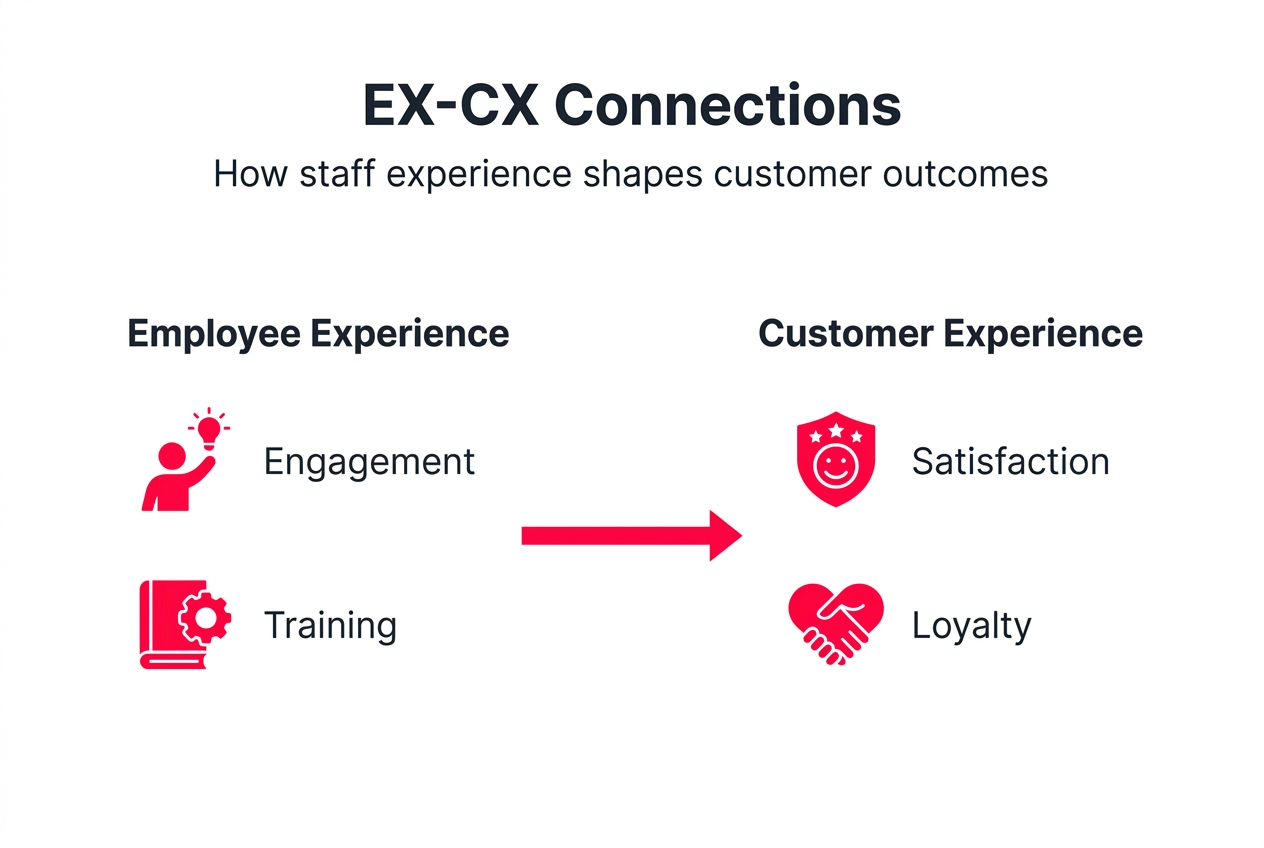
Aligning metrics across employee engagement, turnover rates, and agent satisfaction alongside customer-facing KPIs is essential for improving both EX and CX simultaneously. Organizations need visibility into both domains to understand cause and effect relationships.
| Metric Category | Key Indicators | Impact on Business |
|---|---|---|
| Employee Engagement | eNPS, engagement scores, survey responses | Predicts service quality and innovation |
| Employee Retention | Turnover rate, tenure, retention by role | Affects consistency and institutional knowledge |
| Employee Capability | Training completion, skill assessments, autonomy levels | Determines resolution effectiveness |
| Customer Satisfaction | NPS, CSAT, CES | Reflects employee performance outcomes |
| Customer Loyalty | Retention rate, repeat purchase, referrals | Validates long-term EX-CX alignment |
To align your measurement approach effectively:
- Establish baseline metrics for both employee and customer experience domains
- Identify specific touchpoints where employee actions directly impact customer outcomes
- Create correlation analyses linking employee engagement scores to customer satisfaction trends
- Implement regular review cycles that examine both metric sets together
- Adjust EX initiatives based on observed impacts to CX performance
Pro Tip: Many organizations measure EX and CX separately, creating blind spots. Integrate your analytics platforms to track how changes in employee metrics precede shifts in customer metrics. This temporal analysis reveals true causation and helps you prioritize EX investments with the highest CX impact.
Effective measuring customer experience requires this integrated perspective. Without understanding the employee factors driving customer outcomes, you’re treating symptoms rather than causes.
Common pitfalls and expert nuances in aligning employee experience with customer experience
Despite growing awareness of the connection, actual synergy between CX and EX remains rare in practice. Organizations struggle with specific, recurring challenges that undermine their efforts.
Common mistakes include:
- Maintaining siloed EX and CX strategies with separate ownership and no coordination
- Providing insufficient training while expecting service excellence
- Failing to measure the actual impact of EX initiatives on customer outcomes
- Creating CX strategies written for customers rather than enabling employees to deliver them
- Implementing one-size-fits-all EX programs without considering role-specific needs
The measurement gap proves particularly damaging. Without tracking how EX changes affect CX metrics, organizations cannot demonstrate ROI or refine their approaches. This leads to underfunding EX initiatives and perpetuating the cycle of poor employee and customer experiences.
Leadership commitment represents another frequent failure point. When executives view EX as an HR concern separate from business strategy, integration never happens. EX requires the same strategic priority as CX, with executive sponsors who connect the dots between employee engagement and business results.
The cost equation is often misunderstood. While investment cost of EX is limited, a toxic culture can cost the entire business through turnover, reputation damage, and customer defection. The question is not whether you can afford to invest in EX, but whether you can afford not to.
Expert approaches recognize nuance. Different employee roles require tailored EX strategies. Frontline service staff need different support than back-office operations teams. Customer touchpoint analysis should inform which employee experiences to prioritize. A contact center agent’s experience matters more for phone support quality than a software developer’s experience does, though both contribute to overall organizational performance.
Pro Tip: Map your customer journey to identify critical moments of truth, then work backward to understand which employee experiences directly enable or undermine those moments. Focus your EX investments on roles and processes with the highest customer impact. This targeted approach delivers faster, more visible results than broad EX programs.
Applying CX strategy best practices requires this employee-centric lens. Your strategy must work for the people executing it, not just the customers receiving it.
Enhance CX by integrating employee experience with Xverse
Transforming how you connect employee and customer experience requires expertise, frameworks, and strategic guidance. Xverse partners with organizations to build integrated approaches that drive measurable business results.
Our customer experience leadership services help you establish the governance, metrics, and culture needed for EX-CX alignment. We work with your teams to identify gaps, prioritize initiatives, and build capabilities that last beyond our engagement.
Through customer journey mapping, we help you understand exactly how employee experiences at each touchpoint shape customer perceptions and outcomes. This clarity enables targeted EX investments with direct CX impact. Whether you’re beginning your transformation or refining existing programs, Xverse brings the strategic perspective and practical tools to elevate both employee and customer experiences simultaneously.
Frequently asked questions
What is employee experience (EX) and why does it matter for CX?
Employee experience encompasses all interactions employees have within the workplace, including culture, tools, processes, leadership, and daily work experiences that affect their engagement and satisfaction. It matters for CX because engaged employees deliver better customer service, solve problems more creatively, and create positive emotional connections with customers. When employees feel valued and empowered, they naturally extend that positive experience to customer interactions, driving higher customer trust, loyalty, and business success.
How do you measure the impact of employee experience on customer experience?
Measure employee engagement scores, turnover rates, and satisfaction levels alongside customer KPIs like Net Promoter Score and Customer Satisfaction scores to identify correlations. Use integrated analytics platforms and frameworks like the Service-Profit Chain to understand how changes in employee metrics precede shifts in customer outcomes. Regularly align and review these metrics together rather than in isolation, adjusting EX strategies based on observed impacts to CX performance over time.
What are common challenges in aligning EX and CX strategies?
Common challenges include siloed departments where EX and CX teams operate independently, insufficient employee training despite high customer service expectations, and lack of shared metrics that connect employee and customer outcomes. Misalignment leads to poor employee morale, inconsistent customer service, and wasted investments in initiatives that don’t address root causes. Overcoming these challenges requires executive leadership buy-in, strategies tailored to specific employee roles and customer touchpoints, continuous measurement of integrated metrics, and treating EX as a strategic priority equal to CX.
How can training and empowerment improve both employee and customer experience?
Training equips employees with skills, knowledge, and confidence to resolve customer issues effectively and efficiently, reducing frustration for both parties. Empowerment gives employees authority to make decisions, creating faster resolution times and more personalized customer interactions. Organizations investing in comprehensive training programs see revenue increases of 24% per employee and profit margin improvements of 21%, demonstrating that developing employee capabilities directly translates to better business outcomes through enhanced customer experiences and operational efficiency.