

Most organizations believe customer loyalty hinges on points and discounts. Yet 75% of consumers favor brands with loyalty programs, and members generate 12-18% more revenue, not because of transactions but because of emotional connections. This disconnect reveals a fundamental misunderstanding among CX leaders about what truly drives loyalty. This guide cuts through the noise with data-driven frameworks and actionable strategies that transform how you design, measure, and optimize customer loyalty programs. You will discover the mechanics of emotional loyalty, industry benchmarks that matter, common pitfalls to avoid, and hybrid models that deliver measurable ROI.
Table of Contents
- Understanding Customer Loyalty Mechanics Beyond Transactions
- Benchmarking Loyalty: Industry Retention Rates And Metrics That Matter
- Navigating Loyalty Program Pitfalls And Evolving Strategies With Technology
- Designing Hybrid Loyalty Models For Sustainable Impact
- Explore Advanced Customer Experience Leadership With Xverse
- Frequently Asked Questions
Key takeaways
| Point | Details |
|---|---|
| Emotional over transactional | Loyalty stems from recognition, community, and personalized experiences rather than points alone. |
| Industry benchmarks vary | Retention rates range from 63% in retail to 90% in B2B SaaS, requiring sector-specific strategies. |
| Technology enables personalization | AI and first-party data drive dynamic, ethical loyalty programs that adapt to customer behavior. |
| Measure holistically | Integrate CX metrics like NPS and CRR with financial KPIs such as ROI and LTV for complete insight. |
| Avoid common pitfalls | Complexity, irrelevant rewards, and unmet expectations undermine loyalty program effectiveness. |
Understanding customer loyalty mechanics beyond transactions
Customer loyalty is not a byproduct of accumulating points or redeeming discounts. It emerges from emotional connections that include recognition, personalized experiences, community building, and behavior-based rewards. When you treat loyalty as purely transactional, you miss the psychological drivers that keep customers returning even when competitors offer better prices. Emotional loyalty creates brand attachment that withstands market disruptions and price wars.
Consider how personalized recognition transforms routine interactions. A customer who receives a birthday message with a tailored offer feels seen and valued, not just monetized. Community incentives amplify this effect by fostering peer connections and shared identity around your brand. Behavioral rewards that celebrate milestones like first purchases, referrals, or social shares encourage ongoing participation beyond simple point accumulation. These elements combine to create a loyalty ecosystem where customers choose your brand because it aligns with their identity and values.
Differentiating loyalty from retention is critical for strategic clarity. Retention measures repeat purchasing behavior, which can result from convenience, switching costs, or lack of alternatives. Loyalty reflects a deeper preference and emotional commitment that persists even when competitors aggressively court your customers. You can retain customers without earning their loyalty, but loyal customers become advocates who amplify your brand organically. This distinction shapes how you allocate resources and design optimizing customer interactions across touchpoints.
Pro Tip: Map customer emotions at each journey stage to identify where recognition, community, or behavioral rewards will have the greatest impact on loyalty formation.
Key loyalty drivers include:
- Personalized recognition that acknowledges individual preferences and history
- Community incentives that foster belonging and peer engagement
- Behavior-based rewards that celebrate meaningful actions beyond transactions
- Emotional resonance that aligns brand values with customer identity
“Loyalty is emotional, involving recognition, personalized experiences, community building, and behavior-based rewards rather than just points.” This insight from emotional loyalty research underscores why transactional models alone fail to sustain long-term customer relationships.
Benchmarking loyalty: industry retention rates and metrics that matter
Retention rates vary dramatically across industries, making sector-specific benchmarks essential for realistic goal setting. Media companies retain 84% of customers, while retail averages 63% and B2B SaaS reaches 90%. These differences reflect distinct purchase cycles, switching costs, and competitive dynamics. Understanding where your industry stands helps you evaluate whether your loyalty initiatives are performing above or below par.
Top-performing companies measure loyalty through integrated metrics that span financial and experiential dimensions. Retention rate tracks the percentage of customers who continue purchasing over a defined period. Lifetime value (LTV) quantifies the total revenue a customer generates across their relationship with your brand. Revenue impact isolates how much incremental revenue stems from loyalty program members versus non-members. Engagement metrics capture participation rates, redemption frequency, and interaction depth across touchpoints. Together, these indicators provide a holistic view of loyalty program effectiveness.
Combining CX metrics like Net Promoter Score (NPS) and Customer Retention Rate (CRR) with financial KPIs delivers actionable intelligence. NPS reveals advocacy potential and emotional sentiment, while CRR measures behavioral persistence. When you correlate these with ROI and LTV, you can identify which loyalty initiatives drive both satisfaction and profitability. This integrated approach prevents the common mistake of optimizing for engagement metrics that do not translate to revenue growth or for financial metrics that sacrifice customer experience quality.
| Industry | Average Retention Rate | Key Loyalty Drivers |
|---|---|---|
| Media | 84% | Content personalization, subscription value |
| Retail | 63% | Convenience, rewards relevance |
| B2B SaaS | 90% | Product stickiness, support quality |
| Banking | 75% | Trust, service reliability |
| Hospitality | 55% | Experience quality, recognition |
Leading organizations also track program participation rates, redemption velocity, and member versus non-member revenue gaps. Participation rates indicate how many eligible customers actively engage with your loyalty program. Redemption velocity measures how quickly customers use earned rewards, signaling perceived value. The revenue gap between members and non-members quantifies the financial impact of loyalty initiatives. These granular metrics help you diagnose program health and prioritize improvements.
Pro Tip: Use control groups to measure incremental loyalty ROI accurately by comparing member behavior against similar non-member cohorts, isolating the true impact of your program.
Explore how measuring loyalty ROI integrates with broader CX measurement frameworks to justify loyalty investments. Aligning these metrics with customer experience leadership priorities ensures loyalty programs support strategic business objectives rather than operating in isolation. Review industry retention benchmarks regularly to adjust your targets as market conditions evolve.
Navigating loyalty program pitfalls and evolving strategies with technology
Loyalty programs backfire when they raise expectations without delivering proportional value. Customers who join expecting generous rewards but encounter restrictive redemption rules or irrelevant offers feel deceived, not rewarded. This boomerang effect damages trust and can accelerate churn faster than having no program at all. Common pitfalls include dissatisfaction from unmet expectations, irrelevant rewards that ignore customer preferences, and overly complex systems that frustrate rather than delight.

Irrelevance kills engagement. A frequent flyer who values lounge access gains nothing from discounts on rental cars they never use. When rewards do not align with customer priorities, redemption rates plummet and program participation becomes a checkbox exercise rather than a meaningful relationship driver. Complexity compounds this problem. Multi-tier structures with opaque earning rules and expiration policies create cognitive load that discourages participation. Simplicity and transparency are not just nice features but essential design principles.
Emotional loyalty differs fundamentally from repeat buying behavior. A customer who repurchases due to convenience or lack of alternatives is not loyal, just habituated. Emotional loyalty can survive even without incentives because it is rooted in identity alignment and positive associations. This distinction matters when designing loyalty strategies. Transactional incentives may boost short-term repeat purchases, but emotional engagement sustains relationships through market shifts and competitive pressures.
Mobile and AI technologies enable dynamic, personalized loyalty experiences that adapt in real time. AI analyzes behavioral patterns to predict which rewards will resonate with individual customers, delivering offers at optimal moments in their journey. Mobile apps provide frictionless redemption and gamified interactions that make participation effortless and engaging. However, these technologies require ethical data use to maintain trust. Transparency about data collection, clear opt-in mechanisms, and respect for privacy boundaries are non-negotiable.
Emerging technologies offer new opportunities but demand responsible implementation:
- AI-driven personalization that tailors rewards to individual preferences and behaviors
- Mobile-first experiences that reduce friction and increase engagement
- Predictive analytics that anticipate customer needs before they articulate them
- Blockchain for transparent, tamper-proof loyalty point tracking
- Ethical data governance that prioritizes customer consent and privacy
Pro Tip: Segment customers by journey stage to tailor loyalty efforts effectively, offering onboarding incentives to new customers while providing exclusive experiences to long-term advocates.
Discover how AI applications in customer loyalty transform traditional programs into adaptive, intelligent systems. Understand data’s role in CX loyalty to balance personalization with privacy. Review loyalty program pitfalls to avoid common design mistakes. Explore research on emotional loyalty resilience to differentiate between habitual repurchasing and genuine brand commitment.
Designing hybrid loyalty models for sustainable impact
Hybrid loyalty models integrate emotional engagement with data-driven personalization to maximize both satisfaction and profitability. Sustainable loyalty blends service quality, brand equity, engagement, journey orchestration, and first-party data for hyper-personalization. This approach recognizes that neither pure transactional incentives nor purely emotional branding alone suffice. You need both the analytical rigor to understand customer behavior and the creative empathy to design experiences that resonate emotionally.
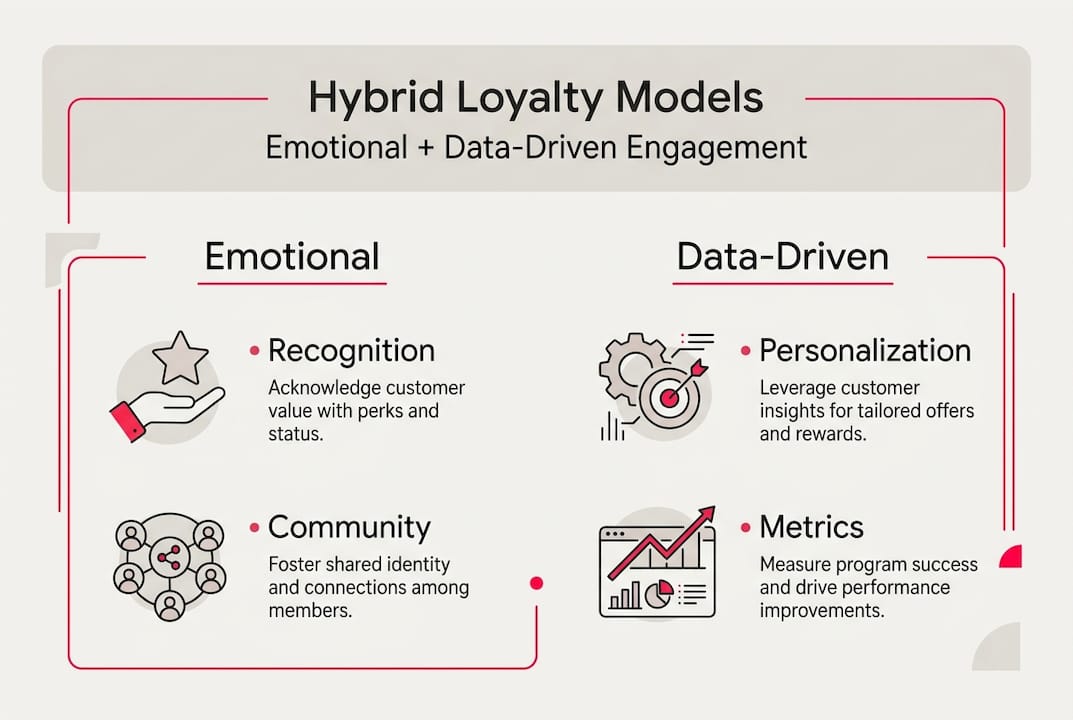
Journey orchestration ensures loyalty touchpoints align with customer needs at each stage. A new customer requires onboarding support and early wins to build confidence. A repeat customer values recognition and exclusive access that acknowledges their tenure. A lapsed customer needs re-engagement incentives that address why they left. First-party data powers this orchestration by revealing behavioral patterns, preferences, and sentiment across channels. When you combine this intelligence with emotional design principles, you create loyalty programs that feel personal rather than algorithmic.
Measuring success holistically requires integrating CX metrics with financial KPIs. NPS and Customer Retention Rate (CRR) capture experiential quality and behavioral persistence. ROI and LTV quantify financial returns and long-term value creation. Customer Effort Score (CES) reveals friction points that undermine loyalty despite positive sentiment. When these metrics align, you have evidence that your loyalty program delivers both customer satisfaction and business growth. Divergence signals misalignment that demands investigation.
| Model Type | Primary Focus | Best For | Key Metrics |
|---|---|---|---|
| Transactional | Points, discounts | High-frequency, low-margin businesses | Redemption rate, member spend |
| Emotional | Brand connection, values | Premium brands, lifestyle products | NPS, advocacy rate |
| Hybrid | Personalization plus incentives | Most B2C and B2B contexts | LTV, CRR, engagement depth |
| Community | Peer engagement, co-creation | Brands with strong identity | Community activity, UGC volume |
Gamification should be ethical and aligned with customer values. Points, badges, and leaderboards can drive engagement when they celebrate meaningful achievements and foster healthy competition. They backfire when they manipulate behavior through dark patterns or create anxiety about missing out. Design gamification elements that enhance intrinsic motivation rather than replacing it with extrinsic rewards. Celebrate milestones that matter to customers, not just to your business objectives.
Follow these steps to build and refine a hybrid loyalty program:
- Assess current loyalty drivers through customer research and behavioral analysis to identify emotional and transactional motivators.
- Define success metrics that integrate CX indicators like NPS with financial KPIs such as LTV and incremental revenue.
- Design a tiered structure that rewards both transactions and engagement behaviors like reviews, referrals, and community participation.
- Implement personalization engines using first-party data and AI to tailor rewards and communications to individual preferences.
- Orchestrate journey touchpoints so loyalty interactions align with customer needs at onboarding, growth, and retention stages.
- Test and iterate using A/B experiments and control groups to measure incremental impact and refine program elements.
- Monitor holistically by tracking both experiential metrics and financial outcomes to ensure alignment and sustainability.
Learn how CX strategy for loyalty frameworks guide program design from concept to execution. Apply customer journey mapping techniques to identify optimal loyalty touchpoints. Review hybrid loyalty program design best practices to balance emotional and transactional elements effectively.
Explore advanced customer experience leadership with Xverse
Transforming customer loyalty from a tactical program into a strategic asset requires specialized expertise and proven frameworks. Xverse provides customer experience leadership services that empower CX leaders to design, implement, and optimize loyalty programs that drive measurable business growth. Our approach integrates emotional design principles with data-driven personalization to create hybrid models that resonate with customers and deliver ROI.
Access frameworks that align loyalty initiatives with broader digital transformation goals. Partner with Xverse to leverage AI-enhanced approaches that boost engagement and retention while maintaining ethical data practices. Explore our CX strategy customer loyalty guide for actionable insights. Discover how AI in customer loyalty transforms traditional programs into adaptive, intelligent systems that anticipate customer needs and deliver personalized experiences at scale.
Frequently asked questions
What is the difference between customer loyalty and retention?
Customer loyalty involves an emotional connection and preference for your brand that persists even when competitors offer better prices or convenience. Retention measures repeat purchasing behavior, which can result from switching costs, habit, or lack of alternatives rather than genuine preference. Loyalty is deeper and more resistant to market disruptions because it is rooted in identity alignment and positive emotional associations. You can retain customers without earning their loyalty, but loyal customers become advocates who amplify your brand organically and resist competitive offers.
How can AI improve customer loyalty programs ethically?
AI enables hyper-personalization by analyzing behavioral patterns to predict which rewards and communications will resonate with individual customers at optimal moments in their journey. It automates real-time engagement through chatbots, personalized offers, and predictive recommendations that adapt to changing preferences. Ethical use requires transparent data practices, clear opt-in mechanisms, and respect for privacy boundaries to maintain customer trust. AI should enhance customer value rather than manipulate behavior through dark patterns or create anxiety about missing out on rewards.
What are common mistakes to avoid in loyalty program design?
Avoid complexity, irrelevant rewards, and unmet expectations that create friction and erode trust. Multi-tier structures with opaque earning rules and restrictive redemption policies frustrate customers rather than delight them. Rewards that do not align with customer priorities result in low redemption rates and disengagement. Raising expectations through program enrollment but failing to deliver proportional value creates a boomerang effect that accelerates churn. Prioritize emotional engagement through recognition, community, and personalized experiences over solely transactional incentives to build sustainable loyalty.
How do CX metrics integrate with financial KPIs to measure loyalty?
Combine Net Promoter Score (NPS) and Customer Retention Rate (CRR) with ROI and lifetime value (LTV) for holistic insight into loyalty program effectiveness. NPS captures advocacy potential and emotional sentiment, while CRR measures behavioral persistence over time. ROI quantifies the financial return on loyalty investments, and LTV reveals the total revenue a customer generates across their relationship with your brand. Use control groups to isolate incremental loyalty impact by comparing member behavior against similar non-member cohorts. This integrated approach ensures loyalty programs deliver both customer satisfaction and business growth rather than optimizing for engagement metrics that do not translate to profitability.