

Managing customer expectations isn’t just about setting the bar low. Unmet expectations cause 57% of customers to switch after just one bad experience, a figure that climbs to 73% after multiple failures. For CX leaders and senior management, this represents a critical strategic gap: the difference between what customers anticipate and what you deliver directly determines loyalty, satisfaction, and revenue. This guide reveals evidence-based frameworks and actionable strategies to align perception with reality, transforming expectation management into a competitive advantage that builds trust and reduces churn.
Table of Contents
- Key takeaways
- Understanding why managing customer expectations matters
- Core methodologies for effective customer expectation management
- Addressing nuances and contrasting views on expectation versus norm management
- Applying effective expectation management in CX leadership strategies
- Enhance your customer experience leadership with Xverse
- Frequently asked questions
Key Takeaways
| Point | Details |
|---|---|
| Expectation alignment reduces churn | Align what customers anticipate with what your organization delivers to prevent dissatisfaction and reduce churn. |
| Transparency and proactive communication | The most effective approaches combine transparency, personalization, and proactive communication to shape realistic perceptions before interactions occur. |
| AI driven personalization impact | AI driven personalization boosts loyalty by 3.5 times compared with reactive approaches. |
| Expectancy Disconfirmation Theory focus | Customers evaluate experiences by comparing what they receive against what they expected, and gaps can drive dissatisfaction and churn. |
| Warning signs of gaps | Warning signs include declining CSAT with stable quality, rising delivery inquiries, social media complaints, and higher churn among recently acquired customers. |
Understanding why managing customer expectations matters
At the heart of customer satisfaction lies a simple psychological principle: Expectancy-Disconfirmation Theory (EDT). This framework explains that customers evaluate experiences by comparing what they receive against what they expected. When reality exceeds expectations, positive disconfirmation occurs, driving satisfaction and loyalty. When reality falls short, negative disconfirmation triggers dissatisfaction and churn.
For CX leaders, understanding EDT isn’t academic exercise. It’s the foundation of strategic expectation management. Your customers form expectations from multiple sources: marketing messages, past experiences, peer reviews, and industry norms. Each touchpoint shapes their mental model of what your organization will deliver. When customer expectations align with actual performance, trust builds. When gaps emerge, even once, damage occurs.
The business consequences are severe. Research shows that 40% of customers stop engaging after a single negative interaction. This isn’t about minor inconveniences. Customers who experience unmet expectations feel misled, frustrated, or undervalued. They perceive a broken promise, which erodes the relationship foundation faster than any competitor offer.
CX leaders must recognize warning signs that expectation gaps exist:
- Declining CSAT scores despite stable product quality
- Increased service inquiries about delivery timelines or feature availability
- Social media complaints about “not what I expected”
- Rising churn among recently acquired customers
- Disconnect between marketing promises and operational capabilities
“Customers don’t just want great experiences. They want the experiences they were promised. The gap between promise and delivery is where loyalty dies.” — CX Research Institute
The data is unambiguous. Organizations that fail to manage expectations systematically face higher acquisition costs, lower lifetime value, and reputational damage that compounds over time. Conversely, those that align perception with reality create predictable, trustworthy experiences that customers recommend and return to repeatedly.
Core methodologies for effective customer expectation management
Successful expectation management requires deliberate strategies that shape customer perceptions before, during, and after interactions. The most effective CX leaders deploy five core methodologies that work in concert to align expectations with delivery.
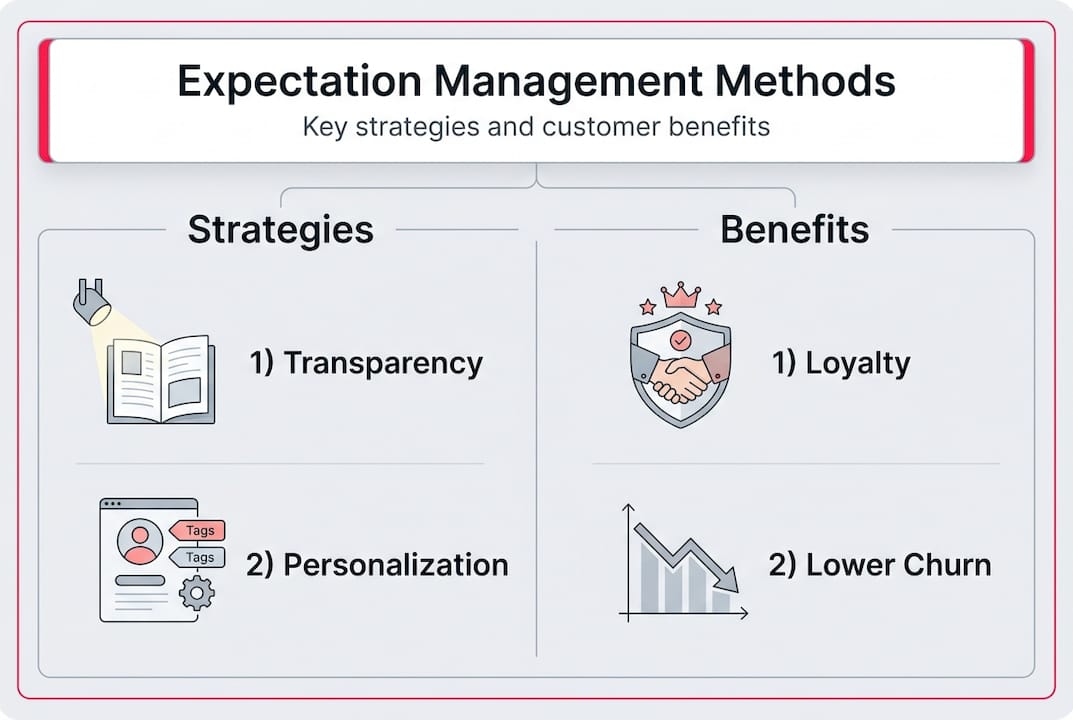
First, transparency sets realistic expectations from initial contact. This means clearly communicating what customers will receive, when they’ll receive it, and what limitations exist. Overpromising to close a sale creates inevitable disappointment. Key strategies include honest marketing, detailed product descriptions, and upfront disclosure of potential delays or constraints.
Second, deep customer research reveals what customers actually need versus what they think they want. Surveys, interviews, and behavioral analytics uncover the underlying jobs customers hire your product to do. This intelligence allows you to shape messaging that resonates with real needs rather than assumed desires.
Third, AI-driven personalization enables proactive, tailored communication at scale. Modern AI applications in CX analyze customer history, preferences, and context to predict needs and deliver relevant information before customers ask. This shifts the dynamic from reactive problem solving to anticipatory guidance.

Fourth, omnichannel consistency ensures customers receive aligned messages regardless of touchpoint. When marketing promises one thing, sales another, and service delivers a third, expectation gaps widen. Integrated systems and shared data create coherent experiences across channels.
Fifth, customer journey mapping frameworks like Gartner’s CX CORE model or Forrester’s CX Index help organizations visualize and optimize expectation touchpoints throughout the lifecycle. These tools identify moments where expectations form, shift, or get violated, allowing targeted interventions.
The benchmarks are clear. According to 2025 CX research, 70% of customers now expect AI-powered service, 77% want proactive support, and 87% demand personalization based on their interaction history. Organizations meeting these expectations see twice the revenue growth of those that don’t.
| Methodology | Customer Expectation | Adoption Rate |
|---|---|---|
| AI-powered service | Intelligent, context-aware support | 70% |
| Proactive communication | Anticipatory problem resolution | 77% |
| Personalization | History-based customization | 87% |
| Omnichannel consistency | Seamless cross-channel experience | 65% |
Pro Tip: Map your customer journey to identify the three highest-impact moments where expectations form. Focus your transparency and communication efforts on these critical touchpoints first, then expand systematically to other stages.
Implementing these methodologies requires cross-functional coordination. Marketing must align campaigns with operational capacity. Sales needs real-time inventory and delivery data. Service teams require authority to set accurate expectations even when it means disappointing customers short-term. The customer experience guide for 2026 emphasizes that expectation alignment is an organizational capability, not a departmental task. Leaders who treat it as such build sustainable competitive advantages. Those who delegate it to marketing or service alone create internal silos that customers experience as broken promises.
The investment in customer journey mapping pays dividends by revealing hidden expectation gaps. Most organizations discover that customers form critical expectations at touchpoints the company never considered important. A vague delivery estimate, an unclear return policy, or an ambiguous feature description can set unrealistic expectations that doom the relationship before it begins.
Addressing nuances and contrasting views on expectation versus norm management
Not everyone agrees that managing expectations is the right focus. A growing body of CX research argues that organizations should prioritize meeting consistent norms rather than shaping variable expectations. This perspective, articulated in analyses of why managing expectations misses the point, suggests customers don’t enter interactions with fixed expectations. Instead, they react to whether experiences match established category norms.
Consider McDonald’s. Customers don’t expect gourmet food or exceptional service. They expect fast, consistent, predictable meals that taste the same globally. McDonald’s wins not by exceeding expectations but by reliably meeting norms. The food arrives quickly, tastes familiar, and costs what customers anticipate. This predictability builds trust more effectively than occasional moments of delight.
The norms-based view challenges CX leaders to shift focus from managing what customers expect to delivering what the category demands consistently. It emphasizes operational excellence over perception management. In this framework, the goal isn’t to set lower expectations but to execute flawlessly against industry standards.
However, this perspective has limits. While norms matter enormously in transactional, commodity categories, differentiated services still require active expectation management. When you promise personalized financial advice, custom software development, or strategic consulting, you’re creating specific expectations that norms alone can’t address.
The most sophisticated approach combines both views. Deliver consistently against category norms as your baseline, then manage expectations carefully when you offer differentiated value. This dual strategy prevents the disappointment of norm violations while creating space for meaningful differentiation.
Critically, both perspectives agree on one priority: design for exceptions first. Edge cases like payment failures, delivery delays, or technical errors are where trust gets built or destroyed. When systems fail gracefully, communicate proactively, and resolve issues quickly, customers forgive and often become more loyal. When exceptions create confusion, blame, or silence, customers leave.
The statistics support this focus. While 57% of customers switch after one bad experience, 73% leave after multiple failures. This suggests that how you handle exceptions matters more than whether they occur. Perfect execution is impossible. Exceptional recovery is achievable.
| Approach | Focus | Best For | Key Metric |
|---|---|---|---|
| Expectation management | Align perception with delivery | Differentiated services | Positive disconfirmation rate |
| Norm fulfillment | Consistent category performance | Commodity transactions | Reliability score |
| Exception-first design | Graceful failure recovery | All contexts | Recovery satisfaction |
Pro Tip: Audit your last 100 customer complaints. Categorize them as norm violations (failed to meet industry standards), expectation gaps (delivered something different than promised), or exception failures (poor handling of errors). This reveals where to focus your improvement efforts.
For CX leadership, the practical implication is clear. Don’t choose between managing expectations and meeting norms. Do both. Establish operational excellence that consistently delivers against category standards, then layer strategic expectation management for differentiated offerings. Finally, invest disproportionately in exception handling because that’s where customers decide whether to trust you long-term.
The CX strategy best practices for 2026 emphasize this integrated approach. Organizations that excel at both consistency and recovery outperform those that focus on either alone. They create experiences that feel both reliable and responsive, predictable yet personalized.
Applying effective expectation management in CX leadership strategies
Translating expectation management theory into organizational practice requires systematic integration into CX leadership strategies. For senior management, this means embedding EDT principles into decision-making frameworks, measurement systems, and cross-functional processes.
Start with these strategic steps:
-
Audit current expectation touchpoints: Map every customer interaction where expectations form or get reinforced. Include marketing materials, sales conversations, onboarding sequences, product documentation, and service scripts.
-
Quantify expectation gaps: Use CSAT surveys with open-ended questions asking what customers expected versus what they received. Analyze the gap size and frequency across segments.
-
Align cross-functional teams: Bring marketing, sales, product, and service leaders together to review expectation data. Identify where internal misalignment creates customer confusion.
-
Implement measurement frameworks: Track disconfirmation explicitly. Don’t just measure satisfaction. Measure whether experiences exceeded, met, or fell short of expectations.
-
Deploy AI for personalization: Leverage AI to deliver proactive support that anticipates needs and sets accurate expectations before customers ask. Organizations using AI for expectation management see 3.5 times higher loyalty.
The cross-functional alignment step is critical. Bridging internal expectation gaps prevents the common scenario where marketing promises capabilities that product hasn’t built or service can’t support. When departments operate in silos, customers experience contradictory messages that erode trust.
Measurement must go beyond traditional CSAT or NPS. While these metrics indicate satisfaction levels, they don’t reveal whether satisfaction stems from exceeded expectations, met expectations, or low expectations. Add questions like:
- “How did this experience compare to what you expected?”
- “What specifically surprised you, positively or negatively?”
- “Did we deliver what we promised?”
These questions surface disconfirmation data that guides strategic improvements. When you discover that 40% of customers expected same-day delivery but you promise three-day shipping, you’ve found an expectation gap to address through clearer communication or operational enhancement.
Pro Tip: Implement exception-first design by stress-testing your CX processes against worst-case scenarios. Build communication templates, escalation paths, and recovery protocols for payment failures, shipping delays, technical outages, and data errors before they occur. This preparation transforms crises into trust-building opportunities.
For customer experience leadership teams, the practical application involves:
- Training frontline staff to set realistic expectations even when it means short-term disappointment
- Empowering service teams to under-promise and over-deliver rather than the reverse
- Redesigning marketing campaigns to emphasize reliability and transparency over aspirational claims
- Building feedback loops that surface expectation gaps in real-time
The CX strategy for customer loyalty emphasizes that expectation management isn’t a one-time project. It’s an ongoing capability that requires continuous monitoring, adjustment, and reinforcement. Customer expectations evolve as technology advances, competitors innovate, and cultural norms shift. What delighted customers in 2024 may merely meet expectations in 2026.
Leading organizations treat expectation management as a strategic competency. They invest in tools that track sentiment, analyze feedback, and predict emerging expectations. They create governance structures that ensure marketing, product, and service stay aligned. They reward employees who set accurate expectations even when it costs short-term conversions.
The payoff is substantial. Organizations that excel at expectation management report higher NPS, lower churn, increased customer lifetime value, and stronger word-of-mouth referrals. They spend less on acquisition because satisfied customers become advocates. They face fewer service escalations because customers know what to expect.
Most importantly, they build trust. In an era where optimizing customer interactions determines competitive advantage, trust is the ultimate differentiator. Customers forgive mistakes when they trust you’ll handle them well. They pay premium prices when they trust you’ll deliver value. They stay loyal when they trust you’ll meet their evolving needs.
Enhance your customer experience leadership with Xverse
Managing customer expectations effectively requires more than good intentions. It demands strategic frameworks, cross-functional alignment, and continuous optimization based on real customer insights. At Xverse, we specialize in helping CX leaders transform expectation management from a tactical concern into a strategic capability that drives loyalty and revenue growth.
Our customer experience leadership services provide the frameworks, tools, and advisory support you need to align perception with delivery across every touchpoint. Through comprehensive customer journey mapping, we help you identify critical expectation moments and design interventions that build trust systematically. Whether you’re looking to reduce churn, improve satisfaction scores, or create differentiated experiences, Xverse partners with you to elevate your CX maturity and achieve measurable business outcomes.
Frequently asked questions
Why is managing customer expectations important in CX?
Managing expectations prevents dissatisfaction by aligning what customers anticipate with what you deliver, directly reducing churn and building loyalty. When expectations match reality, customers perceive value accurately and trust your organization to deliver consistently. This alignment is the foundation of positive customer relationships and sustainable revenue growth.
How can AI be used to manage customer expectations effectively?
AI enables proactive, personalized communication that anticipates customer needs and sets accurate expectations before interactions occur. By analyzing customer history, behavior patterns, and contextual signals, AI systems deliver relevant information at the right moment, increasing transparency and expectation accuracy. Benchmark data shows 70% of customers now expect AI-powered service, making it essential for competitive CX strategies.
What are the risks of not managing customer expectations?
Unmet expectations directly cause customer churn, with 57% switching after one bad experience and 73% leaving after repeated failures. This dissatisfaction translates into revenue loss, increased acquisition costs, and negative word-of-mouth that damages brand reputation. Organizations that ignore expectation management face systematically higher churn and lower lifetime customer value.
How do customer norms differ from expectations in CX?
Norms represent consistent category standards that customers use to evaluate experiences, while expectations are specific beliefs about what a particular interaction will deliver. Customers often respond more to norm fulfillment than expectation management, particularly in commodity categories where predictability drives trust. Leading organizations deliver reliably against norms while managing expectations for differentiated offerings.
What role does journey mapping play in expectation management?
Journey mapping reveals critical touchpoints where customer expectations form, shift, or get violated, allowing targeted interventions. By visualizing the end-to-end experience, CX leaders identify moments where communication, transparency, or process improvements can align perception with reality. This systematic approach ensures expectation management efforts focus on high-impact moments rather than scattered tactical fixes.