

Every executive has witnessed the fallout when customer expectations go unmet and loyalty erodes overnight. For CX leaders, the challenge lies in recognizing that expectations are layered—with wants, needs, and desires shifting as market and technology evolve. Understanding that customer expectation fundamentally shapes customer experience is essential. This article uncovers the core definition, common misconceptions, and actionable insights to help organizations respond rapidly to changing expectations and turn them into a source of lasting advantage.
Table of Contents
- Core Definition And Key Misconceptions
- Types Of Customer Expectation Explained
- How Customer Expectation Shapes Cx
- Evolving Behaviors And Influences In 2026
- Risks Of Failing To Meet Expectations
Key Takeaways
| Point | Details |
|---|---|
| Customer Expectations Are Complex | They encompass wants, needs, and desires, varying between current and potential customers. Understanding this complexity is vital for effective management. |
| Expectations Are Dynamic | They change with market conditions, competition, and individual experiences. Ignoring these shifts can lead to customer loss and decreased loyalty. |
| Types of Expectations Matter | Different expectation categories—like normative and predictive—impact customer satisfaction in distinct ways. Tailoring strategies to these categories can enhance service delivery. |
| Proactive Communication Is Essential | With rising customer expectations, organizations must continuously adapt and communicate changes. Building strong relationships depends on exceeding expectations consistently. |
Core Definition and Key Misconceptions
Customer expectation isn’t just what people want. It’s the combination of wants, needs, and desires customers hold about your products and services. This distinction matters because many leaders treat expectations as a single thing when they’re actually layered and complex.
What Customer Expectations Actually Are
Customer expectations span both current and potential customers. Your existing client base has one set of expectations. Your prospective customers—those watching from the sidelines—have another. Missing either group creates blind spots.
Customer expectations of service operate on two levels:
- Desired levels (what customers hope you’ll deliver)
- Minimum acceptable levels (what they’ll tolerate before leaving)
This matters because managing expectations isn’t about hitting one target. It’s about understanding the range.
The Three Major Misconceptions Holding CX Leaders Back
Most organizations struggle because they believe expectations are static. They’re not. Customer expectations shift based on competitive moves, market changes, and personal circumstances.
The second misconception: expectations are uniform across all customers. They aren’t. A Fortune 500 purchaser has different expectations than a mid-market buyer. A loyal ten-year customer expects something different from a first-time user.
The third misconception: failing to understand expectations is a minor issue. It’s not. When businesses don’t properly address customer expectations, they miss retention opportunities and risk business survival. This isn’t hyperbole—this is organizational sustainability.
Understanding customer expectations directly determines your ability to attract, retain, and grow your customer base. Missing this means missing everything else.
Why CX Leaders Get This Wrong
You might treat expectations as stable across your customer base. You might assume last year’s research still holds true. You might believe that understanding expectations is someone else’s job—product, marketing, service.
Here’s what actually happens: expectations are dynamic and multifaceted. They change when competitors raise the bar. They shift when your industry adopts new technology. They evolve as individual customers’ circumstances change.
The cost of this misconception shows up in three ways:
- Lost customers who expected something you didn’t deliver
- Wasted investment in features nobody asked for
- Service failures that could have been prevented
The Strategic Implication for Your Organization
Your competitive advantage isn’t just product quality or price. It’s whether you respond appropriately to changing expectations faster than your competitors do. Organizations that systematically track and adapt to expectation shifts outpace those relying on annual surveys and gut feel.
Pro tip: Start your expectation work by mapping both desired and minimum acceptable levels for your top three customer segments, then identify where you’re currently falling short on each level.
Types of Customer Expectation Explained
Not all expectations are created equal. Different types shape how customers evaluate your service and judge satisfaction differently. Understanding these distinctions helps you allocate resources where they matter most.
The Two Foundational Levels
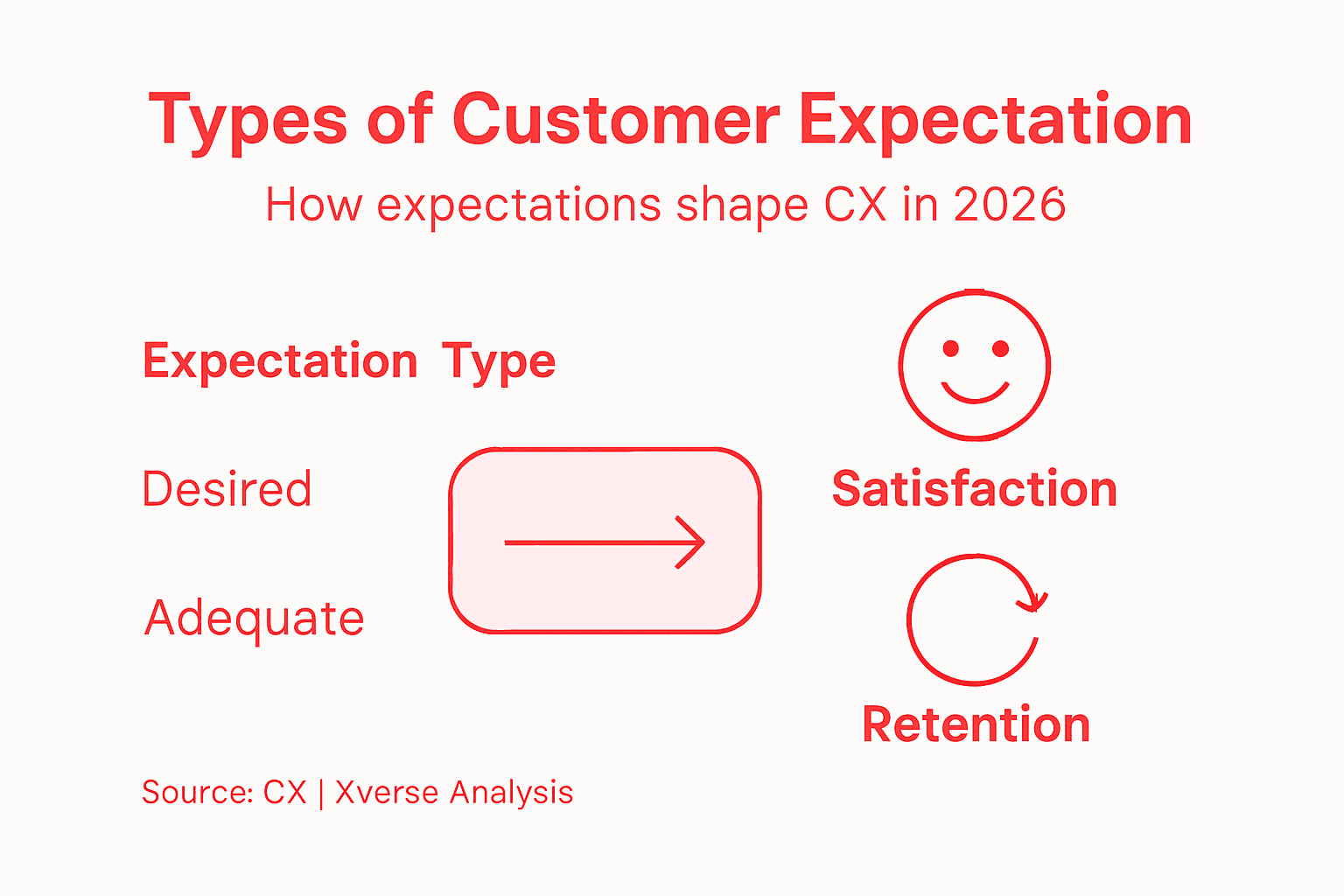
Customers operate with two baseline expectations simultaneously. Desired service levels represent what customers hope you’ll deliver—the ideal experience they’re imagining. Adequate service levels are the minimum they’ll tolerate before walking away.

Think of it as a range rather than a target. Your job isn’t hitting one number. It’s ensuring you stay within the acceptable band while pushing toward the desired end.
Normative vs. Predictive Expectations
Expectations can be normative or predictive in nature. Normative expectations reflect what customers believe should happen based on standards and principles. Predictive expectations reflect what customers believe will happen based on past experience and competitor behavior.
These matter because they influence satisfaction differently. A customer with high predictive expectations (expecting poor service) might be satisfied with mediocre delivery. A customer with high normative expectations (believing service should be excellent) will be dissatisfied with the same experience.
To clarify how types of customer expectations differ and influence business strategy, see this comparison:
| Expectation Type | How Formed | Impact on Satisfaction | Example Business Response |
|---|---|---|---|
| Normative | Based on ideals or standards | Drives demand for best-in-class service | Set high service benchmarks |
| Predictive | Based on past experience | Influences response to actual delivery | Align communication with reality |
| Desired | Represents the ideal scenario | Exceeding builds loyalty, falling short may disappoint | Invest in delight features |
| Adequate | Minimum acceptable level | Falling below triggers churn | Ensure reliable service at base level |
Multidimensional Expectation Categories
Expectations aren’t one-dimensional. They span multiple dimensions that affect purchasing decisions and post-purchase satisfaction:
- Quality expectations (product durability, reliability, performance)
- After-sales service expectations (support, returns, warranties)
- Customer consideration expectations (responsiveness, personalization, respect)
- Offers and promotions expectations (fairness, clarity, value)
- Price expectations (fairness relative to value delivered)
Each dimension carries weight differently depending on your industry and customer segment. A software buyer prioritizes after-sales service differently than a retail customer.
How Expectations Shift Across Contexts
Expectations aren’t static fixtures. They change across customer encounters, over time, and between segments. Your enterprise client has different expectations in January than in June. A loyal customer expects something different than a first-time buyer.
These varying expectation types influence customer perceptions and satisfaction differently, requiring segment-specific management strategies rather than one-size-fits-all approaches.
Why This Matters for Strategy
Most organizations treat all expectations equally. They don’t. Focusing improvement efforts on adequate service levels produces different results than focusing on desired levels. Understanding whether your customers hold high normative or predictive expectations shapes your entire service positioning.
Segmenting by expectation type—not just demographics—reveals where competitive opportunities actually exist. You might find that mid-market customers care intensely about after-sales service while enterprise customers prioritize custom integration support.
Pro tip: Map your top three customer segments across all five expectation dimensions, identifying which dimensions create the largest satisfaction gaps, then prioritize fixing those dimensions first.
How Customer Expectation Shapes CX
Customer expectation isn’t background noise. It’s the measuring stick against which customers evaluate everything you do. When expectations and reality align, you build loyalty. When they don’t, you lose customers.
The Expectation-Performance Gap
Here’s the fundamental dynamic: customers arrive with expectations already formed. Your service gets measured against that internal benchmark, not against your intentions or effort. Meeting expectations feels normal. Exceeding them feels remarkable. Missing them feels like failure.
Satisfaction Flows From Expectation Confirmation
Expectation confirmation or disconfirmation shapes whether customers feel satisfied. When perceived service quality matches or exceeds what customers expected, confirmation occurs. Disconfirmation happens when reality falls short.
This matters because the gap between expectation and perceived quality directly influences three outcomes:
- Customer commitment (willingness to stay long-term)
- Trust in your organization (belief you’ll deliver next time)
- Repurchase intentions (actual likelihood they’ll buy again)
These aren’t nice-to-haves. They’re the foundation of customer lifetime value.
The Cognitive, Emotional, and Social Dimensions
Expectations shape more than satisfaction ratings. Customer experience unfolds across three interconnected layers shaped by expectation confirmation:
- Cognitive: Customers think about whether you delivered what you promised
- Emotional: Customers feel relief, delight, or disappointment based on expectation gaps
- Social: Customers tell others whether you met, exceeded, or failed their expectations
A customer with high expectations who receives acceptable service experiences cognitive satisfaction but emotional letdown. They may think you did okay but feel disappointed. That emotional gap often determines whether they recommend you.
Resilience Flows From Consistent Expectation Management
Setting a standard against which service performance is measured allows you to build organizational resilience. When you consistently meet expectations, customer loyalty strengthens even during service failures.
Conversely, organizations that repeatedly miss expectations experience compounding damage. Each gap erodes trust further. Customers stop giving benefit of the doubt.
Expectation management directly determines whether service failures become learning opportunities or relationship killers—it’s the difference between recovering from mistakes and losing customers permanently.
Strategic Implications
Most organizations focus on delivering excellent service then wonder why customers aren’t loyal. They’re ignoring the expectation piece. Setting and managing expectations upstream prevents massive satisfaction gaps downstream.
This is why customer journey mapping helps organizations identify where expectation gaps emerge and where confirmation moments matter most.
Pro tip: Conduct an expectation audit with your top three customer segments: ask them what they expected before purchase, compare it to what they actually received, and identify the largest gaps to address first.
Evolving Behaviors and Influences in 2026
Customer expectations aren’t static fixtures from last year. They’re shifting right now based on what competitors offer, what technology enables, and what customers experience everywhere else. Understanding 2026’s behavioral trends keeps you ahead rather than reactive.
The Digital-First Baseline
Digital engagement has become the default expectation, not the exception. Customers expect to interact with you seamlessly across channels—mobile, web, email, social, phone—without repeating themselves. They’re not asking for multichannel support anymore. They’re demanding it.
Customer behaviors are evolving due to increased digital engagement, creating expectations your organization must match. This isn’t about having a website. It’s about creating experiences that work equally well everywhere customers choose to engage.
Personalization Has Become Non-Negotiable
Generic experiences feel insulting now. Customers expect you to know who they are, remember their preferences, and tailor interactions accordingly. The bar isn’t “we know your name.” It’s “we anticipate what you need before you ask.”
This expectation stems from experiences with organizations that genuinely personalize. Customers compare you against the best personalization they’ve experienced anywhere, not just in your industry.
Speed and Proactivity Matter More Than Ever
Waiting is becoming intolerable. Customers expect answers immediately, problems solved without having to escalate, and service teams reaching out before issues escalate. Reactive support feels archaic.
Shifts in consumer expectations emphasize swiftness and competence, reshaping how successful organizations compete. Speed without quality backfires. Quality without speed frustrates. You need both.
Relationship-Building Over Transactions
In 2026, customers increasingly expect genuine relationships, not transactional interactions. They want to feel valued as individuals, not as account numbers or lifetime value statistics.
This manifests through:
- Remembering their history and preferences across interactions
- Offering help proactively based on their patterns
- Showing genuine interest in their success, not just your revenue
- Delivering consistent experience across every touchpoint
The Commitment and Consistency Expectation
Customer loyalty increasingly depends on one thing: consistent, high-quality interactions that demonstrate you understand their changing needs. One excellent interaction followed by mediocre service erodes trust quickly.
Organizations that survive 2026 won’t be those with the flashiest technology—they’ll be those delivering predictable excellence repeatedly, anticipating needs, and maintaining genuine relationships.
What This Means for Your Strategy
These evolving expectations demand agility. You can’t plan your CX strategy for 2026 in 2024 and expect it to hold. You need systems for continuous learning about what customers need, rapid experimentation, and quick adjustments.
This requires balancing standardization (consistency) with flexibility (personalization). It means investing in technology that enables speed without sacrificing human connection. It means building teams trained not just in processes but in customer empathy.
Here’s a summary of evolving customer behaviors and what companies should prioritize to stay competitive in 2026:
| Trend for 2026 | Customer Expectation | Business Priority |
|---|---|---|
| Ubiquitous digital engagement | Seamless, cross-channel service | Integrate all service touchpoints |
| Personalization everywhere | Recognized and anticipatory support | Use data for tailored experiences |
| Instant response and solutions | Fast, proactive communication | Automate routine requests; empower staff |
| Consistency and trust | Reliable, predictable outcomes | Standardize high-quality processes |
Pro tip: Survey your top customer segments quarterly about what they expect in the next six months, test new service approaches with early adopters, and measure impact on loyalty before rolling out broadly.
Risks of Failing to Meet Expectations
Unmet expectations don’t just disappoint customers. They trigger a cascade of business damage that compounds over time. Understanding these risks moves expectation management from nice-to-have to mission-critical.
The Satisfaction Spiral Downward
When you miss expectations, satisfaction drops immediately. But that’s just the beginning. Disappointed customers start questioning their purchase decision, experiencing what psychologists call cognitive dissonance. They wonder if they made a mistake buying from you.
This internal doubt is dangerous. It makes customers receptive to competitor messaging. It makes them vulnerable to switching at the first opportunity.
Loyalty Erodes Faster Than You Can Rebuild It
Failing to meet customer expectations leads to diminished loyalty and increased defection to competitors. One unmet expectation doesn’t destroy loyalty immediately. But repeated failures compound trust erosion until customers leave.
The painful part: rebuilding trust takes roughly seven times longer than destroying it. One year of missed expectations might require seven years of consistent delivery to recover from.
Word-of-Mouth Becomes Your Enemy
Dissatisfied customers tell an average of 9-15 people about their negative experience. Satisfied customers tell roughly 5 people about positive ones. Your worst marketing comes from customers you disappointed.
In the digital age, this multiplies. Negative reviews spread faster. Social media amplifies complaints. One customer’s bad experience can reach thousands before you know it happened.
Trust Erosion Creates Cascading Damage
The risks of not meeting customer expectations include erosion of trust and customer disengagement. When trust erodes, customers stop believing anything you say. Marketing messages get dismissed. Service improvements go unnoticed. Loyalty programs feel like manipulation.
This creates a vicious cycle: you invest in improvement, but damaged trust prevents customers from recognizing it.
Market Share and Revenue Losses Accelerate
Unmet expectations trigger three simultaneous revenue threats:
- Lost customers (churn increases)
- Reduced spending (remaining customers buy less)
- Acquisition costs spike (negative word-of-mouth makes new customers harder to attract)
The financial impact compounds. You lose revenue from existing customers while spending more to replace them.
Brand Equity Deteriorates
Your brand equity—the premium customers pay for your name versus competitors—depends entirely on delivering what you promise. Miss expectations consistently, and that equity evaporates.
Every unmet expectation represents a broken promise. Broken promises accumulate into a broken brand—one that customers avoid rather than choose.
The Complexity Multiplier
Customer expectations are accelerating in complexity and scale. Meeting simple expectations in 2015 was achievable. Meeting the personalized, omnichannel, proactive expectations of 2026 requires systematic excellence.
The good news: organizations that invest in expectation management now gain competitive advantage. The bad news: those that don’t will face increasingly rapid customer loss as expectations continue rising.
Pro tip: Identify your top three reasons customers currently leave or express dissatisfaction, then measure whether these stem from unmet expectations or service delivery failures, and address root causes first.
Drive CX Innovation by Mastering Customer Expectations Today
The challenge of managing evolving customer expectations is critical for any organization aiming to lead in 2026. This article highlights how dynamic, multidimensional expectations shape loyalty and trust while exposing risks from unmet demands such as inconsistent service and slow responsiveness. If you struggle to keep pace with these fast-changing expectations or find gaps between desired and adequate service levels, you are not alone. Understanding these complexities and acting on them strategically will empower your business to deliver seamless, personalized experiences that foster lasting relationships.
Explore actionable insights and expert guidance in the CX | Xverse category to stay ahead in the customer experience game. At Xverse, we specialize in transforming these challenges into competitive advantages through strategy-led transformation and AI-driven insights. Visit our site to learn how our tailored consulting and experience blueprint development can help you anticipate shifting expectations and build resilient customer relationships. Act now to turn expectation management into your organization’s growth engine and avoid the high costs of customer churn.
Frequently Asked Questions
What are customer expectations and why are they important?
Customer expectations are the combination of wants, needs, and desires that customers hold regarding products and services. They are crucial because they directly influence customer satisfaction, loyalty, and overall business success.
How can businesses effectively manage shifting customer expectations?
Businesses can manage shifting customer expectations by systematically tracking changes through customer feedback, competitive analysis, and adapting to industry trends. Regular audits and mapping desired and minimum acceptable service levels can help identify gaps.
What are the different types of customer expectations?
Customer expectations can be classified into normative (what should happen), predictive (what will happen based on past experiences), desired (ideal scenarios), and adequate (minimum acceptable levels). Understanding these types helps tailor customer experiences effectively.
How do unmet customer expectations impact businesses?
Unmet customer expectations can lead to a downward satisfaction spiral, erode loyalty, generate negative word-of-mouth, and ultimately result in revenue losses. Rebuilding trust after unmet expectations takes significantly longer than the initial erosion process.