

What happens at every interaction defines whether a customer chooses trust or walks away. Mapping your current touchpoints is the first step to revealing hidden friction and missed opportunities that impact loyalty. By focusing on data-driven interaction enhancements and embracing deep customer journey mapping, you gain actionable clarity to prioritize improvements. This article outlines strategies to uncover, personalize, and optimize each phase for measurable gains in engagement and satisfaction.
Table of Contents
- Step 1: Assess Current Customer Touchpoints
- Step 2: Map And Personalize Critical Customer Journeys
- Step 3: Implement Data-Driven Interaction Enhancements
- Step 4: Validate Improvements Through Real-Time Feedback
Quick Summary
| Key Message | Explanation |
|---|---|
| 1. Assess All Customer Touchpoints | List and evaluate every platform where customers engage with your business to identify gaps and opportunities. |
| 2. Personalize Customer Journeys | Design tailored experiences based on distinct customer segments to enhance relevance and connection. |
| 3. Implement Data-Driven Enhancements | Use specific metrics to identify pain points and apply targeted changes that improve customer interactions. |
| 4. Validate Changes with Real-Time Feedback | Capture immediate customer feedback post-interaction to ensure changes resonate and meet expectations. |
Step 1: Assess current customer touchpoints
You’re about to map the reality of how customers interact with your organization right now. This isn’t about what you think is happening—it’s about what actually is. Understanding your current touchpoints reveals gaps, redundancies, and opportunities that directly impact loyalty.
Start by listing every place where customers interact with your business. Think beyond obvious channels like email and phone. Include your website, social media, in-person locations, product packaging, customer support portals, billing statements, and post-purchase communications.
Your team should approach this horizontally across the entire customer journey. Map touchpoints across three critical phases:
- Pre-purchase interactions where customers discover and evaluate your offering
- Purchase-stage touchpoints where transactions occur
- Post-purchase engagements that define ongoing relationships
For each touchpoint, assess what’s actually happening. Are customers satisfied? Frustrated? Confused? Research shows that understanding customer preferences at different purchase stages reveals which touchpoints maximize value and improve overall experience.
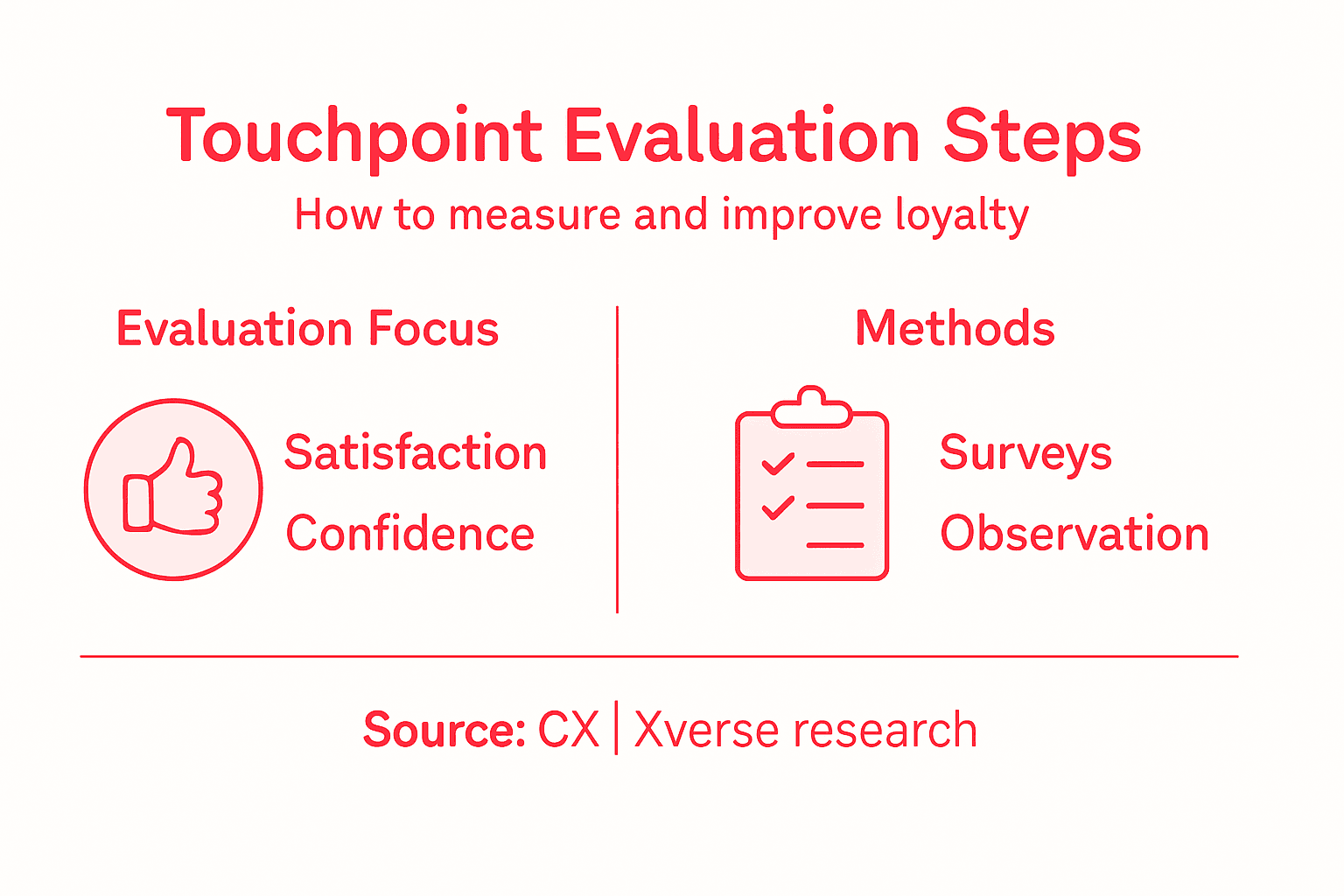
Measure touchpoint effectiveness beyond simple satisfaction metrics. Look at whether each interaction inspires confidence, solves problems, or creates friction. Document how well each touchpoint aligns with your brand promise and customer expectations.
Here’s a summary of ways to measure and enhance customer touchpoint effectiveness:
| Evaluation Method | What It Measures | Benefit for Loyalty |
|---|---|---|
| Customer Satisfaction | Emotional response per interaction | Reveals like or dislike in the moment |
| Problem Resolution Rate | Speed and success clearing issues | Builds trust with efficient solutions |
| Friction Points Analysis | Locations where confusion occurs | Directs improvement to pain points |
| Brand Alignment Score | Consistency with brand promise | Reinforces expectations and credibility |
Document the current state honestly. Don’t polish it or present it as you’d like it to be. This baseline becomes your reference point for improvement. Note which touchpoints lack data, staff training, or proper systems.
Consider conducting a formal CX maturity assessment to understand your organization’s readiness and capability across customer experience dimensions.
Your current touchpoints are either building loyalty or eroding it—there’s no neutral ground. Assess them honestly.
Pro tip: Use your frontline teams to identify overlooked touchpoints. Customer service reps, sales staff, and support specialists know where friction actually occurs, revealing hidden interactions that executive stakeholders often miss.
Step 2: Map and personalize critical customer journeys
Now that you understand your current touchpoints, it’s time to create intentional journeys that speak directly to your customers. Mapping and personalizing these journeys transforms generic interactions into experiences that resonate with specific customer needs and preferences.

Start by identifying your most valuable customer segments. These aren’t just demographic categories—they’re distinct groups with different needs, pain points, and expectations. Understanding these segments allows you to design journeys that feel relevant rather than one-size-fits-all.
For each segment, map the critical journey stages:
- Awareness stage where customers first discover your solution
- Consideration phase where they evaluate options
- Decision point where they commit to purchase
- Onboarding and activation after the sale
- Loyalty and advocacy as ongoing relationships develop
At each stage, document what messages, content, and support this specific segment needs. This is where personalization begins. One segment might need extensive educational content while another needs quick, transactional efficiency.
Use AI-driven journey mapping to capture precise interactions and predict how customer preferences shift over time. This approach helps you continuously refine journeys based on actual behavior rather than assumptions.
Design for both scope and intensity across your channels. Scope refers to which touchpoints are included in each journey. Intensity determines how personalized each interaction becomes. A high-intensity journey might include predictive outreach and customized content, while lower-intensity touchpoints maintain consistency without over-personalizing.
Compare these journey mapping approaches and their advantages:
| Approach | Personalization Level | Best Used For |
|---|---|---|
| Generic Journey Mapping | Low | Mass communication, simple products |
| Segment-Based Mapping | Medium | Targeted offers, key user groups |
| AI-Driven Personalization | High | Predictive, evolving customer needs |
Consider using a customer journey mapping service to structure this work and ensure alignment across your organization.
Personalization at scale requires knowing your customer segments deeply enough to anticipate their next move before they make it.
Pro tip: Test your journey maps with actual customers from each segment before rolling them out organization-wide. Five to ten interviews per segment reveal blindspots that internal teams always miss, saving months of misaligned efforts.
Step 3: Implement data-driven interaction enhancements
You’ve mapped your journeys and identified where improvements matter most. Now it’s time to use data to actually make those improvements real. Data-driven enhancements transform assumptions into concrete changes that measurably increase loyalty.
Start by identifying which metrics reveal the health of each interaction. Don’t measure everything—focus on what matters for loyalty. Track completion rates, time spent, abandonment points, sentiment shifts, and post-interaction behavior.
Analyze the data at the interaction level. What happens right before customers abandon? Where do they slow down? When do they show signs of frustration? Use real-time analysis of engagement and behavior patterns to identify exactly where friction exists and where improvements will have the biggest impact.
Implement targeted enhancements based on what the data reveals:
- Simplify interactions with high abandonment rates
- Add clarity where confusion signals appear in your data
- Reduce unnecessary steps in journeys that feel slow
- Personalize moments where generic messaging converts poorly
- Improve timing based on when customers actually engage
Test each enhancement with a subset of your audience before rolling it out. Run experiments that compare the old interaction to the new one. Measure whether your change actually increases the metrics that matter for loyalty.
Collect actionable feedback after implementing changes. Ask customers what improved and what still frustrates them. This qualitative data catches what your metrics miss and guides your next round of enhancements.
Create a feedback loop that continuously refines interactions. Each quarter, analyze what’s working, test new improvements, and measure results. This cycle compounds over time.
Data reveals where customers struggle. Wisdom is knowing which struggles matter most for loyalty and acting on them relentlessly.
Pro tip: Start with your lowest-performing touchpoint, not your highest-performing one. Quick wins on struggling interactions often yield faster loyalty gains than optimizing what already works well.
Step 4: Validate improvements through real-time feedback
You’ve implemented changes based on data analysis. Now you need to confirm those changes actually work by listening to customers as they experience them. Real-time feedback validation closes the gap between what you think improved and what customers actually feel.
Set up mechanisms to capture feedback immediately after customers interact with your enhanced touchpoints. Don’t wait for quarterly surveys. Ask right after the experience while it’s fresh in their minds.
Implement multiple feedback channels simultaneously:
- Post-interaction surveys with 2-3 quick questions about the experience
- Net Promoter Score tracking to monitor shifts in loyalty sentiment
- Open-ended feedback boxes where customers describe what worked and what didn’t
- Social listening to catch unsolicited comments about your improvements
- Direct follow-up calls or messages with high-value customers
Use real-time feedback systems to capture continuous evaluation and behavior insights that reveal whether improvements actually resonate with customers. This approach uncovers gaps between metrics and emotional experience.
Analyze feedback patterns weekly, not monthly. Look for trends in what customers repeatedly mention. One customer saying an interaction felt rushed matters less than ten customers saying it. Patterns reveal what’s genuinely broken versus isolated complaints.
Compare feedback between customer segments. An improvement that delighted one segment might have frustrated another. This reveals whether your personalization is actually working or creating confusion.
Close the loop by communicating changes back to customers who provided feedback. Show them that their input directly influenced your decisions. This builds trust and encourages continued participation in your feedback process.
Customers will tell you exactly what works if you ask them while the experience is still vivid. Listen harder than you push back.
Pro tip: Weight feedback from your most loyal customers more heavily than from new ones. Long-term customers understand your brand deeply and their resistance to changes often signals real problems, not just resistance to novelty.
Elevate Your Customer Interactions to Build Lasting Loyalty
Understanding the real challenges behind customer touchpoints is vital to creating experiences that truly resonate. This article highlights key pain points such as identifying friction points, personalizing journeys for distinct customer segments, and using data-driven insights to enhance interactions. If you are aiming to move beyond assumptions and want to craft meaningful, loyalty-driving experiences, integrating strategic design and AI-driven analysis can make all the difference.
Discover how CX | Xverse helps organizations transform customer experience from a fragmented set of touchpoints into a cohesive, impactful journey.
Take action now to harness expert guidance and innovative solutions tailored to your business needs. Visit Xverse today to explore how our consulting services and technology enable you to close the gap between data and emotion, creating real customer loyalty. Start optimizing your interactions with proven strategies from our Uncategorized | Xverse insights and join the many businesses accelerating growth through exceptional customer experience.
Frequently Asked Questions
How can I assess my current customer touchpoints?
Start by listing every interaction point customers have with your organization, including your website, social media, and customer support. Evaluate customer satisfaction, confusion, and alignment with your brand promise to identify gaps and opportunities for improvement.
What are effective methods for mapping customer journeys?
Use segmentation to identify your most valuable customer groups and map their journey stages, including awareness, consideration, and loyalty. Document the specific needs and expectations for each segment to create personalized and relevant experiences.
How can data help improve customer interactions?
Focus on metrics that measure interaction health, such as abandonment points and sentiment shifts. Analyze data to identify friction areas and implement targeted enhancements that simplify the customer experience, aiming for measurable loyalty increases.
What strategies should I use to validate improvements?
Implement real-time feedback mechanisms immediately after customer interactions, such as short surveys and open-ended feedback boxes. Analyze feedback patterns weekly to understand what changes resonate with customers and adjust your strategies accordingly.
How often should I review customer feedback?
Analyze customer feedback weekly to identify trends and recurring themes that indicate how customers perceive your brand. This frequent review allows you to make timely adjustments and continuously enhance the loyalty-building aspects of customer interactions.