

Customers today expect every interaction with your brand to feel seamless, personal, and emotionally resonant. For CX leaders working in global retail, defining a customer experience strategy is much more than managing touchpoints—it is a holistic approach that influences loyalty and business growth at every stage of the journey. This article offers practical guidance on building a strategy that unifies departments and harnesses data-driven frameworks, preparing you to deliver consistent satisfaction across all markets.
Table of Contents
- Defining Cx Strategy And Its Core Concepts
- Essential Components Of An Effective Cx Strategy
- How Data, Ai, And Omnichannel Drive Success
- Building Customer-Centric Cultures For Innovation
- Common Pitfalls And How To Avoid Them
Key Takeaways
| Point | Details |
|---|---|
| Understand CX Strategy | Customer Experience (CX) is the totality of customer interactions, requiring a deliberate strategy that aligns all departments towards a unified goal. |
| Focus on Customer Perception | Emotional responses shape brand loyalty; understanding customer perceptions is crucial for enhancing interactions at every touchpoint. |
| Utilize Data and AI | Leveraging data and AI allows for personalized experiences and proactive customer engagement, driving loyalty and satisfaction. |
| Foster a Customer-Centric Culture | Building a culture that prioritizes customer needs across all levels of the organization leads to improved decision-making and exceptional experiences. |
Defining CX Strategy and Its Core Concepts
Customer experience (CX) is far more than a buzzword. It represents every interaction a customer has with your brand—from the moment they discover you until long after purchase. Customer experience encompasses all interactions throughout the journey, including pre-purchase exploration, purchase transactions, and post-purchase support.
Your CX strategy is the deliberate plan to manage these interactions consistently and competitively. It’s not isolated to one department. Rather, it acts as a unifying force that breaks down silos between marketing, sales, service, and product teams.
What Makes CX Different From Customer Service
Customer service handles specific problems when they arise. CX strategy shapes the entire perception of your brand across all touchpoints. Think of service as reactive and CX as proactive architecture.
When a customer calls your support team, that’s service. When they find your website intuitive, receive personalized recommendations, and feel valued after checkout—that’s CX at work.
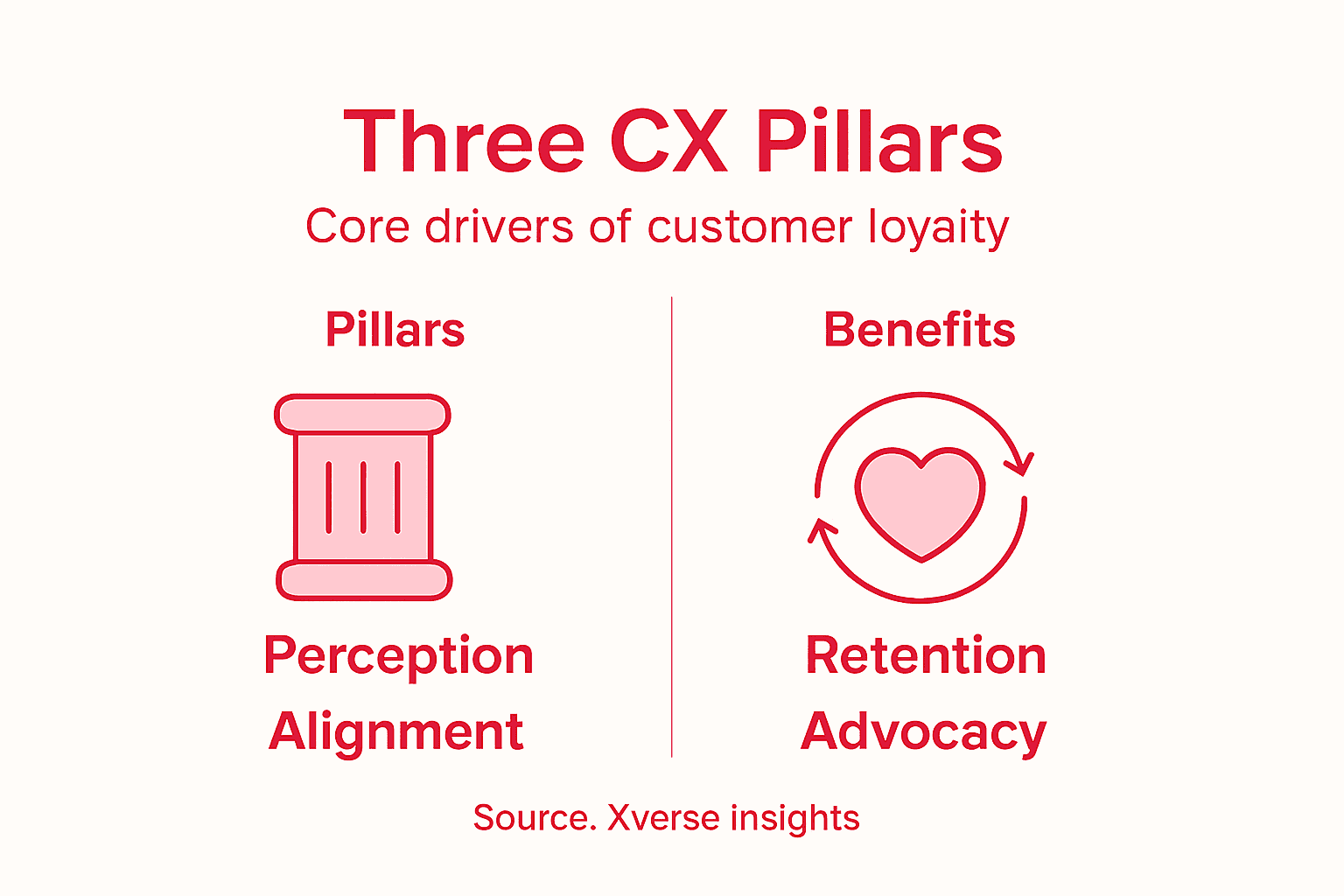
The Three Pillars of CX Strategy
Effective CX strategy rests on three foundational elements:
- Customer perception – How customers emotionally respond to and interpret your brand at every interaction
- Organizational alignment – How all departments integrate customer-focused thinking into their daily decisions and processes
- Touchpoint management – How consistently you deliver on promises across channels, devices, and teams
Customer experience is fundamentally about perception and emotional response, not just transactional efficiency. It’s the feeling customers carry away from every interaction.
Your strategy must address the reality that perception varies. A seamless checkout for one customer might feel impersonal to another. Geographic location, industry, and individual preferences all shape expectations differently.
Here’s how CX strategy pillars influence business outcomes:
| Pillar | Business Impact | Example Benefit |
|---|---|---|
| Customer Perception | Drives brand loyalty and repeat visits | Higher retention rates |
| Organizational Alignment | Reduces internal conflicts and silos | Consistent messaging across teams |
| Touchpoint Management | Enhances service consistency | Smooth omnichannel experience |
Why Retail Leaders Need CX Strategy Now
For global retail organizations, CX strategy directly impacts loyalty metrics. Customers with strong emotional connections show higher repeat purchase rates and become advocates for your brand.
Consider this: loyalty isn’t built through price alone. It emerges when customers feel understood, when friction disappears, and when their values align with yours. CX strategy creates that alignment systematically.
Without a deliberate strategy, you’re leaving loyalty gains on the table. Departments make isolated decisions that contradict each other. Customers experience inconsistency. Opportunities vanish.
The Core Components You Need
A robust CX strategy includes:
- Clear understanding of customer segments and their unique expectations
- Mapping of all touchpoints where customers interact with your brand
- Definition of what successful experience looks like at each stage
- Measurement systems that capture both satisfaction and emotional resonance
- Cross-functional governance to ensure consistent execution
Your strategy framework becomes the reference point for all customer-facing decisions. It prevents conflicting actions and creates coherent customer journeys.
Pro tip: Start by interviewing customers across different segments—not just your best customers. Ask them what frustrates them most and when they felt most valued. These insights become the foundation for strategy that actually resonates.
Essential Components of an Effective CX Strategy
Building a winning CX strategy requires more than good intentions. You need concrete components that work together to create seamless customer experiences. Each element supports the others, creating a foundation that scales across your entire organization.
Understanding Your Customers First
You cannot design for customers you don’t truly understand. Customer understanding forms the bedrock of everything that follows. This means moving beyond demographic data to grasp emotional needs, pain points, and unmet desires.

Conduct research across different customer segments. Interview long-time customers and those who left. Observe real behaviors, not just what surveys tell you. This intelligence shapes every strategic decision moving forward.
Designing for Every Touchpoint
Service design translates customer insights into tangible experiences. It requires interdisciplinary collaboration across design, development, and operational teams. You’re architecting how customers interact with your brand.
Map every touchpoint where customers engage with you:
- Pre-purchase discovery and research
- Purchase transactions across channels
- Post-purchase support and engagement
- Loyalty and advocacy opportunities
Each touchpoint either builds trust or erodes it. Consistency matters more than perfection.
Measuring What Matters
You manage what you measure. Robust measurement systems capture both satisfaction scores and emotional resonance. Track metrics that reveal whether customers feel valued, understood, and respected.
Go beyond Net Promoter Score alone. Include:
- Customer effort scores that reveal friction points
- Emotional metrics that show whether customers feel connected
- Behavioral data showing actual loyalty and repeat purchase rates
- Feedback channels that surface real-world frustrations
Effective CX strategy requires continuous measurement and refinement. You’re not hitting a target once—you’re building an ongoing improvement engine.
Governance That Ensures Alignment
Governance policies prevent departments from working at cross-purposes. Without clear guidelines, marketing promises something sales can’t deliver, or service contradicts what product was designed for.
Establish clarity on:
- Who owns customer experience decisions
- How conflicts get resolved between departments
- What success looks like and who’s accountable
- How quickly you respond to customer feedback
Governance isn’t bureaucracy. It’s the operating system that keeps everyone moving in the same direction.
Building a Customer-Centric Culture
Strategy lives or dies based on whether your team believes in it. Fostering a customer-centric culture means every employee, from logistics to finance, understands their role in shaping experiences.
This requires regular communication, clear examples of customer impact, and celebrating when teams go the extra mile. Culture change takes time, but it’s what separates companies that deliver exceptional experiences from those that just talk about it.
Pro tip: Assign one person to own the CX strategy end-to-end—this champion keeps initiatives moving and connects disparate teams around shared customer goals.
How Data, AI, and Omnichannel Drive Success
Data and AI aren’t future technologies anymore. They’re the operating system behind winning CX strategies today. When you harness both intelligently, you unlock the ability to deliver personalized experiences at scale across every channel your customers use.
The Power of Data-Driven Personalization
Your customers expect you to remember them. They want relevant recommendations, contextual messaging, and interactions tailored to their preferences. This only happens when you collect, organize, and act on customer data strategically.
Data analytics reveals patterns that intuition misses. You see which customers are likely to churn, which products resonate with specific segments, and where friction actually occurs in your journeys.
Start collecting data that matters:
- Purchase history and browsing behavior
- Customer service interactions and feedback
- Demographic and preference information
- Engagement across channels and devices
Data alone changes nothing. You must translate insights into action—faster delivery recommendations, proactive service outreach, or adjusted pricing strategies that feel fair.
AI as Your Experience Engine
AI-driven capabilities transform how you interact with customers in real time. Predictive analytics anticipate needs before customers articulate them. Sentiment analysis reveals emotional states hidden in feedback. Dynamic pricing optimizes value without feeling exploitative.
Intelligent experience engines personalize journeys across omnichannel environments by learning from millions of interactions. The result is context-aware interactions that feel natural, not mechanical.
Your AI should handle:
- Recommendation engines that suggest relevant products and content
- Chatbots that resolve issues instantly while knowing when to escalate
- Predictive models that flag at-risk customers for targeted retention
- Behavioral analysis that optimizes website layouts and messaging
AI multiplies the impact of your CX strategy by enabling personalization at scale. Without it, you’re guessing. With it, you’re predicting and responding intelligently.
Omnichannel Integration That Actually Works
Your customers don’t think in channels. They move fluidly between your website, mobile app, social media, physical stores, and support lines. Your systems must work together seamlessly.
Omnichannel orchestration means a customer can start their journey online, continue in-store, and complete via mobile without repeating information or losing context. This requires backend integration that connects inventory, customer profiles, and transaction history across all touchpoints.
The friction points most retailers miss:
- A customer researches online but their store associate has no visibility into that research
- Purchase history doesn’t follow customers between channels
- Loyalty programs don’t recognize customers equally across touchpoints
- Support tickets exist in silos rather than showing complete customer context
Break these silos. Invest in systems that share customer data across channels in real time. When your entire organization sees the same customer view, experiences become genuinely seamless.
Connecting Data, AI, and Channels
These three elements work best together. Data feeds AI models. AI personalizes omnichannel experiences. Omnichannel interactions generate new data that refines AI further. It’s a virtuous cycle.
Retailers who master this combination see measurable loyalty improvements—higher repeat purchase rates, longer customer lifespans, and stronger advocacy.
Consider the ways data, AI, and omnichannel strategies enhance CX effectiveness:
| Approach | CX Enhancement | Loyalty Outcome |
|---|---|---|
| Data Analytics | Personalizes recommendations | Increased repeat purchases |
| AI Capabilities | Predicts customer needs | Faster issue resolution |
| Omnichannel | Integrates journeys | Reduced customer frustration |
Pro tip: Start with one high-impact use case: AI-powered product recommendations across your top three channels. Measure the results, then expand to sentiment analysis, churn prediction, or dynamic pricing.
Building Customer-Centric Cultures for Innovation
Strategy documents sit on shelves. Culture lives in how people actually work. For CX strategy to transform loyalty, it must become embedded in your organizational DNA—how people are hired, rewarded, and recognized.
Making Customer Empathy Operational
Customer empathy starts as a nice sentiment but becomes powerful when you operationalize it. This means building systems and processes that force teams to confront actual customer needs, not assumptions.
Create regular touchpoints where employees interact with real customers. Have customer service representatives share stories in all-hands meetings. Bring actual customers into product development sessions. When your finance team hears directly from customers about payment struggles, budgets shift.
Your teams will make better decisions when they truly understand who they’re serving and why it matters.
Hiring for the Right Mindset
Hiring for customer orientation means looking beyond technical skills to find people who naturally empathize with others. You can teach someone SQL. You cannot teach someone to genuinely care about solving problems for others.
Interview questions should probe for:
- Examples of when they went extra for a customer
- How they’ve handled frustration from difficult people
- Stories showing they listen more than they talk
- Times they prioritized someone else’s needs over convenience
One wrong hire—someone who treats customer concerns as obstacles—can poison an entire team’s culture. Hiring carefully compounds your advantage over time.
Democratizing Customer Insights
When only executives see customer research, decisions remain disconnected from reality. Democratizing customer insights means making data accessible and visible across your organization.
Share insights widely:
- Publish quarterly customer research summaries accessible to all employees
- Host monthly customer insight sessions where different teams analyze feedback
- Create dashboards showing real-time satisfaction, sentiment, and behavioral data
- Invite frontline staff to contribute observations from their customer interactions
A warehouse manager who sees customer frustration data will make different staffing decisions. An accountant who understands payment pain points will streamline processes differently. Insights drive better choices when they’re widely shared.
Linking Employee Culture to Customer Outcomes
Operationalizing customer empathy requires deliberate leadership actions that connect how employees work to actual customer results. When people see the direct line between their efforts and customer satisfaction, motivation shifts from compliance to ownership.
Create transparency around the connection:
- Show how service teams’ response speed affects customer loyalty scores
- Demonstrate how product teams’ quality improvements reduce support volume
- Display how operations teams’ accuracy prevents customer frustration
When people see their work’s impact, they care differently.
Tying Rewards to Customer Behaviors
Your compensation and recognition systems reveal what you actually value. Reward systems should reinforce customer-centric choices, not just revenue targets or cost cuts.
Tie bonuses and promotions to:
- Customer satisfaction improvements
- Loyalty metrics specific to their department
- Cross-functional collaboration that improves experiences
- Innovation that solves real customer problems
When incentives reward customer-centric behavior, culture shifts naturally. People follow money—point it toward customer outcomes.
Pro tip: Start with one team: identify your highest-impact customer-facing group and redesign their rewards completely around customer outcomes for one quarter, then measure the culture shift.
Common Pitfalls and How to Avoid Them
CX strategy fails not because the concept is flawed, but because organizations stumble on execution. Understanding where retailers typically falter helps you sidestep those mistakes and accelerate your progress toward loyalty impact.
The Ownership Vacuum
When everyone owns CX, no one owns it. This is the most common trap. Strategy gets buried under daily priorities. Initiatives stall. Budgets disappear when quarterly pressures hit.
Dedicated CX teams with clear accountability prevent this drift. Your CX leader needs authority to make decisions, access to budgets, and visibility with executives. They own the strategy’s execution end-to-end.
Without dedicated ownership:
- CX initiatives compete with other projects and lose
- Measurement systems never get built
- Customer insights sit in reports nobody reads
- Problems identified never get solved
Assign a CX leader with real power. Give them a team. Hold them accountable for loyalty metrics.
Misunderstanding Customer Journeys
Many retailers know their transactions but miss the actual customer journey. You see the purchase. You miss the research phase, the post-purchase support needs, the moment they almost left but didn’t.
Journey mapping requires talking to customers at every stage, not just guessing based on internal processes. When you understand the full journey, you see friction points your systems create.
Map journeys by:
- Interviewing customers across different segments and purchase sizes
- Observing actual behavior, not just surveying stated preferences
- Documenting emotional highs and lows at each stage
- Identifying where customers interact with multiple departments
Incomplete journey understanding leads to incomplete solutions. You fix symptoms while problems fester elsewhere.
Failing to Monitor and Share Insights
Incomplete understanding and poor measurement create blind spots that widen over time. You collect data but never act on it. Insights remain locked in reports. Patterns go unnoticed until customers vote with their wallets.
Continuous monitoring means real-time dashboards, not quarterly reports. Weekly team reviews of customer sentiment. Monthly deep dives into friction points. This rhythm keeps CX top-of-mind.
Ensure insights flow everywhere:
- Share monthly summaries with all leadership
- Publish customer feedback in team channels
- Celebrate improvements driven by insights
- Show exactly how customer feedback drove decisions
Organizations that fail to share insights widely end up with data silos and disconnected decisions. Information without distribution is just noise.
The Measurement Trap
Measuring everything but understanding nothing wastes effort. You track dozens of metrics but can’t explain what’s actually driving loyalty. This happens when measurement lacks strategy.
Focus measurement on outcomes that matter. Start with:
- Overall loyalty (repeat purchase rate, lifetime value)
- Customer satisfaction at key journey stages
- Effort required to complete common tasks
- Emotional connection and brand advocacy
Then trace backward to understand what drives these outcomes. Abandon metrics that don’t connect to loyalty impact.
Isolated Departments, Fragmented Experiences
Marketing promises convenience. Operations delivers delays. Product emphasizes features. Support emphasizes limitations. Without cross-functional governance, departments create contradictory experiences.
Break silos through:
- Shared customer metrics all departments contribute to
- Monthly cross-functional CX review meetings
- Joint goal-setting around loyalty improvements
- Shared accountability for customer experience outcomes
Pro tip: Audit your last five customer complaints—trace them to root cause and you’ll identify exactly which silos need breaking first.
Unlock True Customer Loyalty With a Strategic CX Partner
The challenge many organizations face today is turning their CX strategy into a powerful engine that drives real customer loyalty and advocacy. This article highlights key pain points including fragmented touchpoint management, siloed departments, and the struggle to harness data and AI effectively. At Xverse, we understand that customer perception, organizational alignment, and omnichannel integration are not just ideas but essential pillars that must work together seamlessly to create lasting emotional connections with customers.
Take the next step in transforming your customer experience by partnering with Xverse. We specialize in strategy-led transformation, helping businesses design impactful customer journeys and leverage AI-driven insights for faster, smarter decision-making. Don’t let inconsistent touchpoints or unclear governance hold you back from the loyalty your brand deserves. Visit Xverse to discover how our CX leadership advisory can empower your teams to build a customer-centric culture that drives measurable growth. Start elevating your CX maturity today with Xverse digital transformation solutions and access insightful resources like our CX Chronicles blog to keep your organization ahead of evolving customer expectations.
Frequently Asked Questions
What is a CX strategy?
A CX strategy is a deliberate plan that aims to manage every interaction a customer has with your brand from discovery to post-purchase support, ensuring consistency and competitiveness across all touchpoints.
How does CX differ from customer service?
CX encompasses the entire customer journey and perception of the brand, while customer service focuses on addressing specific problems as they arise. CX is proactive, aiming to improve overall experiences rather than just reacting to issues.
What are the key pillars of an effective CX strategy?
The three pillars of an effective CX strategy are customer perception, organizational alignment, and touchpoint management. These elements help shape how customers view your brand and ensure consistent experiences across all interactions.
Why is a customer-centric culture important for CX strategy?
A customer-centric culture ensures that every employee understands their role in shaping customer experiences. This alignment fosters empathy towards customer needs and drives better decision-making, ultimately enhancing customer loyalty and satisfaction.
Recommended
- How to Optimize Customer Interactions for Stronger Loyalty – Xverse
- 6 Customer Experience Trends 2026 for Tech Leaders – Xverse
- Xverse – Transforming experiences with the power of CX, Design & Digital transformation
- Customer Expectation: Shaping CX Innovation in 2026 – Xverse
- Stratégie contenu vidéo 2025 : réussir l’engagement client