

Disconnected transactions no longer satisfy customers who crave experiences that flow smoothly across every touchpoint. For senior CX leaders in the technology sector, defining an innovative customer journey means moving beyond isolated interactions to deliver connected experiences that create value at each stage. As research shows, building a structured sequence of experiences deepens engagement, strengthens loyalty, and supports lasting business growth in an environment where expectations continue to evolve.
Table of Contents
- Defining Innovative Customer Journeys Today
- Types of Journey Innovation Approaches
- How Journey Innovation Impacts Growth
- Governance, Data, and AI Integration Essentials
- Common Pitfalls and How to Avoid Them
Key Takeaways
| Point | Details |
|---|---|
| Innovative Customer Journeys | They require a structured sequence where every interaction is designed to enhance value and loyalty. |
| Dual Perspective on Value | Effective journeys must align both customer satisfaction and business objectives for mutual gains. |
| Four Innovation Approaches | Organizations may use design-led, technology-enabled, customer-involvement, or data-driven methods to innovate journeys. |
| Continuous Learning | Innovation should be an ongoing process involving regular feedback and adaptation to changing customer needs. |
Defining Innovative Customer Journeys Today
Innovative customer journeys go far beyond disconnected transactions. They represent a structured sequence of stages and touchpoints where customers interact with your organization, each moment carefully designed to build value and drive loyalty.
At their core, innovative customer journeys map the complete experience customers encounter across every interaction point. This isn’t about isolated touchpoints anymore—it’s about understanding how each moment connects and compounds to shape perception.

What Makes a Journey Innovative Today
Innovative journeys differ from traditional approaches in three fundamental ways:
- Customer-centric design: Every stage reflects what customers actually need, not what’s easiest to deliver
- Cross-channel continuity: Experiences flow seamlessly whether customers engage through mobile, web, in-store, or support channels
- Data-informed evolution: Journeys adapt based on real customer behavior, preferences, and feedback patterns
The shift from static customer journeys to dynamic, intelligent ones requires rethinking how you orchestrate experiences. Technology enables this, but strategy drives it.
Journey Value: The Dual Perspective
Modern customer journey innovation recognizes that customer journey value integrates both customer and firm perspectives, creating mutual benefit. This means designing experiences that customers find genuinely valuable while generating measurable business outcomes.
Customers expect journeys that feel personalized and efficient. Simultaneously, your organization needs these journeys to improve retention, increase lifetime value, and create operational efficiency.
When both perspectives align, something powerful happens. Customers move further along their journey, engagement deepens, and growth accelerates.
The Engagement Multiplier Effect
Engagement sits at the intersection of these perspectives. Higher engagement transforms how customers perceive your brand and what they’re willing to invest—time, attention, loyalty, and spending.
Innovative journeys intentionally create moments where customers want to engage:
- Moments of genuine value (not superficial interactions)
- Opportunities to feel heard and understood
- Clear paths forward when customers need help or want to explore more
- Recognition of their unique needs and behaviors
These aren’t accidents. They’re designed outcomes embedded throughout the journey.
Why Definition Matters for Your Strategy
Many organizations operate without a clear, shared definition of what their customer journey actually is. This creates fragmentation. Marketing, product, support, and sales teams optimize for different outcomes using different metrics.
When you define your innovative customer journey explicitly, alignment follows. Teams understand the sequence of experiences they’re responsible for. Investments target the highest-value touchpoints. Performance measurement becomes coherent.
Defining your customer journey creates a shared blueprint that transforms isolated efforts into coordinated growth acceleration.
The definition process itself—identifying stages, mapping touchpoints, understanding the mediators and moderators that influence outcomes—becomes your first strategic asset.
Pro tip: Start by mapping your current customer journey as it actually exists today (not how you think it works), interviewing real customers across different segments to uncover hidden friction points and unexpected moments of delight.
Types of Journey Innovation Approaches
Not all journey innovation looks the same. Organizations succeed with radically different strategies, depending on their maturity, market position, and customer base. Understanding the primary approaches helps you choose the right path for your context.
Research identifies ten distinct domains of customer insights that fuel innovation, from crowdsourcing and co-creation to observing customer behavior directly. Each domain represents a fundamentally different way of gathering intelligence and translating it into journey improvements.
The Four Primary Innovation Approaches
Most journey innovation falls into one of these categories:
- Design-led innovation: Reimagining touchpoints and interactions from scratch, grounded in deep customer understanding and creative problem-solving
- Technology-enabled innovation: Deploying digital tools, AI, and automation to enhance speed, personalization, and consistency across touchpoints
- Customer-involvement innovation: Co-creating experiences with customers, incorporating their feedback and ideas directly into journey design
- Data-driven optimization: Using behavior analytics and performance metrics to systematically improve existing journeys
Many leading organizations blend multiple approaches rather than choosing just one.
Here’s how the four primary journey innovation approaches differ in focus and business impact:
| Approach | Main Focus | Typical Outcomes |
|---|---|---|
| Design-led Innovation | Creative reimagining of touchpoints | Improved differentiation |
| Technology-enabled Tech | Automation and personalization | Increased efficiency and scale |
| Customer-involvement | Collaborative creation with users | Greater loyalty and advocacy |
| Data-driven Optimization | Analytics-led continuous upgrades | Higher retention and satisfaction |
Customer Insights as Your Foundation
Whichever approach you take, it starts with generating customer insights systematically. This isn’t occasional feedback collection. It’s continuous intelligence gathering about what customers need, expect, and value across every stage.
Generating insights means listening through multiple channels. Crowdsourcing uncovers ideas from your broader audience. Direct observation reveals what customers actually do versus what they say. Imagining future scenarios helps anticipate emerging needs before competitors do.
Disseminating insights ensures teams actually use them. When marketing, product, and customer service operate with fragmented customer understanding, journey innovation stalls.
B2B Journey Innovation Differs
Business-to-business customer journeys require different innovation approaches than consumer contexts, given longer cycles, multiple stakeholders, and relationship complexity. B2B buyers expect journeys that accommodate multiple decision-makers with different information needs.
This shapes innovation priorities. Technology integration becomes critical for coordinating across stakeholder groups. Customer involvement deepens because B2B buyers demand transparency and collaboration in journey design.
Applying Insights Across Stages
Customer journey innovation isn’t a one-time project. It’s systematic application of insights at every stage—awareness, consideration, decision, retention, and advocacy.
Each stage presents different innovation opportunities:
Below is a summary of innovation opportunities across customer journey stages:
| Journey Stage | Innovation Opportunity | Example Focus Area |
|---|---|---|
| Awareness | Captivating initial experiences | Storytelling campaigns |
| Consideration | Reducing friction, clear choices | Guided product comparisons |
| Decision | Seamless transactions | One-click purchasing |
| Retention | Ongoing engagement, support | Proactive help, updates |
| Advocacy | Turning users into promoters | Loyalty and referral programs |
- Early stages benefit from awareness innovation and compelling storytelling
- Middle stages need friction removal and clear guidance
- Post-purchase stages require proactive support and relationship deepening
- Advocacy stages turn satisfied customers into active promoters
Real journey innovation happens when organizations systematically generate insights, share them across teams, and apply them to create measurable improvements at every customer touchpoint.
Pro tip: Start by mapping one specific stage where you have the most customer pain points, then test one innovation approach in that stage before rolling out broader changes.
How Journey Innovation Impacts Growth
Journey innovation isn’t just about creating nicer customer experiences. It directly drives measurable business outcomes. When you optimize how customers move through their journey, growth follows as a natural consequence.
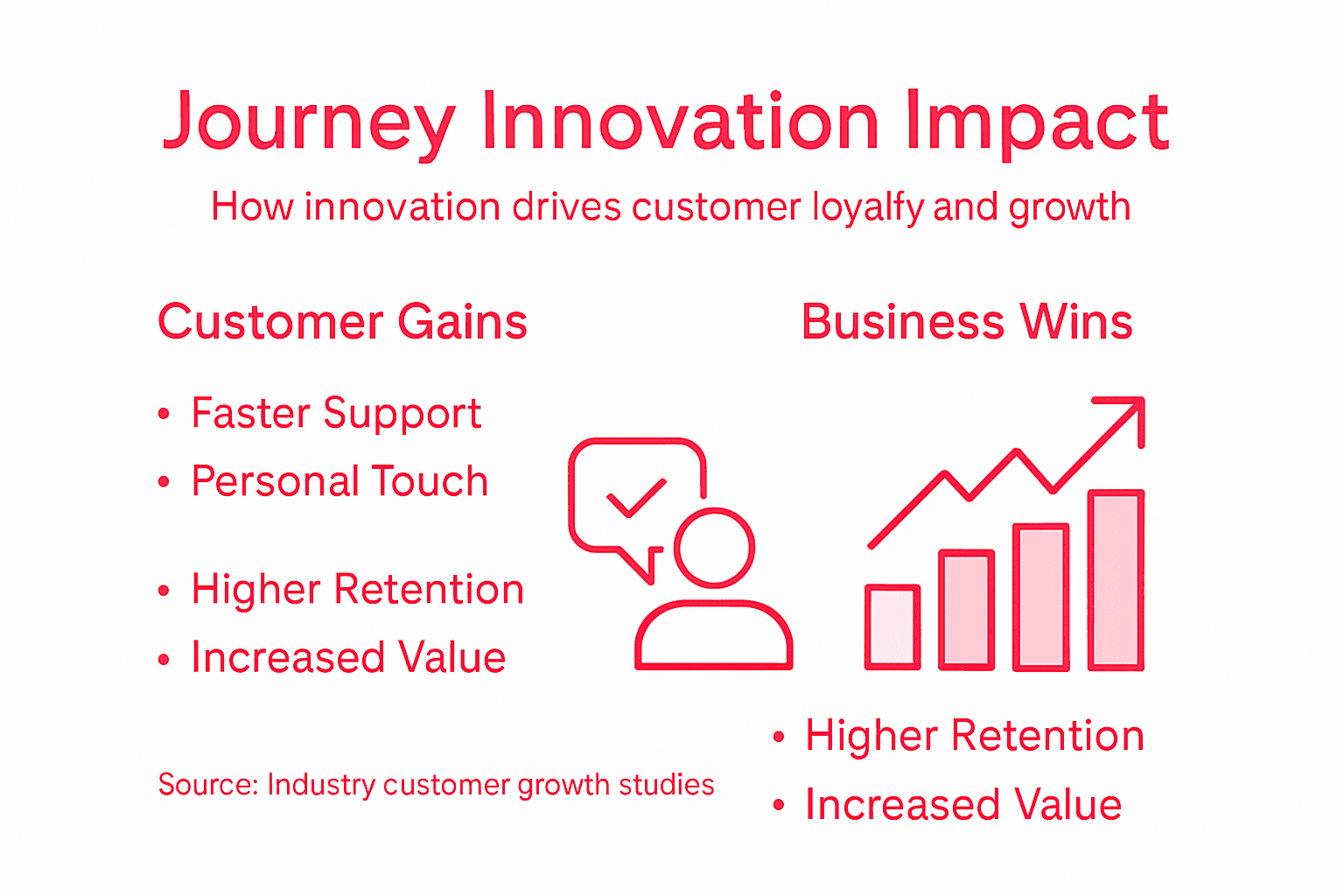
The connection runs deeper than intuition. Effective customer journey design significantly drives brand loyalty, which translates directly into increased customer lifetime value and sustainable revenue growth. This isn’t a soft metric—it’s a hard financial impact.
The Loyalty Multiplier Effect
Loyalty is where journey innovation creates its most powerful growth lever. When customers experience a thoughtfully designed journey that anticipates their needs and removes friction, they don’t just buy again. They become advocates.
This matters most for customers who haven’t yet developed strong brand identification. Journey excellence converts these customers into loyal repeat buyers, expanding your addressable market and reducing acquisition costs.
The math is straightforward:
- Better journeys increase satisfaction scores
- Higher satisfaction strengthens behavioral loyalty
- Loyal customers spend 23-67% more over their lifetime
- Loyal customers refer others, lowering acquisition costs
From Experience Quality to Revenue Impact
Journey innovation enhances experience quality at every touchpoint. This quality improvement influences customer behavior in specific, measurable ways.
When customers encounter reduced friction during consideration, they move faster to purchase. When support interactions resolve issues on the first contact, retention improves. When post-purchase experiences delight customers, advocacy increases.
Each improvement compounds. A 5% increase in retention can boost lifetime value by 25-100% depending on your industry.
Behavioral Loyalty vs Transactional Relationships
There’s a critical distinction here. Journey innovation builds behavioral loyalty—customers choosing you repeatedly because you’ve earned it—rather than transactional relationships held together by discounts or switching costs.
Behavioral loyalty is more resilient. These customers stick with you even when competitors offer lower prices. They forgive occasional mistakes because the overall journey has built trust.
For technology sector leaders, this becomes your competitive moat. In markets where switching is easy and alternatives abundant, journey excellence creates stickiness.
Calculating the Growth Impact
The growth impact scales with your customer base size:
- Small improvements (10% loyalty increase) in large customer bases yield dramatic revenue increases
- Retention gains compound annually—a 5% improvement this year flows through next year
- Advocacy effects create a growth multiplier as satisfied customers bring referrals
- Reduced churn protects revenue while you focus on acquisition
Journey innovation creates a virtuous cycle where improved experiences drive loyalty, loyalty sustains revenue, and growing customer lifetime value funds further innovation.
This is sustainable growth because it’s driven by customer satisfaction rather than aggressive acquisition spending.
Pro tip: Measure customer lifetime value by cohort before and six months after implementing journey improvements—you’ll see the correlation between experience quality and financial outcomes firsthand.
Governance, Data, and AI Integration Essentials
Journey innovation at scale requires more than good intentions. You need governance frameworks, data infrastructure, and AI capabilities working in concert. Without these three elements, innovation stalls or creates risk.
Think of it this way: data tells you what customers do, AI helps you respond intelligently, and governance ensures you do it ethically and legally. Miss any piece, and your competitive advantage becomes a liability.
Why Governance Comes First
Governance isn’t bureaucracy. It’s the guardrails that let your organization move fast safely. Governance frameworks ensure ethical AI use, data privacy, and trust while enabling the innovation velocity your market demands.
Without clear governance, teams make inconsistent decisions about data use and AI deployment. Privacy risks mount. Customer trust erodes. Regulatory exposure grows.
Governance should address:
- Data ownership and accountability across teams
- AI model validation and bias detection processes
- Customer consent and transparency standards
- Privacy compliance integrated into journey design
- Escalation paths for edge cases and exceptions
The best governance frameworks enable speed by removing ambiguity, not by slowing decisions.
Data: Your Foundation for Personalization
Every intelligent journey decision flows from data. AI technologies like chatbots and voice assistants enable personalization through sophisticated data management across customer touchpoints throughout the journey.
But data alone isn’t enough. You need infrastructure that:
- Centralizes customer data from fragmented sources
- Updates in real time so decisions reflect current customer state
- Connects behavioral data with intent signals and historical context
- Maintains data quality and accuracy across systems
Many organizations struggle here. They have data but can’t access it when they need it. Real-time personalization requires data that flows instantly to decision points.
AI Integration: From Reactive to Predictive
AI transforms journey innovation from reactive improvements to predictive optimization. Rather than waiting for customers to encounter friction, AI anticipates needs and prevents problems.
Practical AI applications across the journey include:
- Discovery stage: Recommendation engines that surface relevant solutions
- Consideration stage: Chatbots answering questions instantly
- Decision stage: Dynamic pricing and offer optimization
- Support stage: Intelligent routing to the right specialist
- Advocacy stage: Predictive identification of expansion opportunities
Integration requires thinking about AI not as a separate tool but as embedded decision-making throughout your journey orchestration.
Building Organizational Continuous Learning
The most successful organizations treat journey innovation as continuous learning. Each customer interaction generates signals. Each intervention creates measurable outcomes. This feedback loop enables constant evolution.
This requires moving beyond annual strategy reviews. You need:
- Weekly monitoring of journey performance metrics
- Rapid testing and learning cycles
- Quick decisions when data indicates opportunity
- Willingness to reverse course when approaches underperform
Governance, data, and AI work together—governance creates safe space for innovation, data enables smart decisions, and AI turns insights into action at scale.
Pro tip: Start by auditing your current data accessibility and governance gaps using a small, high-value customer segment—prove the value in a controlled environment before expanding to your full customer base.
Common Pitfalls and How to Avoid Them
Most customer journey innovation efforts fail not because the vision is wrong, but because execution hits predictable obstacles. Understanding these pitfalls before you encounter them dramatically increases your success rate.
The good news: these obstacles are avoidable with the right approach. Organizations that recognize them early course-correct before wasting resources or damaging customer trust.
Fragmented Insight Efforts
Fragmented customer insight efforts and inconsistent definitions plague journey innovation across most organizations. Marketing collects data one way. Product measures engagement differently. Support tracks issues separately. Nobody has a shared customer view.
This fragmentation creates blind spots. You optimize one touchpoint while unknowingly breaking another. Teams make contradictory decisions because they’re working from different customer intelligence.
The fix is systematic. Establish:
- Single definitions of key customer metrics
- Centralized insight platforms accessible to all teams
- Weekly cross-functional insight reviews
- Clear ownership of customer intelligence
This isn’t about perfect data. It’s about everyone seeing the same customer reality.
Ignoring Emotional Responses
Many organizations focus obsessively on behavioral metrics while missing emotional context. Journey innovation fails when teams ignore customer emotional responses to their interactions, optimizing for efficiency while destroying satisfaction.
A customer might complete a purchase quickly, but if the experience felt cold or confusing, they won’t return. Speed without emotional resonance creates one-time transactions.
Balance your metrics:
- Behavioral metrics: completion rates, time-to-purchase, support resolution time
- Emotional metrics: satisfaction, trust, confidence in your guidance
- Attitudinal metrics: likelihood to recommend, intent to repurchase
The strongest journeys win on both dimensions.
Static Designs in Dynamic Markets
Many organizations design a journey, implement it, then treat it as permanent. Customers evolve. Competitors emerge. Technology disrupts. Markets shift. Your journey becomes obsolete.
Avoid this by building adaptation into your process:
- Monthly performance reviews against customer expectations
- Quarterly deep-dives with actual customers about emerging friction
- Rapid testing of alternative approaches
- Willingness to completely redesign underperforming stages
The best journeys aren’t static artifacts. They’re living systems that evolve as customer needs change.
Missing the Integration Problem
Many leaders invest in AI and analytics tools but fail to integrate them meaningfully with journey design. Technology sits separate from customer experience strategy.
Integration requires starting with journey strategy first, then selecting technology that serves it. When you reverse this order, you end up with impressive tools that don’t solve real customer problems.
The most damaging pitfall is treating journey innovation as a project rather than a continuous practice of listening, learning, and evolving based on what customers tell you.
Pro tip: Conduct a “pit stop” audit with your teams—list the three biggest customer friction points in your current journey, then have each team member independently name their perception of the top three issues and see where perception misalignment exists.
Elevate Your Customer Journey Innovation with Expert Guidance
The article highlights the critical challenge organizations face in creating seamless, data-driven, and emotionally engaging customer journeys that drive loyalty and sustainable growth. Many companies struggle with fragmented insights, static designs, and ineffective AI integration that slow down innovation and diminish customer trust. If you’re seeking to overcome these pain points by adopting a truly customer-centric, cross-channel, and data-informed approach, this is where your transformation starts.
Unlock the full potential of your customer experience by partnering with Xverse, a leader in CX strategy, digital transformation, and AI-powered insights. Our tailored services help you build a structured journey blueprint aligned with your business goals while fostering continuous innovation and emotional connection. Take the next step now to enhance loyalty and accelerate growth. Discover how our CX leadership advisory and experience blueprint development solutions can turn your customer journey into a strategic asset. Visit our website to start your journey towards exceptional customer experiences today.
Frequently Asked Questions
What are innovative customer journeys?
Innovative customer journeys are structured sequences of stages and touchpoints in which customers interact with an organization. They are designed to build value and drive loyalty, focusing on the complete experience rather than isolated interactions.
How can I ensure my customer journey is customer-centric?
To ensure your customer journey is customer-centric, gather insights directly from customers, map their actual experiences, and design each stage based on their needs and preferences, rather than what may be easiest for your organization to deliver.
What are the benefits of using data in customer journey innovation?
Using data in customer journey innovation helps organizations adapt their strategies based on real customer behavior and feedback patterns. This data-informed approach enhances personalization, improves customer satisfaction, and ultimately drives retention and loyalty.
What should I consider when implementing technology in customer journey innovation?
When implementing technology in customer journey innovation, focus on enhancing speed, personalization, and consistency across touchpoints. Ensure that any tools or systems you adopt integrate seamlessly with your existing processes to optimize the customer experience.
Recommended
- How to Optimize Customer Interactions for Stronger Loyalty – Xverse
- Xverse – Transforming experiences with the power of CX, Design & Digital transformation
- 6 Customer Experience Trends 2026 for Tech Leaders – Xverse
- Customer Expectation: Shaping CX Innovation in 2026 – Xverse
- Amazon Customer Journey Explained: Boost Listings to Increase Sales – Searchoneers
- Digital Growth Strategy: Shaping Nonprofit Impact | AI and Digital Marketing Service by MCNM
- Workflow Efficiency: Unlocking SaaS Growth Potential | Rule27 Design